Two killed, six injured in Trinamool party office blast
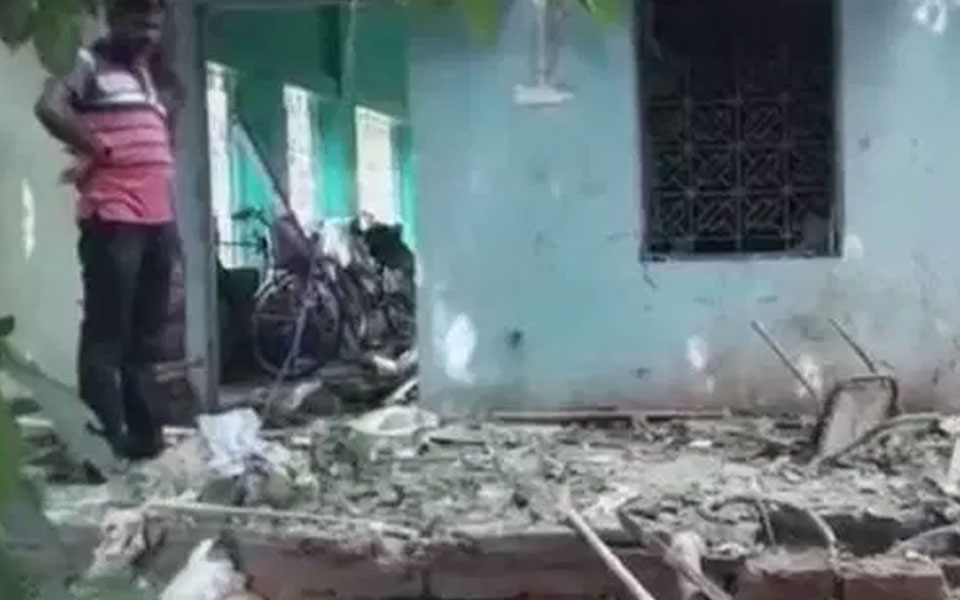
Kolkata, Aug 24 : Two persons were killed and six others were injured in an explosion at a Trinamool Congress party office in West Bengal's West Midnapore district, police said on Friday.
Police said the explosion took place at a house used as the Trinamool's party office in West Midnapore district's Narayangarh area on Thursday morning when over a dozen party workers were present inside.
The high intensity blast caused the walls of the party offce to partially collapse and cracks appeared in the walls of neighbouring houses as well.
"The explosion killed two persons and injured six others. However, the reason of the blast is yet to be ascertained," an officer from Narayangarh police station said, adding that they have found no proof of crude bombs being stored inside the party office yet.
The local Trinamool Congress leadership confirmed that all those killed or wounded in the incident were there party workers and claimed that the party has appealed to administration to find out and take strong action against those involved in the blast.
"Two of our party activists, Sudipto Ghosh and Bimal Chowdhury, were killed in the blast on Thursday. Six others have been injured, out of whom two have been referred to Kolkata as their condition were critical," Ajit Maity, district president of the state ruling party said.
"We have informed the party high command about the incident and trying to find out who might be responsible for the explosion. There is a chance that miscreants from outside are involved. We have appealed to the administration to catch and punish the offenders as soon as possible," he added.
The incident of explosion at the Trinamool office took place less than a week before the party is going to form the boards in 11 out of 16 gram panchayat seats in the area.
The opposition parties claimed faction fight within the ruling party was responsible for the incident.
Let the Truth be known. If you read VB and like VB, please be a VB Supporter and Help us deliver the Truth to one and all.
3 Indians injured after fire breaks out in UAE's Fujairah due to drone attack
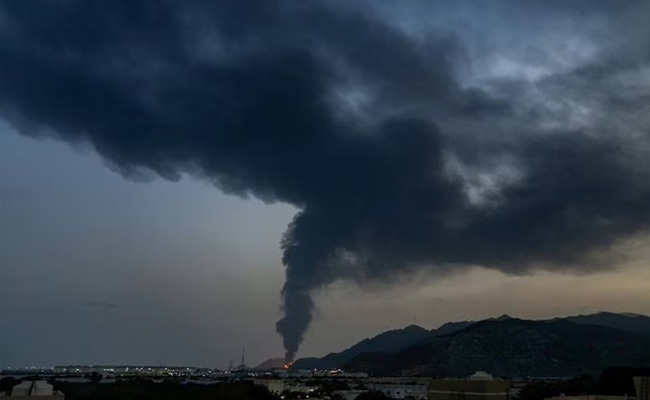
Dubai (PTI): Three Indian nationals were injured on Monday after a fire broke out on the Fujairah Petroleum Industries Zone (FOIZ) in the UAE following a drone strike originating from Iran, according to local media reports.
The relevant authorities in the eastern emirate of Fujairah confirmed that a fire has broken out in the FOIZ, resulting from a drone attack coming from Iran, the state-run WAM news agency reported.
Fujairah Civil Defence teams immediately responded to the incident and are continuing efforts to bring the fire under control, it added.
Three Indian nationals sustained moderate injuries after the fire broke out on the FOIZ, the Khaleej Times reported, quoting authorities in Fujairah.
The injured were taken to the hospital for treatment, it added.
In a post on X, the UAE's Ministry of Defence said that Iran launched four missiles toward various areas across the country. "Three were successfully engaged over the country's territorial waters, while one fell into the sea," it said.
The ministry urged the public to comply with all public safety procedures when warning messages are issued to the public.
Authorities have urged the public not to circulate rumours and to rely only on official sources for information, Gulf News reported.