Uddhav, Raj meet for second time in two weeks amid Sena (UBT)-MNS alliance buzz for polls
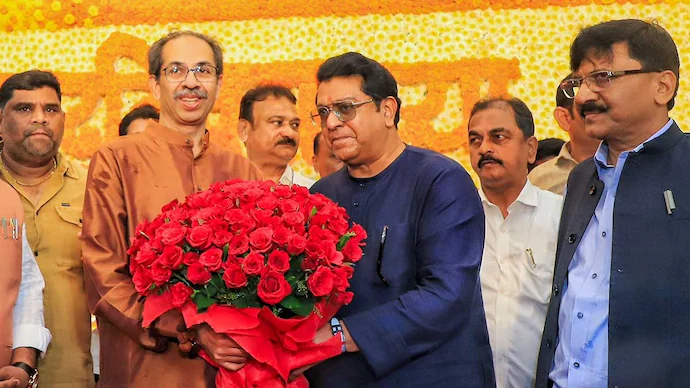
Mumbai (PTI): Shiv Sena (UBT) chief Uddhav Thackeray on Wednesday visited the home of his cousin and Maharashtra Navnirman Sena (MNS) president Raj Thackeray in Mumbai amid the buzz of an alliance between the two parties ahead of local body polls after years of estrangement.
The latest meeting between the two party chiefs and their leaders was held at 'Shivtirth', the residence of Raj Thackeray in the city's Dadar area.
Incidentally, Maharashtra Congress leaders met Uddhav Thackeray on Monday, during which the issue of a possible alliance between the Shiv Sena (UBT) and the MNS cropped up. Leaders of the Congress, an ally of the Shiv Sena (UBT), had then said they would discuss the issue with their high command.
This was the second known interaction between the once-estranged cousins in the past fortnight. Uddhav had visited 'Shivtirth' late last month on the occasion of the Ganesh festival.
Shiv Sena (UBT) MP Sanjay Raut later told reporters Uddhav Thackeray visited 'Shivtirth' to meet Raj's mother Kunda, who is his 'mavshi' (mother's sister), but did not dwell on the political angle of the meeting.
Both Raj and Uddhav Thackeray are maternal as well as paternal cousins.
However, an MNS leader insisted this was the first time the two leaders met to discuss the possibility of a formal alliance between their parties and broad contours of it.
The Thackerays had shared a stage on July 5 in Mumbai to celebrate their "victory" after the Maharashtra government rolled back its contentious orders on the three-language formula for students of Classes 1 to 5 amid charges of imposition of Hindi in the state dominated by Marathi speakers.
At the end of Jul, Raj visited Matoshree, the residence of Uddhav Thackeray in suburban Bandra, to wish the latter on his birthday.
Although Raj Thackeray quit the undivided Shiv Sena in 2005, blaming Uddhav for his exit, the drubbing of their parties in the 2024 Maharashtra assembly polls appears to have pushed the rivals to improve ties and create their own political space in the state.
Both parties have dropped enough hints of forging an alliance for the upcoming local body polls, including elections to the cash-rich Brihanmumbai Municipal Corporation (BMC), but have not yet announced a formal tie-up.
If a tie-up does take concrete shape, the BJP, a fierce critic of the Shiv Sena (UBT), will be its main rival. Raj Thackeray has had been a critic as well as a supporter of the BJP in the past.
Asked about the latest meeting between the Thackerays, Chief Minister Devendra Fadnavis said he didn't have any mechanism to understand what was on the minds of the cousins.
"I didn't meet anyone, and I don't know what they said. I don't have any technique to understand what they have on their mind. I don't know anything about their meeting," Fadnavis told reporters in Nashik.
Mumbai BJP chief and MLA Ameet Satam sought to downplay its significance, saying citizens are more concerned about development than family meetings between political leaders.
"It is not about who is meeting whom and their family-related bonding, but it is more about who constructed Atal Setu, the Coastal Road, the redevelopment of BDD chawls in Worli and neighbouring areas, and who set up a vast network of CCTV cameras across Mumbai. These are the key issues, and Mumbaikars will vote on that basis," Satam told reporters.
He asserted Mumbai voters have supported Prime Minister Narendra Modi and Maharashtra Chief Minister Devendra Fadnavis in past elections, and they will continue to do so in future polls also.
Harping on the BJP-led coalition's development agenda, the MLA noted the Union and state governments have expedited the construction of the Navi Mumbai International Airport.
Citizens want this pace of development, which was never offered during the 25 years of rule by others. Just meetings between cousins have no political value; people are more interested in who will solve their problems, the BJP leader affirmed.
BJP MLC Pravin Darekar also sought to downplay the meeting.
"As a junior political worker, I would be delighted to see the two cousins come together as Maharashtra has a history of civil discourse and aligning with like-minded groups. But it is not the time to speak of their alliance," Darekar said.
He wondered what Uddhav Thackeray's position would be in the Opposition bloc Maha Vikas Aghadi (MVA) if he chose to align with Raj.
There is no point in rushing to claim their alliance will bring the Shiv Sena (UBT) and the MNS to power in the BMC, Darekar said.
Shiv Sena minister Uday Samant said, regardless of new alliances, the Mahayuti will sweep the upcoming elections to local bodies in the state.
Samant said Sena is of the view that Raj Thackeray should join the Mahayuti alliance.
"However, it is up to Raj Thackeray to decide his political future. As a Mahayuti leader, I am confident that we will come to power in all local and urban bodies and BMC irrespective of any alliances," he told reporters in Pune.
Amid the buzz over their pan-Maharashtra alliance, the Sena (UBT) and MNS faced a setback last month in the election to the BEST Employees Cooperative Credit Society Ltd, where the panel backed by the two parties lost all 21 seats up for grabs.
Let the Truth be known. If you read VB and like VB, please be a VB Supporter and Help us deliver the Truth to one and all.
Uttarakhand Assembly passes censure motion against opposition over women's reservation bill
Dehradun (PTI): The Uttarakhand Assembly passed a censure motion against the Congress and other opposition parties on Tuesday for allegedly blocking the passage of the Constitution (131st Amendment) Bill, 2026, in Parliament.
The motion, which expressed the House's formal disapproval of the opposition's conduct, triggered a massive uproar by Congress members, leading to the adjournment of the House sine die.
Parliamentary Affairs Minister Subodh Uniyal moved the censure motion, citing the "uncooperative attitude" of opposition parties toward the bill seeking 33 per cent reservation for women in legislative bodies.
Addressing a special daylong session convened specifically to discuss "Nari Samman -- Rights in Democracy", Chief Minister Pushkar Singh Dhami said the bill's passage would have benefitted every political party.
Dhami noted that after delimitation, the number of Assembly seats in the hill state would have gone up to 105, with 35 reserved for women. He added that the number of Lok Sabha seats from Uttarakhand would have risen from five to seven or eight.
"The opposition fears that if women from ordinary households enter politics, the shops of dynastic politics run by certain parties will shut down," the chief minister claimed.
He compared the opposition's conduct in Parliament to the assembly in Mahabharat where Draupadi was insulted. Dhami further likened the opposition's behaviour to the "arrogance of Ravan".
The chief minister highlighted his government's initiatives, asserting that Uttarakhand was the first state to implement a Uniform Civil Code (UCC) to protect women's rights. He said the UCC freed Muslim women from practices like "halala", "iddat", polygamy and child marriage.
Leader of Opposition Yashpal Arya questioned the technical feasibility of the bill, calling the ruling Bharatiya Janata Party's (BJP) claims of providing reservation by 2029 "misleading".
He argued that the bill is linked to census and delimitation processes. The Congress leader said the 2026 census would conclude by 2027 and the final data publication would take two more years.
"The delimitation process will take another six years. The actual implementation of this bill is not possible before 2034," Arya said, describing the move as a strategy to protect the BJP's "political ground".
The session also saw high drama outside the Assembly gates, where Congress MLA Virendra Jati staged a protest, demanding the payment of "outstanding" dues to farmers by sugar mills.
Jati arrived at the Assembly's main gate with a tractor-trolley loaded with sugarcane and dumped it on the road. The move brought the traffic to a halt, prompting traffic and security personnel to intervene and clear the area.
Women Congress workers also staged a demonstration against the "anti-people policies" of the state government.