Uddhav Thackeray-Sharad Pawar Phone Call? Twist In Sena-BJP Power Tussle
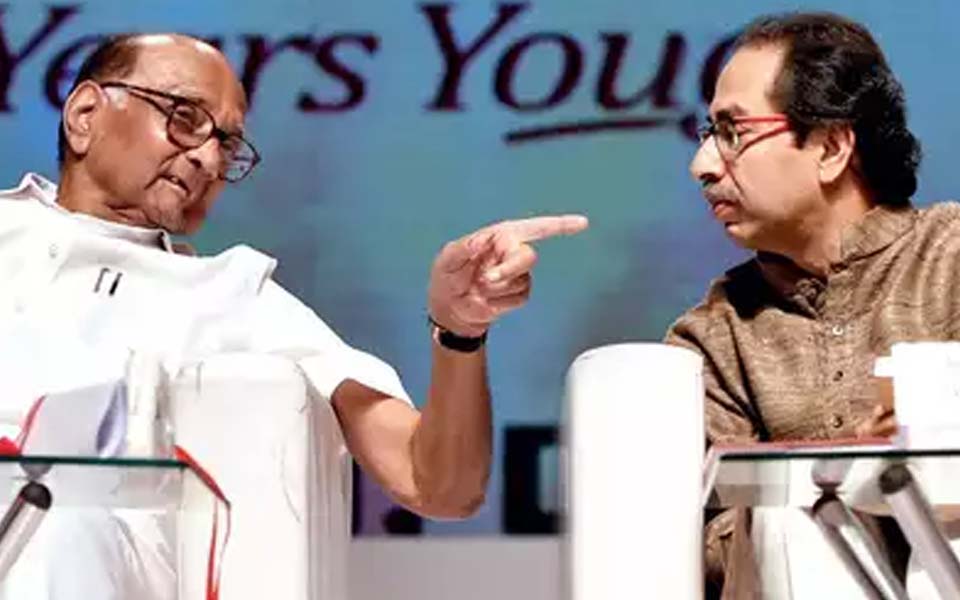
Mumbai: The BJP-Shiv Sena standoff over power-sharing in Maharashtra, which has stalled government formation for over a week, took a dramatic turn on Friday with reports emerging of Sena chief Uddhav Thackeray talking to Sharad Pawar, the opposition stalwart who can facilitate a reconfiguration of alliances.
Reports suggest Uddhav Thackeray and the Nationalist Congress Party (NCP) leader have spoken on the phone. Sharad Pawar, say sources, will fly to Delhi to meet with Congress president Sonia Gandhi.
These reports have contributed significantly to speculation that the Shiv Sena has sent feelers to the NCP-Congress combine, upset with its ally BJP for not accepting its demand for rotational chief ministership and a "50:50" deal for power sharing.
Buzz about the Sena flirting with its rival became louder when its leader Sanjay Raut met with Mr Pawar last afternoon.
"If the Shiv Sena decides, it will get the required numbers to form stable government in the state. People have given the mandate to form government on basis of the 50-50 formula that was reached in front of people of Maharashtra. They want a chief minister from the Shiv Sena," Sanjay Raut told reporters this morning.
"There is no ultimatum to the BJP. They are big people," the Rajya Sabha MP added. He also delivered a message through a tweet without naming the BJP: "Sahib, don't feed your arrogance...many Alexanders have drowned in the ocean of time...."
The BJP won 105 of the state's 288 seats and the Sena finished with 56 in the state election last week. Together, they are comfortably past the 145-majority mark. Mr Pawar's NCP placed third in the Maharashtra election with 54 seats, just two behind the Shiv Sena. The Congress won 44.
The BJP and Sena's ties, mended just before the state election after a long period of bitterness, soured again when Uddhav Thackeray brought up the "50:50 arrangement" he said was discussed before the national election earlier this year.
"It is time to remind the BJP about the formula arrived at when BJP chief Amit Shah visited my home. We had decided on a 50:50 formula," Uddhav Thackeray told the media on October 24, the day of the Maharashtra poll results.
With the BJP ending up with fewer seats than in the 2014 state election, the Sena believes it deserves an equal timeshare in power, which means two-and-a-half years for a chief minister from each party.
The BJP's Chief Minister Devendra Fadnavis, who is eyeing another full term, has denied such a deal. On Thursday, Uddhav Thackeray reportedly told his party MLAs he was disappointed with Mr Fadnavis's stand.
Earlier this week, the Sena and the BJP held separate meetings with Governor Bhagat Singh Koshyari, calling them courtesy visits for Diwali greetings.
Yesterday, Uddhav Thackeray's son Aaditya Thackeray led another delegation of MLAs in a meeting with the Governor. This time, it was on farmers' issues, he said.
The NCP has declared that the people's mandate is for the party to sit in the opposition, along with ally Congress and other parties.
That clarification came after reports that the NCP had conveyed to the Sena its willingness to support it in a new political configuration to keep the BJP out of power.
Mr Pawar has backed the Sena's demand. "In the 1990s also, there was a 50-50 formula for the Shiv Sena and the BJP. So they have past experience (in running the government). So the Sena can insist, nothing wrong in that," Mr Pawar had said in an interview with NDTV.
Today, Mr Pawar's daughter Supriya Sule, an NCP MP, said on Mr Fadnavis: "I have known him for many years. The way he is insisting that only he will be chief minister...This new arrogance is surprising..."
Courtesy: www.ndtv.com
Let the Truth be known. If you read VB and like VB, please be a VB Supporter and Help us deliver the Truth to one and all.
Indian startup's 'Drishti' satellite launched aboard SpaceX rocket
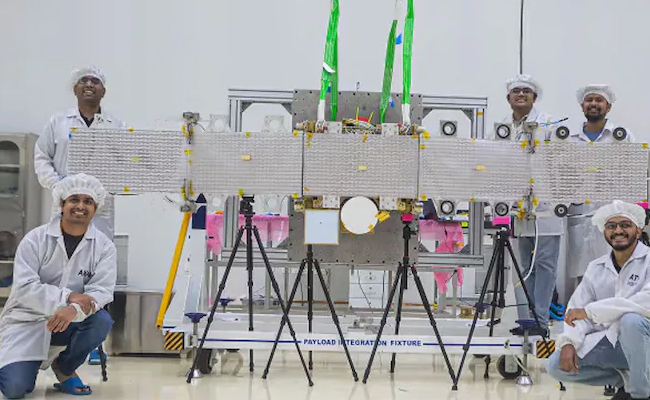
New Delhi (PTI): Bengaluru-based space start-up GalaxEye's Mission Drishti satellite was launched on Sunday aboard SpaceX's Falcon 9 rocket from California.
Mission Drishti is the world's first OptoSAR satellite, integrating electro-optical (EO) and synthetic aperture radar (SAR) sensors into a single operational platform, according to the company.
While EO sensors capture high-resolution images during sunlight and clear skies, SAR sensors provide all-weather and all-time images, using radar pulses.
In a statement, Suyash Singh, founder and CEO of GalaxEye, said, "With the satellite (Mission Drishti) now successfully in orbit, our immediate focus is on completing its commissioning. As we move through this phase, we are already witnessing strong global interest in the differentiated datasets enabled by our OptoSAR payload."
The satellite will help address long-standing limitations of conventional systems and enable more reliable and consistent data acquisition across diverse environmental conditions, the company said.
As a dual-use Earth observation satellite, the mission will support use cases across defence, agriculture, disaster management, maritime monitoring, and infrastructure planning.
The satellite is also expected to complement India's broader initiatives, including the 29 active Earth Observation satellites outlined in ISRO's recent annual report.
The launch came after five years of indigenous research and development, and extensive environmental testing and performance validation of the Mission Drishti.
In a statement, Lt Gen AK Bhatt (Retd), director general of Indian Space Association (ISpA), said, "GalaxEye has achieved what only a few global players have, which is seamlessly combining optical and SAR capabilities on a single platform to enable persistent, all-weather intelligence."
What stands out is not just the technology, but its broader impact on how downstream applications will increasingly define value in the space economy, particularly in Earth observation, where timely, decision-grade insights are critical," he added.
ISpA is the premier industry association of space and satellite companies in the country.
Union Minister Jitendra Singh also took note of the Mission Drishti launch, saying the development marked a significant milestone in India's space journey.
In a post on X, the minister said, "The successful launch of the world's first OptoSAR satellite, and the largest privately-built satellite in the country, reflects the immense potential of our young innovators driving nation-building."
GalaxEye aims to scale up Mission Drishti to a constellation of 10 satellites by 2030, developing a robust and sovereign Earth observation infrastructure for India.