Uddhav Thackeray wants ban on BJP MLA for objectionable remarks on women
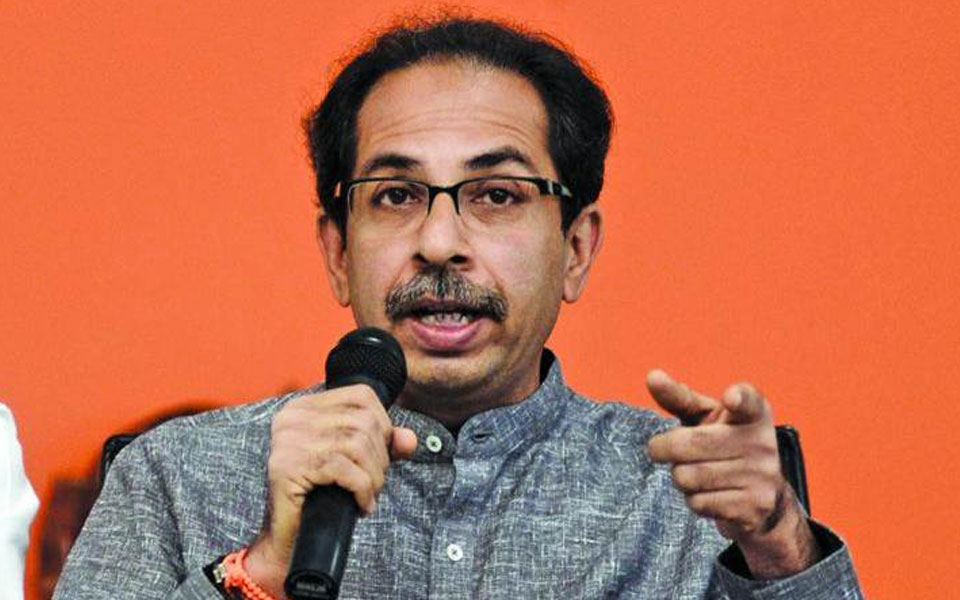
Mumbai, Sep 5 : Shiv Sena President Uddhav Thackeray on Wednesday demanded stringent action against Mumbai Bharatiya Janata Party (BJP) MLA Ram Kadam for his reported objectionable remarks on women.
"Not only should strict action be taken against him, he should not be given a ticket by any party to contest future elections. He is a person of a low character and mentality," Thackeray told the media here.
The Sena chief summoned a hurried press conference after the BJP legislator's remarks on Monday sparked off an uproar in Maharashtra, drawing all-round condemnation from social and political circles.
"I am not aware whether the BJP has launched a 'Beti Bhagao' programme. But if anybody speaks like this about our sisters and daughters, we will not tolerate it," Thackeray warned, coming down heavily on Kadam.
Kicking off a huge controversy, Kadam, a BJP legislator from Ghatkopar in north-east Mumbai, declared publicly that he would abduct girls and bring them to their spurned suitors, and even provided his phone number.
"You need anything, just come to me. If you have proposed to a girl and she has rejected you, I will help you 100 percent. Come to me with your parents and say that they approve of her. Then, I will catch her and bring her to you," Kadam told the gathering.
A video of the incident which went viral on Tuesday evening. But Kadam claimed he had been quoted out of context and the full video clip was not shown, and later, even blamed the media for blowing it out of proportion.
"I had no intentions to hurt anybody's sentiments. But if I have done so, I regret it. Certain opponents are behind this misunderstanding," Kadam said in a late night tweet.
As the issue snowballed, a group of women activists on Wednesday 'gheraoed' Education Minister Vinod Tawde while the Congress and Nationalist Congress Party organised noisy protests in the city, demanding action against the legislator.
In another development, a young Pune girl, Minakshi G. Patil, threw an open challenge to Kadam, daring him to "touch" her if he had the guts.
"I am throwing the gauntlet, accept it. Let's settle this in person. I will come to Mumbai... Lay a finger on me and leave the rest to me. This is shameful and cheap, such statements have no place in Chhatrapati Shivaji's Maharashtra where women are treated like Goddesses," she said.
State Congress President Ashok Chavan asked: "Has the BJP made him a legislator to kidnap women?"
NCP spokesperson Nawab Malik said "the BJP's 'Ravana' face has emerged. He is talking about kidnapping women. So henceforth he should be called 'Ravana Kadam'."
Senior Shiv Sena leader and spokesperson Neelam Gorhe said though he (Kadam) was named after Ram, he harboured evil thoughts like Ravana.
Samajwadi President Abu Asim Azmi said the BJP MLA's speech was a clear indicator that the 'Beti Bachao, Beti Padhao' campaign was a sham.
The NCP Women's Wing demanded an unconditional apology from Kadam besides action against him by the BJP.
Let the Truth be known. If you read VB and like VB, please be a VB Supporter and Help us deliver the Truth to one and all.
Power bank catches fire inside stationary IndiGo plane at Chandigarh airport; all evacuated
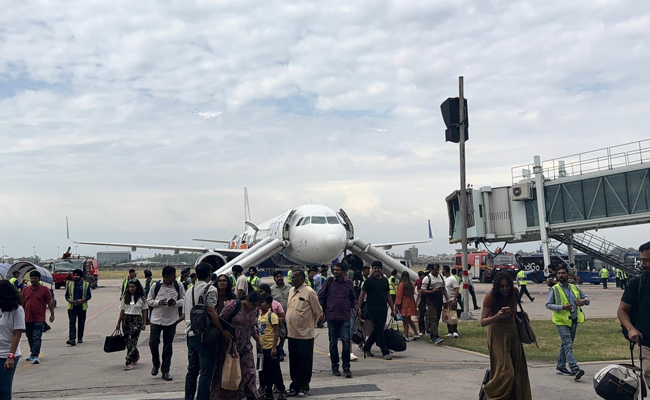
New Delhi (PTI): The power bank of a passenger onboard a stationary IndiGo aircraft caught fire at the Chandigarh airport on Tuesday, and all passengers and the crew were evacuated, according to a source.
In a statement, the airline said that when IndiGo flight 6E 108 from Hyderabad to Chandigarh was stationary after landing, an incident involving a customer's personal electronic equipment catching fire was reported.
"In the interest of safety, an immediate evacuation was carried out, and all the relevant authorities were immediately informed. All customers have been safely moved to the terminal and are being attended to by the team to ensure their well-being," the statement said.
The source said that soon after the aircraft landed, there was smoke coming from one of the overhead bins and all onboard were evacuated.
The smoke was due to the power bank catching fire, the source said, adding that no one sustained major injuries.
Details about the number of passengers could not be ascertained.