U'khand forest fires: IAF helicopter assists in firefighting for 2nd day, blaze doused in many areas
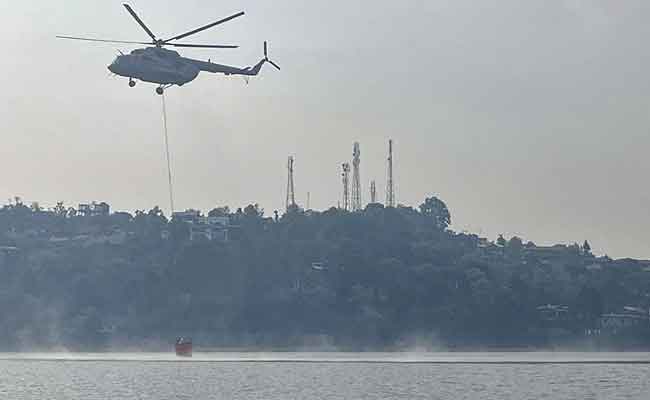
Dehradun (PTI): The firefighting operation in Uttarakhand's forests with the help of an Indian Air Force (IAF) helicopter continued for the second day on Sunday with the blaze brought to control in several areas, officials said.
Efforts have also intensified to extinguish the raging forest fires in the state, especially in the worst-affected areas of Nainital, Haldwani and Ramnagar forest divisions, forest officials here said on Sunday.
The forest fires are gradually being controlled with the flames already doused in many areas. The fires in Marora and Khanana civil areas in Maniknath range of the Narendranagar forest division have been completely extinguished, they said.
The forest blaze in Nainital and adjoining areas is gradually being brought under control after the deployment of an IAF helicopter for the firefighting operations on Saturday morning, Chief Minister Pushkar Singh Dhami said after reviewing the situation in the Kumaon region on Saturday night.
According to the Indian Air Force, a Mi-17 V5 helicopter has been deployed in Nainital and surrounding areas to douse the flames.
Apart from the IAF helicopter and Army personnel, Prantiya Rakshak Dal volunteers and homeguard personnel have also been roped in to help in the firefighting operations, Kumaon Commissioner Deepak Rawat said.
Additional government vehicles, two each for the three forest divisions, have been provided to rush firefighting teams to the affected areas, he added.
ALSO READ: IAF helicopter roped in to douse forest fires in Uttarakhand
Help from locals with the involvement of forest panchayat officials is also being taken as they are the first responders to forest fires, Rawat said.
Forest department personnel are going from village to village in the hills to raise awareness about forest fires, Garhwal DFO Anirudh Swapnil told reporters in Pauri.
Loudspeakers are being used to spread the messages. People are being asked to report any forest blaze immediately to the authorities and not to burn garbage in the open or carelessly throw burning cigarette butts or bidis in the forest areas, Swapni said.
People are also being asked to report to the authorities if they catch someone setting a fire in the forests, he said, adding that any person reporting such a violation will be rewarded by the forest department.
Legal action under the Forest Act 1927 will be taken against anyone caught setting fire to the jungles, he added.
Burning forests in order to obtain fresh grass for their cattle is a widely prevalent practice in the hills of Uttarakhand.
The chief minister has cancelled the leaves of forest department officials until the fire situation is completely brought under control.
Leave applications of forest department personnel will be considered only in case of medical emergencies, Dhami said.
Forest officials said the IAF helicopter collected water from the Naini and Bhimtal lakes in a Bambi bucket and poured it over the burning forests of the Pines, Bhumiadhar, Jyolikot, Narayan Nagar, Bhawali, Ramgarh and Mukteshwar areas.
The bucket can hold up to 5,000 litres of water at a time.
As many as 31 fresh incidents of forest fire were reported from various parts of the state on Friday, destroying 33.34 hectares of forest land, according to officials.
The fire that broke out in the forest near Nainital took a horrific form on Friday, posing a threat to the residents of High Court Colony. It also affected traffic movement in the area.
Let the Truth be known. If you read VB and like VB, please be a VB Supporter and Help us deliver the Truth to one and all.
BJP will form govt in Bengal with thumping majority: Nabin
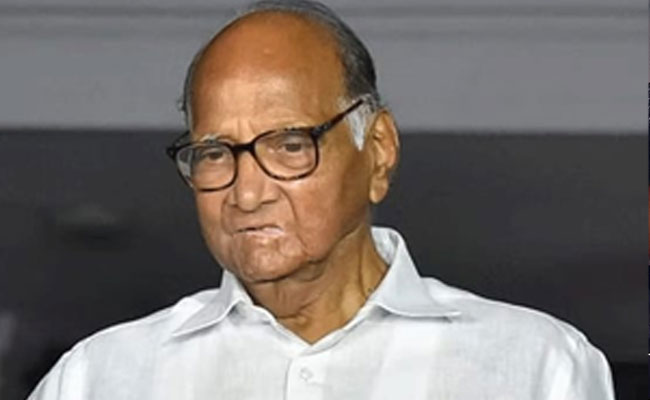
Mirzapur (UP) (PTI): BJP president Nitin Nabin on Wednesday voiced confidence that his party will form the government in West Bengal with a "thumping majority".
Polling is underway for 142 constituencies in the second and final phase of the West Bengal assembly elections, covering key districts, including Kolkata, Howrah and North and South 24 Parganas.
The high-stakes contest is being seen as decisive for the ruling TMC's bid for a fourth consecutive term and the BJP's push to form its first government in the state. The first phase held on April 23 recorded a high voter turnout of over 93 per cent, reflecting intense electoral engagement.
Speaking to reporters in Mirzapur, Nabin said, "The BJP will form the government in Bengal. We are winning the elections with a massive majority."
Earlier in the day, the BJP chief visited the Vindhyavasini temple and offered prayers. The rituals were conducted by his priest Acharya Agastya Kumar Dwivedi.
On his first visit to the district after assuming office, Nabin was welcomed by party workers at several places. At the temple, he was received by city MLA Ratnakar Mishra and District Magistrate Pawan Kumar Gangwar, who felicitated him with a traditional 'angvastram'.
After offering prayers for about 10 minutes amid Vedic chants, Nabin held a meeting at a hotel with local MLAs, including Mishra, Majhwan MLA Suchismita Maurya and Madihan MLA Ramashankar Patel.
Patel said Nabin emphasised strengthening the organisation and asked public representatives to focus on serving people in their respective constituencies.
Several party leaders, including district president Lal Bahadur Saroj, district vice-president Gaurav Umar, municipal chairperson Shyam Sundar Kesari, women workers and senior officials, were present on the occasion.
Elaborate security arrangements were put in place by the district administration for the visit, with multiple officers of circle officer rank deployed, officials said.