Umar Khalid granted interim bail to attend sister’s wedding in Delhi riots conspiracy case
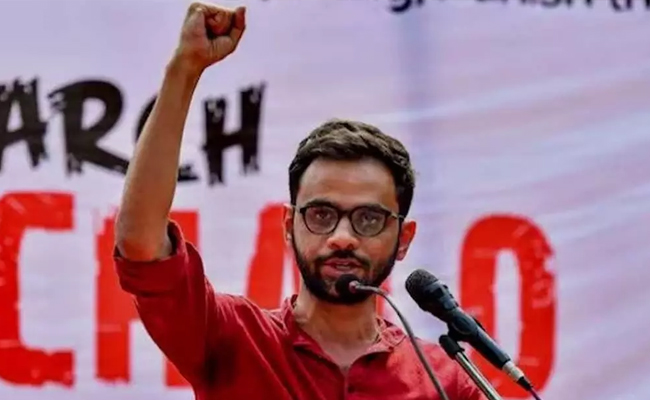
New Delhi: A Delhi court on Thursday, December 11, granted interim bail to former JNU scholar and activist Umar Khalid in the 2020 North-East Delhi riots larger conspiracy case registered under the Unlawful Activities (Prevention) Act (UAPA). Khalid sought temporary relief to attend his sister’s wedding.
Additional Sessions Judge Sameer Bajpai of the Karkardooma Courts allowed Khalid interim bail from December 16 to December 29. The court directed him to furnish a personal bond of ₹20,000 along with two sureties of the same amount.
While granting relief, the court imposed several conditions. Khalid has been barred from contacting any witnesses or individuals connected to the case. He must provide his mobile number to the investigating officer and keep it operational throughout the bail period. The court further directed him not to use social media and to remain either at his home or at the specified wedding-related venues. He is permitted to meet only family members, relatives and friends during the interim bail.
Khalid has been ordered to surrender before the Superintendent of the concerned prison on the evening of December 29.
This is not the first time interim bail has been granted to him for family functions. In December 2023, he received a seven-day interim bail for a family wedding, and earlier in 2022 he was granted a week-long bail to attend another sister’s marriage ceremony.
Khalid’s regular bail pleas have seen multiple rejections. The Delhi High Court denied him bail in October 2022, following which he approached the Supreme Court but later withdrew his special leave petition. A second regular bail plea before the trial court was also rejected, prompting another challenge before the High Court. On September 2, 2024, a division bench observed that Khalid’s prima facie role in the alleged conspiracy appeared “grave,” citing purported inflammatory speeches intended to mobilize members of the Muslim community.
On Wednesday, the Supreme Court reserved its judgment on bail pleas filed by Khalid, along with co-accused Sharjeel Imam, Gulfisha Fatima and others.
FIR 59 of 2020, registered by the Delhi Police Special Cell, names several accused including Tahir Hussain, Khalid Saifi, Ishrat Jahan, Meeran Haider, Shifa-Ur-Rehman, Asif Iqbal Tanha, Safoora Zargar, Natasha Narwal and others, under the Indian Penal Code and UAPA provisions in connection with the alleged conspiracy preceding the 2020 riots.
Let the Truth be known. If you read VB and like VB, please be a VB Supporter and Help us deliver the Truth to one and all.
Four passengers arrested at BLR airport with hydroponic ganja worth over Rs 21.5 crore

Bengaluru (PTI): Four passengers who arrived from Bangkok at Kempegowda International Airport here were arrested with hydroponic ganja valued at over Rs 21.5 crore in two separate cases, officials said on Saturday.
They were intercepted at Terminal 2 of the airport on May 1, they added.
In the first case, Bengaluru Customs said in a post on ‘X’ that three passengers arriving from Bangkok were intercepted, and 52.68 kg of hydroponic ganja, valued at Rs 18.43 crore, was seized from their baggage.
In a separate case on the same day, another passenger arriving from Bangkok was intercepted, and 9 kg of hydroponic ganja, valued at Rs 3.15 crore, was seized from his baggage.
In both cases, the accused, whose identities have not been disclosed, were arrested under the Narcotic Drugs and Psychotropic Substances (NDPS) Act, officials added.