Umar Khalid moves Supreme Court against HC order denying him bail
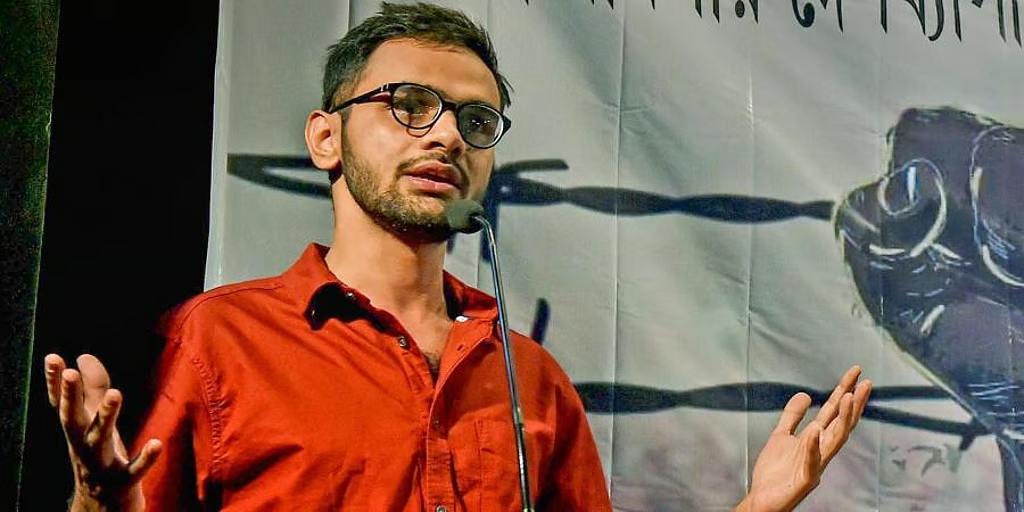
New Delhi (PTI): Activist Umar Khalid has moved the Supreme Court against the Delhi High Court's order rejecting his bail plea in an Unlawful Activities (Prevention) Act case related to the alleged conspiracy behind the February 2020 riots in the national capital.
The high court on September 2 denied bail to nine persons, including Khalid and Sharjeel Imam, in the case, saying "conspiratorial" violence under the garb of demonstrations or protests by citizens couldn't be allowed.
Those who faced rejection include Khalid, Imam, Mohd Saleem Khan, Shifa Ur Rehman, Athar Khan, Meeran Haider, Abdul Khalid Saifi, Gulfisha Fatima and Shadab Ahmed.
The bail plea of another accused Tasleem Ahmed was rejected by a different high court bench on September 2.
Last week, Imam and Gulfisha Fatima moved the apex court challenging the high court's order.
In its order denying bail to the nine accused persons, the high court said the Constitution affords citizens the right to protest and carry out demonstrations or agitations, provided they are orderly, peaceful and without arms and such actions must be within the bounds of law.
While the high court said the right to participate in peaceful protests and to make speeches in public meetings was said to have been protected under Article 19(1)(a), and couldn't be blatantly curtailed, it observed the right was "not absolute" and "subject to reasonable restrictions".
"If the exercise of an unfettered right to protest were permitted, it would damage the constitutional framework and impinge upon the law-and-order situation in the country," the bail rejection order said.
Khalid, Imam and the rest of the accused persons were booked under the Unlawful Activities (Prevention) Act (UAPA) and provisions of the IPC for allegedly being the "masterminds" of the February 2020 riots, which left 53 people dead and over 700 injured.
The violence erupted during the protests against the CAA and NRC.
These accused, who have denied all the allegations levelled against them, have been in jail since 2020 and they sought bail in the high court after a trial court rejected their bail pleas.
Let the Truth be known. If you read VB and like VB, please be a VB Supporter and Help us deliver the Truth to one and all.
Gujarat voted for development & good governance, says Pradhan as BJP sweeps local body polls
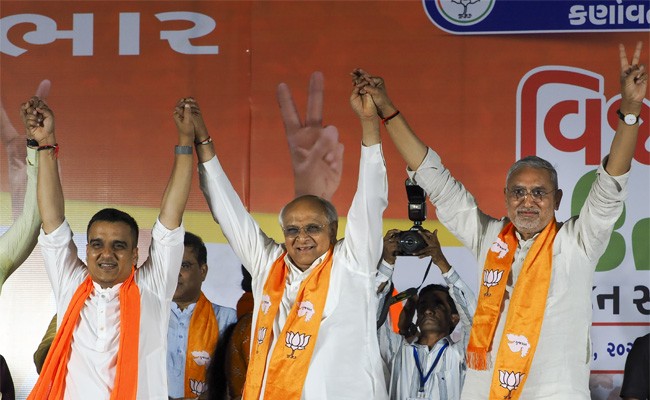
New Delhi (PTI): Union minister Dharmendra Pradhan on Tuesday said the people of Gujarat have reaffirmed their faith in the politics of development, stability and good governance as the BJP swept the local body elections by winning all 15 municipal corporations and 33 out of 34 district panchayats in the state.
Thanking the voters, Pradhan said the result is a testament to the people's unwavering trust in the BJP, the relentless hard work of the party workers and the strength of the organisation under the guidance of Prime Minister Narendra Modi and the leadership of Chief Minister Bhupendra Patel.
“The people of Gujarat have once again made it clear that their trust remains firmly aligned with the politics of development, stability and good governance. I express my heartfelt gratitude to the people of Gujarat for the support received by the BJP in the local body elections,” Pradhan posted on X.
“Under the guidance of the Hon'ble Prime Minister Narendra Modi and the leadership of Gujarat's Chief Minister Bhupendra Patel, this result is a remarkable testament to the people's unwavering trust, the relentless hard work of the Gujarat BJP workers, and the strength of the organisation,” he added.
Earlier, Prime Minister Narendra Modi thanked the people of Gujarat for what he termed a "sweeping mandate" in the local body polls, saying the bond between the state and the BJP has grown even stronger.
Modi said people have voted for the politics of good governance, and assured that the party would work harder to take Gujarat to new heights of progress.
Though final results for 250 taluka panchayats and 84 municipalities were awaited, data from the State Election Commission (SEC) showed that the ruling BJP won most of these local bodies while some were bagged by the Congress, AAP and Independents.
Polling was held on Sunday for 15 municipal corporations, 84 municipalities, 34 district panchayats and 260 taluka panchayats.
The BJP emerged a clear winner in the municipal corporations of Ahmedabad, Vadodara, Surat, Bhavnagar, Jamnagar and Rajkot, besides the newly created municipal corporations of Navsari, Gandhidham, Morbi, Vapi, Anand, Nadiad, Mehsana, Porbandar and Surendranagar.