UN again delays vote on watered-down Gaza aid resolution: The US backs it, others want stronger text
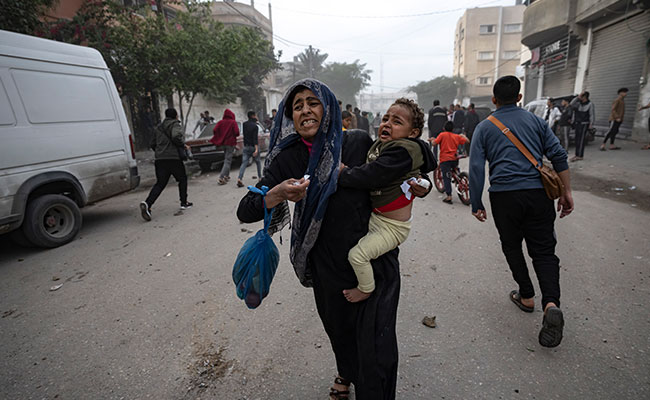
United Nations (AP): The UN Security Council on Thursday again delayed a vote on a watered-down resolution to deliver desperately needed aid to Gaza a revision backed by the United States, while other countries support a stronger text that would include the now eliminated call for the urgent suspension of hostilities between Israel and Hamas.
The revised draft resolution was discussed behind closed doors for over an hour by council members not long after it was circulated. Because there were significant changes, many said they needed to consult their capitals before a vote, which is now expected Friday.
US Ambassador Linda Thomas-Greenfield told reporters after the consultations that the United States backs the new text, and if it is put to a vote the U.S. will support it.
The circulation of the new draft culminated a week and a half of high-level negotiations that at times involved US Secretary of State Antony Blinken and his Arab and Western counterparts. In a sign of intense US efforts, President Joe Biden said Wednesday that diplomats at the U.N. were engaged in negotiations on "a resolution that we may be able to agree to." The vote, initially scheduled for Monday, has been delayed every day since then.
Thomas-Greenfield denied that the resolution is watered down, saying, "The draft resolution is a very strong resolution that is fully supported by the Arab group that provides them what they feel is needed to get humanitarian assistance on the ground."
But the key provision with teeth was eliminated a call for "the urgent suspension of hostilities to allow safe and unhindered humanitarian access, and for urgent steps towards a sustainable cessation of hostilities."
Instead, it calls "for urgent steps to immediately allow safe and unhindered humanitarian access, and also for creating the conditions for a sustainable cessation of hostilities." The steps are not defined, but diplomats said if adopted this would mark the council's first reference to a cessation of hostilities.
On a key sticking point concerning aid deliveries, the new draft eliminates a previous request for the U.N. "to exclusively monitor all humanitarian relief consignments to Gaza provided through land, sea and air routes" by outside parties to confirm their humanitarian nature.
It substitutes a request to U.N. Secretary-General Antonio Guterres to appoint "a senior humanitarian and reconstruction coordinator with responsibility for facilitating, coordinating, monitoring and verifying" whether relief deliveries to Gaza that are not from the parties to the conflict are humanitarian goods. It asks the coordinator to establish a "mechanism" to expedite aid and demands that the parties to the conflict Israel and Hamas cooperate with the coordinator.
Thomas-Greenfield said the U.S. negotiated the new draft with the United Arab Emirates, the Arab representative on the council that sponsored the resolution, and with Egypt, which borders Gaza. This bypassed the 13 other council members, several of whom objected to being left out, according to diplomats speaking on condition of anonymity because the consultations were private.
The U.S. ambassador said the revised resolution "will support the priority that Egypt has in ensuring that we put a mechanism on the ground that will support humanitarian assistance."
U.N. Secretary-General Ant nio Guterres has said Gaza faces "a humanitarian catastrophe" and a total collapse of the humanitarian support system would lead to "a complete breakdown of public order and increased pressure for mass displacement into Egypt."
According to a report released Thursday by 23 U.N. and humanitarian agencies, Gaza's entire 2.2 million population is in a food crisis or worse and 576,600 are at the "catastrophic" starvation level. With supplies to Gaza cut off except for a small trickle, the U.N. World Food Program has said 90% of the population is regularly going without food for a full day.
Nearly 20,000 Palestinians have been killed, according to the Gaza Health Ministry, since the war started. Thousands more Palestinians lie buried under the rubble of Gaza, the U.N. estimates.
Biden has warned that Israel is losing international support because of the "indiscriminate bombing" of Gaza, and U.S. officials have repeatedly expressed concern about the large number of Palestinian civilian deaths. This week, Defense Secretary Lloyd Austin pressed Israel to transition from high intensity operations to targeted operations aimed at killing Hamas leaders, destroying tunnels and rescuing hostages.
In another major change, the U.S.-backed draft resolution eliminates the condemnation of "all violations of international humanitarian law, including all indiscriminate attacks against civilians and civilian objects, all violence and hostilities against civilians, and all acts of terrorism."
The draft resolution does demand the immediate and unconditional release of all hostages and reaffirms the obligations of the parties under international law, including protecting civilians and infrastructure critical for their survival.
It would also reiterate the Security Council's "unwavering commitment to the vision of the two-state solution where two democratic states, Israel and Palestine, live side by side in peace within secure and recognized borders," and it would stress "the importance of unifying the Gaza Strip with the West Bank under the Palestinian Authority."
Security Council resolutions are important because they are legally binding, but in practice many parties choose to ignore the council's requests for action. General Assembly resolutions are not legally binding, though they are a significant barometer of world opinion.
In its first unified action on Nov. 15, with the U.S. abstaining, the Security Council adopted a resolution calling for "urgent and extended humanitarian pauses" in the fighting, unhindered aid deliveries to civilians and the unconditional release of all hostages.
The U.S. on Dec. 8 vetoed a Security Council resolution, backed by almost all other council members and dozens of other nations, demanding an immediate humanitarian cease-fire in Gaza. The 193-member General Assembly overwhelmingly approved a similar resolution on Dec. 12 by a vote of 153-10, with 23 abstentions.
Let the Truth be known. If you read VB and like VB, please be a VB Supporter and Help us deliver the Truth to one and all.
Putin meets Iran's FM Araghchi, says Russia ready to do its best to help bring peace to West Asia
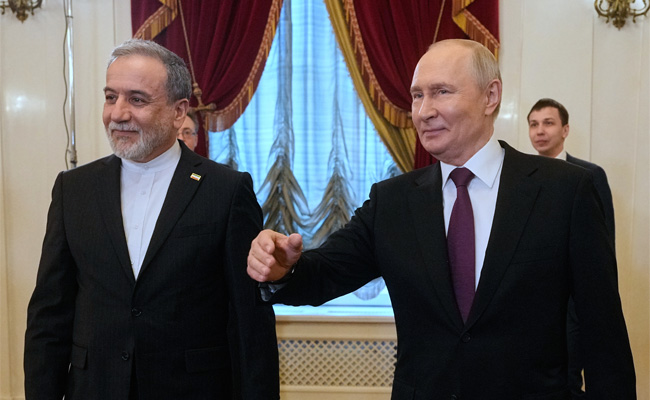
Moscow (PTI): Iran's Foreign Minister Abbas Araghchi on Monday met Russian President Vladimir Putin, who hailed the Iranian people for fighting bravely and heroically for their sovereignty and said Moscow is ready to do its best to help bring peace to West Asia as soon as possible.
Araghchi, who held talks with Omani and Pakistani leadership before arriving in Russia, met Putin in St. Petersburg and thanked him for supporting Iran, state-owned TASS news agency reported.
"Russia is ready to do everything in its power to ensure that peace in the Middle East is achieved as soon as possible," Putin said during his meeting with Araghchi, which was also attended by Russian Foreign Minister Sergey Lavrov.
Revealing that he received a message from Iranian Supreme Leader Mojtaba Khamenei last week, Putin asked Araghchi to convey his "gratitude for this message and best wishes for his health and well-being."
He praised the Iranian people for fighting "bravely and heroically" for their sovereignty, Iran's state-run PRESS TV reported.
"We really hope that, based on the courage and desire for independence, the Iranian people, under the guidance of the new leader, will weather this difficult period of trials and peace will come,” Putin said.
He also stressed that Russia “intends to maintain” its strategic relations with Iran.
Araghchi said that the world witnessed Iran’s strength in countering the US during the recent war, and that the Islamic Republic is a "stable and powerful establishment."
"With their courage, the Iranian people succeeded in resisting the US aggression and will be able to endure it,” he said.
He said that it became clear that Iran has “great friends and allies” like Russia, and conveyed “warmest greetings” from Supreme Leader Mojtaba Khamenei and President Masoud Pezeshkian to the Russian leader.
Araghchi said relations between Moscow and Tehran represent a “strategic partnership at the highest level” and will continue to develop "regardless of circumstances."
"We are grateful to you for the solid and strong positions in support of the Islamic Republic of Iran," he said.
Foreign Minister Lavrov said that the talks between President Putin and the Iranian Foreign Minister were "useful and constructive."
Kremlin Spokesman Dmitry Peskov later said that Russia is "ready to provide any good offices, any mediation services that are acceptable to the parties."
"We will be ready to do everything so that ultimately peace ensues, guaranteed peace, and that there is no return to hostilities," Peskov was quoted as saying by TASS.
He was asked how Moscow can assist in future negotiations on the Iranian settlement.
Araghchi arrived in Russia after his whirlwind trip to Islamabad, which, according to him, was “very productive” and involved “good consultations" with Pakistan's Army Chief Field Marshal Asim Munir, amid uncertainty over the second round of peace talks to resolve the war in West Asia.
"We held good consultations with our friends in Pakistan. The trip was successful. We assessed the outcome of our recent (meetings) and discussed in what direction and under what conditions talks can move on,” Araghchi said in a video posted on his Telegram channel upon his arrival in St Petersburg.
Referring to the second round of talks between the US and Iran to resolve the conflict in West Asia, Araghchi said: "Developments have taken place in the negotiations."
"Despite some progress in earlier rounds, the talks failed to reach their objectives due to the Americans' approach, the excessive demands they made, and the wrong approaches they adopted. Therefore, it was necessary to consult with our friends in Pakistan to review the latest situation,” Iran's official news agency IRNA quoted him as saying.
He said that the trip to Pakistan was a good opportunity to review developments related to the US-Israeli war against Iran, expressing confidence that “these consultations and coordination between the two countries will be highly significant.”
Araghchi arrived at St. Petersburg's Pulkovo Airport early Monday, where he was welcomed by Russian officials and Iran’s ambassador to Russia, Kazem Jalali, the report said.
The first round of peace talks between Iran and the US, held on April 11 and 12, failed to bring the desired result for the parties to the conflict.
The Iranian minister arrived in Islamabad for the second time on Sunday after a short visit to Oman, where he held talks with Sultan Haitham bin Tariq al-Said on security in the Strait of Hormuz and diplomatic efforts to end the Iran-US conflict.
After Araghchi left Pakistan for Oman on Saturday, President Donald Trump announced that US negotiators Steve Witkoff and Jared Kushner would no longer be going to Islamabad for talks with Iran, contending that Washington held all the cards on the matter.
Trump on Sunday reiterated that the US and Iranian officials can talk by phone for a peace solution to the conflict.
On Tuesday, Trump extended the two-week ceasefire with Iran indefinitely to give Tehran more time to prepare a unified proposal to end the war, just hours before the truce was set to expire.
The war began when the US and Israel jointly attacked Iran on February 28, killing Iranian Supreme Leader Ayatollah Ali Khamenei and several top commanders. The retaliation by the Islamic Republic extended the war to the entire Gulf region.