UN appoints veteran Indian officer to lead its mission in Yemen
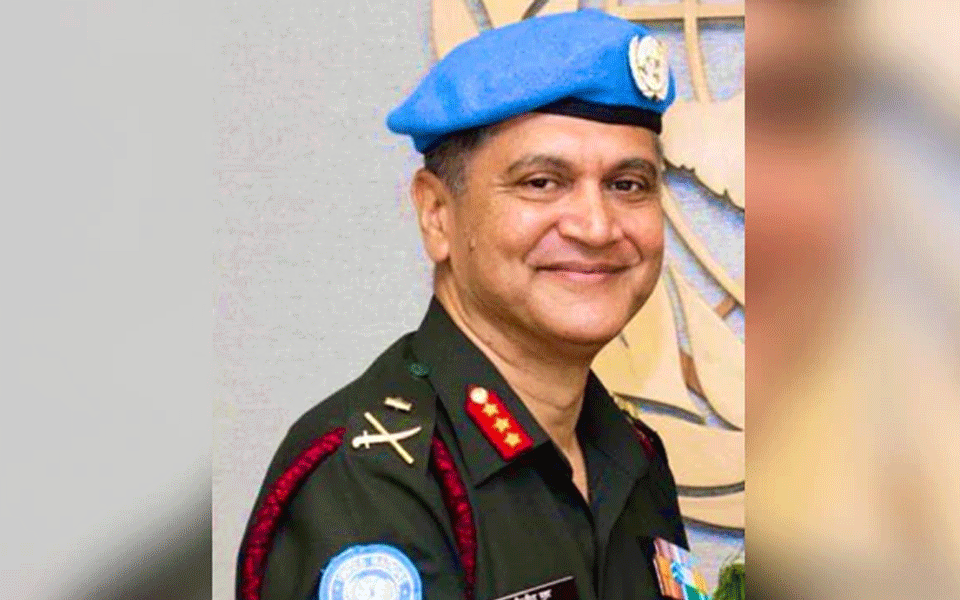
United Nations: Veteran Indian Army officer Lieutenant General (retired) Abhijit Guha has been appointed by the UN chief as the head of the world body's observer mission in the strife-torn Yemen's port city of Hodeidah.
Guha was appointed on Thursday by UN Secretary-General Antonio Guterres as the Chair of the Redeployment Coordination Committee (RCC) and head of the United Nations Mission to support the Hodeidah Agreement (UNMHA).
He will succeeds Lieutenant General Michael Lollesgaard, who served as RCC Chair and head of the UNMHA from January 31 to July 31, the Secretary General's spokesman said in a statement.
The Indian Army officer is tasked with leading the UN oversight of a ceasefire agreement in Hodeidah. The truce went into effect in December after peace talks in Sweden between the Yemen's government and the Iran-backed Houthi rebels, who have been fighting each other since 2015.
Guha brings to this position 39 years of national and international military experience. He served from 2009-2013 as the Deputy Military Adviser and the Military Adviser within the Office of Military Affairs of the United Nations Department of Peacekeeping Operations, while also establishing the Office of Peacekeeping and Strategic Partnerships in 2013, the statement said.
He has also previously served as a Military Observer as part of the United Nations Transitional Authority in Cambodia during 1992-3.
After his retirement from the Indian Army in 2013, General Guha served on the Expert Panel on Technology and Innovation in UN Peacekeeping (2014) and the High Level Independent Panel on Peace Operations (2015).
He has also led a number of United Nations' investigations and boards of inquiry in Africa and the Middle East.
The UNMHA was authorised for an initial period of six months to lead and support the functioning of the RCC, assisted by a secretariat staffed by UN personnel, to oversee the governorate-wide ceasefire, redeployment of forces and mine action operation.
It was also authorised to monitor compliance of the parties to the ceasefire in Hudaydah governorate and the mutual redeployment of forces from the city of Hudaydah and the ports of Hudaydah, Saleef and Ras Isa and to work with the parties so that security of the city and the ports of Hudaydah, Saleef and Ras Isa is assured by the local security forces in accordance with the Yemeni law.
Let the Truth be known. If you read VB and like VB, please be a VB Supporter and Help us deliver the Truth to one and all.
AIITA welcomes Karnataka’s ban on obscene songs in school events
Bhatkal: The Karnataka unit of the All India Ideal Teachers Association (AIITA) has welcomed the Karnataka government’s decision to strictly ban school children from dancing to obscene songs during educational and cultural programmes in government, aided, and private schools across the state.
AIITA Karnataka State President M. R. Manvi congratulated the government for taking what he termed an important step to preserve the sanctity of education.
“Such decisions to safeguard the dignity of school children and uphold the values of education are the need of the hour. This rule should not be limited to government schools alone but must be strictly implemented in all private educational institutions as well,” he said.
He further urged the government to address other concerns within school programmes.
“The government should not only prohibit obscene dances in the name of school anniversaries, but also ensure that plays and dialogues that incite religious hatred are avoided. Schools should be centres of harmony, not platforms for spreading hatred,” he added.
According to a recent circular issued by the Department of School Education and Literacy, obscene dances are adversely affecting the mental health and moral values of students.
In this regard, schools have been advised to use songs that promote nationalism, positive thinking, the greatness of Kannada culture, and value-based traditions instead of inappropriate content during programmes.
The circular also emphasises that students should be dressed in decent attire.
AIITA also backed the department’s warning that disciplinary action would be taken against head teachers if such guidelines are violated. The association has further demanded that district Deputy Directors of Public Instruction strictly monitor the implementation of these rules.