UN report cites ISRO efforts in assisting Indian government to contain COVID19 pandemic
United Nations: A report by the United Nations has cited efforts by Indian Space Research Organisation (ISRO) to leverage its geospatial tools in assisting the central and state governments towards containing the COVID-19 pandemic and supporting sustainable development projects in the country.
The UN report Geospatial Practices for Sustainable Development in Asia and the Pacific 2020' cites the role being played by 'BHUVAN', the national geo-portal developed and hosted by ISRO comprising of geo spatial data, services and tools for analysis, in combating COVID-19.
The Government of India and its state governments have taken several steps to contain the COVID-19 pandemic. ISRO has assisted in this by providing and leveraging geospatial tools, in particular BHUVAN the Indian Geo-Platform, the report said.
It added that the geospatial information platform provided service in six aspects: tracking, identifying hotspots, vegetable markets, food needed, home isolation and pollution.
Additionally, as India needed a dashboard to better understand the current circumstances in the country, ISRO customised the Geo-portal and developed Bhuvan- COVID-19' at a national level to track the pandemic and update the public on the current situation, the report said.
The report, released on Wednesday by the UN Economic and Social Commission for Asia and the Pacific (ESCAP), showcases examples from the region's countries employing applications of space technology to advance sustainable development.
It said that Asian and Pacific nations are increasingly leveraging space technology and geospatial information to respond to challenges on the ground, including in their efforts to contain the spread and mitigate the impact of the coronavirus pandemic.
The report also said that India has been making significant progress in responding to the demands of today's cities by incorporating robust space technologies and GIS (geographic information system) into the urban planning, transport management and traffic navigation techniques.
It said the development of Road Asset Management system for National Highways (NHs) is a flagship project by the National Highways Authority of India in association with the Indian Space Research Organisation and the World Bank.
Bringing both public and private funded roads under one umbrella, the main objective of this project is to assist in accurate and scientific maintenance planning, enhance road safety measures and plan the development of the NH network in India, the report said.
The report also noted that ESCAP, with the support of India, regularly facilitates young professional officials from developing countries in the region to join a nine month post-graduate course on remote sensing and the Global Navigation Satellite Systems at the Centre for Space Science and Technology Education in Asia Pacific, in Dehradun.
Some of the other practices undertaken by countries in the region and cited in the report include Night-light' satellite images monitoring the impact of lockdowns, heatmaps' to chart out communities vulnerable to the pandemic and its socio-economic consequences, real-time situational analysis, and dashboards integrating a wide gamut of critical information to support decisions are some of the practices cited.
The examples, according to the report, show how space applications and geospatial data have played an important role in providing essential location-based and temporal data to make an overall data map and snapshots on the COVID-19 pandemic for policymakers and the public.
In addition, combining spatial data from contact tracing, quarantining, and social distancing with digital solutions and artificial intelligence (AI)-driven risk analytics can help enhance community resilience.
Such applications can also help in the recovery phase to build back better, by providing an evidence base for decisions on the easing of lockdown and the resumption of economic and social activities, the report added.
The effective integration of geospatial data, with existing statistics and ground-based information, will be key to delivering the timely data needed for governments, businesses, communities and citizens to make evidenced-based decisions, Executive Secretary of ESCAP Armida Salsiah Alisjahjabana said.
The report, issued two years after Asian and Pacific countries endorsed an ambitious plan of action on use of space technologies to support sustainable development also provides a baseline for assessing future progress in the region.
In addition to presenting an overview of the status along thematic areas such as disaster risk, natural resource management, connectivity, social development, energy, and climate change, the report also highlights the importance of multi-stakeholder partnerships.
Many regional and country-based efforts are sparking innovations that attract both public and private capital, supporting start-ups and spinoffs from space applications research and pilots, said ESCAP.
The report outlined seven key recommendations for policymakers to integrate applications of geospatial information into their planning and actions towards achieving the Sustainable Development Goals (SDGs).
Let the Truth be known. If you read VB and like VB, please be a VB Supporter and Help us deliver the Truth to one and all.
4 workers die after being buried under coal slurry in Jharkhand's Dhanbad
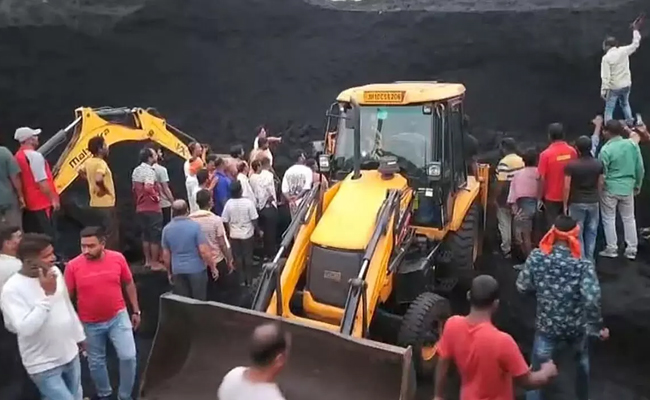
Dhanbad (Jharkhand) (PTI): At least four workers died after being buried under coal slurry in Jharkhand's Dhanbad district on Saturday, a police official said.
The incident took place at Moonidih coal washery in the command area of Bharat Coking Coal Limited (BCCL).
"Bodies of all four workers were dug out of debris during a rescue operation," Putki police station in-charge Waqar Hussain told PTI.
The incident took place when coal slurry was being loaded into trucks by workers, during which a large chunk of slurry fell and trapped several workers underneath, officials said.
The deceased have been identified as Manik Bauri, Dinesh Bauri, Deepak Bauri, and Hemlal Gope.
Meanwhile, the family members of the deceased and local villagers placed the bodies in front of the washery gate and began a protest.
They demanded compensation, jobs for dependents and action against those responsible for the incident.
Police and administration officials are trying to pacify the protesters, an official said.