Unable to answer basic questions on Nicobar project: Ramesh slams Environment Minister
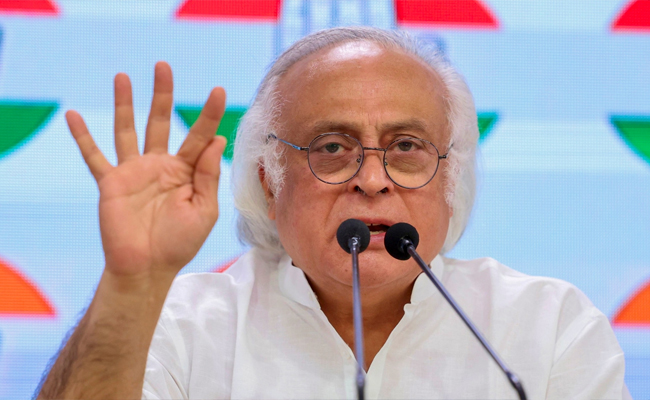
New Delhi (PTI): Hitting back at Environment Minister Bhupender Yadav for criticising the Congress for opposing the Great Nicobar infrastructure project, party leader Jairam Ramesh on Sunday said drawing the nation's attention to an imminent "ecological and humanitarian disaster" is not "negative politics" but an expression of grave concern.
The minister is simply unable to answer basic questions that Congress has been repeatedly raising on the project, Ramesh said.
"The Union Minister of Environment, Forests, and Climate Change Shri Bhupender Yadav has accused the Indian National Congress of doing what he calls 'negative politics' on the Great Nicobar mega infrastructure project.Drawing the nation's attention to an imminent ecological and humanitarian disaster is NOT 'negative politics'. It is an expression of grave concern," Ramesh said on X.
The minister is simply unable to answer basic questions that the INC has been repeatedly raising on the project, he said and asked whether the Great Nicobar Mega Infra Project, which requires the diversion of lakhs of trees, violate the National Forest Policy, 1988 which states that "tropical rain/moist forests, particularly in areas Andaman & Nicobar Islands should be totally safeguarded?"
"Compensatory afforestation is always a poor substitute for old-growth forests but the afforestation planned in this project is farcical. How can afforestation in distant Haryana, with a completely different ecosystem, be considered a genuine offset for the loss of old-growth rainforest unique to Great Nicobar? Why has the Government of Haryana already freed up 25 per cent of this land for mining instead of reserving it for the afforestation?" Ramesh said.
Why was the National Commission on Scheduled Tribes not consulted before the Nicobar project was approved, he asked.
"Why are the concerns of the Tribal Council of Great Nicobar regarding this project being ignored? Why is the Shompen Policy of the Islands, which explicitly calls for the integrity of the community to be prioritised in all projects, being disregarded?" Ramesh said.
Why does the "Social Impact Assessment" conducted as part of the Right to Fair Compensation and Transparency in Land Acquisition, Rehabilitation and Resettlement Act, 2013 (RFCTLARR) ignore the existence of the Shompen and the Nicobarese, the Congress leader further asked.
"The Forest Rights Act (2006) holds the Shompen as the sole legally empowered authority to protect, preserve, regulate, and manage the tribal reserve. Why does the Project's approval process fail to recognize the same?" Ramesh said.
He pointed out that the island harbours endangered species, including leatherback turtles, megapodes, saltwater crocodiles, and rich coral systems.
Won't this project drive these species closer to extinction, he asked.
"Why are critical documents relating to this project, including the reports of the ground-truthing exercise conducted to reclassify the location of the planned transshipment port from CRZ1-A, not being published in the open?" Ramesh said.
Given the island's history of severe subsidence during the 2004 tsunami and its location in a high-seismic zone, can the sustainability of this project be assured, he further asked.
"Over twenty years ago, a valuable book was published. It was called 'Supreme Court on Forest Conservation' and it was authored by Ritwick Dutta and Bhupender Yadav. Sadly the first author has had investigative agencies unleashed against him for his environmental activism - but happily the second author has had a much better fate. When will that Bhupender Yadav awake?" he said.
Yadav last Thursday hit out at the Congress for opposing the Great Nicobar infrastructure project, accusing it of spreading confusion and indulging in "negative politics".
Speaking at an event organised by The Public Affairs Forum of India here, Yadav asserted that the mega project is crucial for national security and strategic connectivity in the Indian Ocean Region.
Yadav said only 1.78 per cent of Great Nicobar's forest area will be used for the project.
His remarks came days after Congress Parliamentary Party chairperson Sonia Gandhi, in an article in The Hindu, termed the Rs 72,000 crore project a "planned misadventure" that threatens the survival of the Shompen and Nicobarese tribes, destroys one of the world's most unique ecosystems and is highly susceptible to natural disasters.
Gandhi alleged the project was being pushed through by "making a mockery of all legal and deliberative processes".
"The ancestral villages of the Nicobarese tribals fall in the project's proposed land area. The Nicobarese were forced to evacuate their villages during the 2004 tsunami. This project will now permanently displace this community, ending its dream of returning to its ancestral villages," Gandhi had said.
She had also argued that the Shompen face an even greater threat as the project denotifies a significant part of their reserve and will bring a large influx of people and tourists to the island.
In response, Yadav recently authored a column in the same newspaper, defending the project as one of strategic, defence and national importance.
He had said the plan is designed to transform Great Nicobar into a major hub of maritime and air connectivity in the Indian Ocean Region, with an international container transhipment terminal, a greenfield international airport, a 450 MVA gas- and solar-based power plant and a township over 16 sq km.
Let the Truth be known. If you read VB and like VB, please be a VB Supporter and Help us deliver the Truth to one and all.
Putin meets Iran's FM Araghchi, says Russia ready to do its best to help bring peace to West Asia
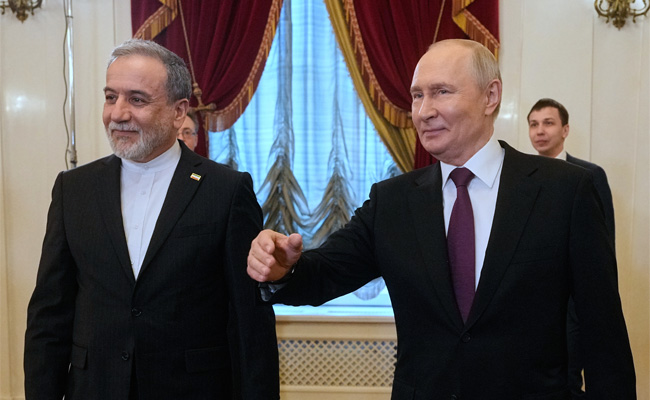
Moscow (PTI): Iran's Foreign Minister Abbas Araghchi on Monday met Russian President Vladimir Putin, who hailed the Iranian people for fighting bravely and heroically for their sovereignty and said Moscow is ready to do its best to help bring peace to West Asia as soon as possible.
Araghchi, who held talks with Omani and Pakistani leadership before arriving in Russia, met Putin in St. Petersburg and thanked him for supporting Iran, state-owned TASS news agency reported.
"Russia is ready to do everything in its power to ensure that peace in the Middle East is achieved as soon as possible," Putin said during his meeting with Araghchi, which was also attended by Russian Foreign Minister Sergey Lavrov.
Revealing that he received a message from Iranian Supreme Leader Mojtaba Khamenei last week, Putin asked Araghchi to convey his "gratitude for this message and best wishes for his health and well-being."
He praised the Iranian people for fighting "bravely and heroically" for their sovereignty, Iran's state-run PRESS TV reported.
"We really hope that, based on the courage and desire for independence, the Iranian people, under the guidance of the new leader, will weather this difficult period of trials and peace will come,” Putin said.
He also stressed that Russia “intends to maintain” its strategic relations with Iran.
Araghchi said that the world witnessed Iran’s strength in countering the US during the recent war, and that the Islamic Republic is a "stable and powerful establishment."
"With their courage, the Iranian people succeeded in resisting the US aggression and will be able to endure it,” he said.
He said that it became clear that Iran has “great friends and allies” like Russia, and conveyed “warmest greetings” from Supreme Leader Mojtaba Khamenei and President Masoud Pezeshkian to the Russian leader.
Araghchi said relations between Moscow and Tehran represent a “strategic partnership at the highest level” and will continue to develop "regardless of circumstances."
"We are grateful to you for the solid and strong positions in support of the Islamic Republic of Iran," he said.
Foreign Minister Lavrov said that the talks between President Putin and the Iranian Foreign Minister were "useful and constructive."
Kremlin Spokesman Dmitry Peskov later said that Russia is "ready to provide any good offices, any mediation services that are acceptable to the parties."
"We will be ready to do everything so that ultimately peace ensues, guaranteed peace, and that there is no return to hostilities," Peskov was quoted as saying by TASS.
He was asked how Moscow can assist in future negotiations on the Iranian settlement.
Araghchi arrived in Russia after his whirlwind trip to Islamabad, which, according to him, was “very productive” and involved “good consultations" with Pakistan's Army Chief Field Marshal Asim Munir, amid uncertainty over the second round of peace talks to resolve the war in West Asia.
"We held good consultations with our friends in Pakistan. The trip was successful. We assessed the outcome of our recent (meetings) and discussed in what direction and under what conditions talks can move on,” Araghchi said in a video posted on his Telegram channel upon his arrival in St Petersburg.
Referring to the second round of talks between the US and Iran to resolve the conflict in West Asia, Araghchi said: "Developments have taken place in the negotiations."
"Despite some progress in earlier rounds, the talks failed to reach their objectives due to the Americans' approach, the excessive demands they made, and the wrong approaches they adopted. Therefore, it was necessary to consult with our friends in Pakistan to review the latest situation,” Iran's official news agency IRNA quoted him as saying.
He said that the trip to Pakistan was a good opportunity to review developments related to the US-Israeli war against Iran, expressing confidence that “these consultations and coordination between the two countries will be highly significant.”
Araghchi arrived at St. Petersburg's Pulkovo Airport early Monday, where he was welcomed by Russian officials and Iran’s ambassador to Russia, Kazem Jalali, the report said.
The first round of peace talks between Iran and the US, held on April 11 and 12, failed to bring the desired result for the parties to the conflict.
The Iranian minister arrived in Islamabad for the second time on Sunday after a short visit to Oman, where he held talks with Sultan Haitham bin Tariq al-Said on security in the Strait of Hormuz and diplomatic efforts to end the Iran-US conflict.
After Araghchi left Pakistan for Oman on Saturday, President Donald Trump announced that US negotiators Steve Witkoff and Jared Kushner would no longer be going to Islamabad for talks with Iran, contending that Washington held all the cards on the matter.
Trump on Sunday reiterated that the US and Iranian officials can talk by phone for a peace solution to the conflict.
On Tuesday, Trump extended the two-week ceasefire with Iran indefinitely to give Tehran more time to prepare a unified proposal to end the war, just hours before the truce was set to expire.
The war began when the US and Israel jointly attacked Iran on February 28, killing Iranian Supreme Leader Ayatollah Ali Khamenei and several top commanders. The retaliation by the Islamic Republic extended the war to the entire Gulf region.