Unattended bag creates panic at Delhi airport; later claimed by passenger
New Delhi: An unattended bag triggered panic on Friday at the Delhi airport on the suspicion of containing RDX, but officials later said it was claimed by a passenger who had forgotten it outside the Terminal-3.
The bag contained a laptop, its charger, some toys and clothes, they said, declaring there was no RDX or any other explosive in the bag, which was opened in the presence of the claimant.
The passenger, who was identified as Shahid Hussain by officials, contacted police authorities after over 16 hours of losing his bag.
He said he was a part of a group of four people and had forgotten the bag outside the Indira Gandhi International airport's Terminal-3 after he arrived from Mumbai on a SpiceJet plane, they said.
The passenger, the officials said, told a joint investigation team of security officials that the bag contained a laptop, among other items. Hussain said he had forgotten his luggage at the airport as the group had a number of bags, they said.
The passenger was taken to the isolated area at the IGI airport where the black coloured trolley bag was kept inside a total containment vessel (TCV) or a thick metal sheeted bomb defusing container, the officials said.
The man has been handed over to the police for further probe and to unravel the entire sequence of events which prima facie looks to be a case of oversight by the passenger and his group, they said.
"Hussain, a resident of Ballabhgarh, landed in Delhi at 12.30 am on Friday from Mumbai in a Spicejet plane. He was accompanied by his three friends. Hussain works in a steel structure company and left he unintentionally," a senior police officer said.
The entire security paraphernalia at the sensitive airport went into a tizzy after initial inputs suggested that the bag could be containing RDX.
What added to the suspicion was that the place where the bag was spotted was in a "dark zone" outside the arrival terminal, where there is little CCTV coverage.
The explosive vapour detector somehow indicated the presence of RDX and hence, all security drills like isolating the suspicious bag and restricting passenger movement was undertaken, officials said.
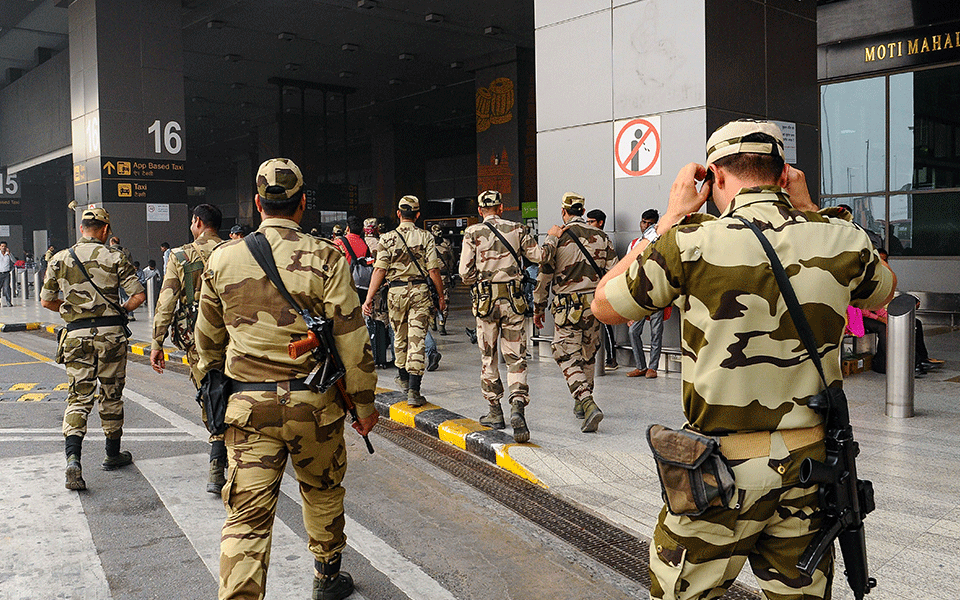
The bag was detected around 1 am by a Central Industrial Security Force (CISF) staffer and was subsequently kept in an isolated zone with a joint team of CISF, the bomb experts of the National Security Guard and forensics keeping it under observation.
"The bag was removed with the help of the CISF and shifted to another place. It has not been opened yet. It seems like there are some electric wires inside it. We have increased the security of the airport premises," Sanjay Bhatia, deputy commissioner of police (airport), had said soon after the incident was reported.
Preliminary inputs suggested the contents of the bag could be RDX, the sources said. It was checked by an explosive detector and a sniffer dog.
CISF Special Director General (airport sector) M A Ganapathy, however, had said it was "premature" to say the explosive is RDX grade.
"It can be any material and the initial inputs can be false. To say it is RDX at this point of time is highly premature. We should wait for the final assessment report," Ganapathy had told PTI.
Research Department Explosive, acronymed RDX, is a deadly non-smelly explosive and has been used by terrorist elements in the past to create mass casualties.
Officials said in the morning that the suspected explosive has been put under observation for the next 24 hours and something certain can be said only after that.
In July this year, a piece of cargo at the Vadodara airport was suspected to containing RDX. It later turned out to be a consignment of pellets and air guns, an official in the security establishment said.
Giving details of Friday's incident, Delhi Police officials said a call was received around 1 am, following which the bag was found at arrival gate number two of the terminal.
The discovery of the bag caused panic among passengers who were not allowed to exit the terminal for sometime, sources at some airlines said.
Officials said CISF and Delhi Police personnel conducted a complete anti-sabotage check of the airport after which passenger movement was allowed around 4 am.
The CISF and police have stepped up security at the facility in accordance with standard procedure, they said. Delhi airport has three terminals and domestic as well as international flights operate from the Terminal-3.
Let the Truth be known. If you read VB and like VB, please be a VB Supporter and Help us deliver the Truth to one and all.
Indian startup's 'Drishti' satellite launched aboard SpaceX rocket
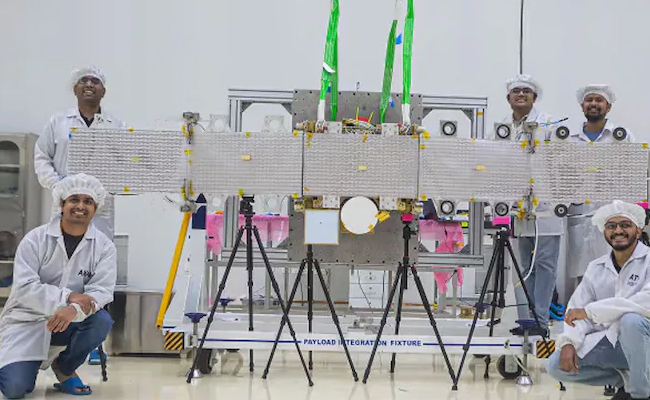
New Delhi (PTI): Bengaluru-based space start-up GalaxEye's Mission Drishti satellite was launched on Sunday aboard SpaceX's Falcon 9 rocket from California.
Mission Drishti is the world's first OptoSAR satellite, integrating electro-optical (EO) and synthetic aperture radar (SAR) sensors into a single operational platform, according to the company.
While EO sensors capture high-resolution images during sunlight and clear skies, SAR sensors provide all-weather and all-time images, using radar pulses.
In a statement, Suyash Singh, founder and CEO of GalaxEye, said, "With the satellite (Mission Drishti) now successfully in orbit, our immediate focus is on completing its commissioning. As we move through this phase, we are already witnessing strong global interest in the differentiated datasets enabled by our OptoSAR payload."
The satellite will help address long-standing limitations of conventional systems and enable more reliable and consistent data acquisition across diverse environmental conditions, the company said.
As a dual-use Earth observation satellite, the mission will support use cases across defence, agriculture, disaster management, maritime monitoring, and infrastructure planning.
The satellite is also expected to complement India's broader initiatives, including the 29 active Earth Observation satellites outlined in ISRO's recent annual report.
The launch came after five years of indigenous research and development, and extensive environmental testing and performance validation of the Mission Drishti.
In a statement, Lt Gen AK Bhatt (Retd), director general of Indian Space Association (ISpA), said, "GalaxEye has achieved what only a few global players have, which is seamlessly combining optical and SAR capabilities on a single platform to enable persistent, all-weather intelligence."
What stands out is not just the technology, but its broader impact on how downstream applications will increasingly define value in the space economy, particularly in Earth observation, where timely, decision-grade insights are critical," he added.
ISpA is the premier industry association of space and satellite companies in the country.
Union Minister Jitendra Singh also took note of the Mission Drishti launch, saying the development marked a significant milestone in India's space journey.
In a post on X, the minister said, "The successful launch of the world's first OptoSAR satellite, and the largest privately-built satellite in the country, reflects the immense potential of our young innovators driving nation-building."
GalaxEye aims to scale up Mission Drishti to a constellation of 10 satellites by 2030, developing a robust and sovereign Earth observation infrastructure for India.