Seventeen unexplained deaths: J&K’s Badhaal village declared containment zone
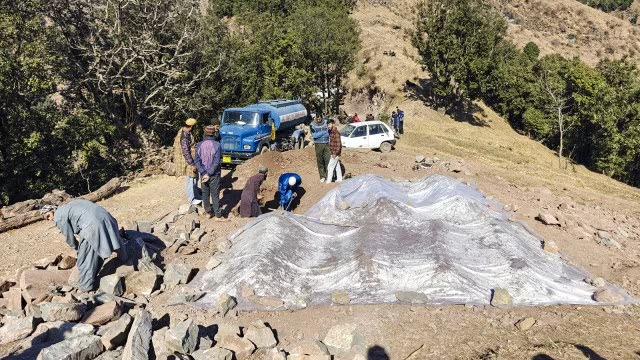
Rajouri/Jammu (PTI): The remote Badhaal village in Jammu and Kashmir's Rajouri district was on Wednesday declared a containment zone and prohibitory orders imposed on all public and private gatherings in the wake of the death of 17 people belonging to three families, officials said.
Another person belonging to the village has been admitted to a hospital in a critical condition, they said.
The containment orders have been imposed under section 163 of the Bharatiya Nagarik Suraksha Sanhita (BNSS). Section 163 of BNSS gives magistrates the power to issue written orders in urgent situations. These orders can be used to prevent or remedy nuisance or dangers.
According to the order issued by additional district magistrate (Rajouri) Rajeev Kumar Khajuria, the village has been divided into three containment zones – the first covering all families where deaths have occurred.
“The houses of these affected families shall be sealed and entry will be totally restricted for all individuals, including their family members, unless otherwise authorized by the designated officers/officials.”
In the containment zone 2, the order said the members of all families identified as close contacts of affected individuals be shifted to Government Medical College, Rajouri for continuous health monitoring which is mandatory.
All households will be covered under the containment zone-3 and staff will be deployed to ensure the continuous monitoring of food consumption, deployment of police personnel to enforce compliance and deployment of designated officers for maintenance of log books, the order said.
“All public and private gatherings are hereby prohibited within the jurisdiction of these containment zones, in order to prevent further spread of the infection,” the order said.
It said the designated officials shall be responsible for monitoring all meals provided to families in containment zones.
“It is mandatory for affected families and their close contacts to consume only the food and water provided by the administration. Any other food items available in the households are strictly prohibited for consumption,” the order said.
It ordered immediate replacement of all food and water supplies, and seizure of all edible materials in the infected households.
The fresh steps were taken after Chief Minister Omar Abdullah visited the village on Tuesday.
Seventeen persons belonging to three families linked to each other have died under suspicious circumstances in the village between December 7 and January 19.
A 24-year-old man identified as Aijaz Ahmad was hospitalised on Tuesday evening after his health deteriorated.
Let the Truth be known. If you read VB and like VB, please be a VB Supporter and Help us deliver the Truth to one and all.
CJI's advice to aspirant: Join the bar, become a lawyer, don't hanker for judicial services post
New Delhi (PTI): She came to the Supreme Court seeking a re-evaluation of her paper in the examination for joining judicial services as a magistrate. What she got instead was a rejection — and a candid confession by the Chief Justice that he too had wanted to join the judicial services in his youth but was advised by a senior judge to become a lawyer instead.
A bench comprising Chief Justice Surya Kant and Justice Joymalya Bagchi on Friday dismissed a plea filed by Prerna Gupta, the judicial services aspirant.
As Gupta pressed her case, the CJI intervened and said, "Let me share my personal story and I hope you will go happily as we cannot allow your petition."
He recounted his time as a final-year law student in 1984 when he wanted to become a judicial officer. As per requirement, he cleared the written test and was set to appear for an interview.
Judicial services is one of the two routes to become a judge after initially joining as a magistrate in lower court and thereafter rising through the ranks to become judge in a high court and possibly the Supreme Court.
The other route is to join the Bar, which means becoming a lawyer, and after building a reputation be picked from the Bar to become a judge at a senior level.
By the time the CJI's exam results came out, he had started practising at the Punjab and Haryana High Court when he was called for the interview.
The senior-most judge on the interview panel happened to be a judge before whom he had recently argued two significant matters.
"One of the matters was Sunita Rani vs Baldev Raj, where he had allowed my appeal in a matrimonial case and set aside the decree of divorce granted by the District Judge on the ground of schizophrenia," he noted.
Before the interview could take place, the judge called the young Surya Kant to his chamber and asked, 'Do you want to become a judicial officer?'
"I said 'yes.' He immediately said, 'Get out from (my) the chamber.'"
The courtroom fell silent as the CJI Justice described his initial heartbreak.
“I came out trembling. All my dreams were shattered. I thought he had snubbed me and that my career was over,” the CJI said.
However, the story took another turn the following day and the judge summoned him again, this time offering a piece of advice that would change the trajectory of his life.
“He said, ‘If you want to become (a judge), you are welcome. But my advice is, don’t become a judicial officer. The Bar is waiting for you,’” Justice Surya Kant recalled.
The CJI said he decided to skip his interview and didn't even tell his parents at first, fearing their disappointment, and instead chose to dedicate himself to his practice as an advocate.
“Now tell me did I make a bad right or bad decision,” the CJI asked and the litigant lawyer left the court with a smile on her face despite her case being dismissed.
Encouraging the petitioner to look toward the future rather than dwelling on the re-evaluation of a single paper, Justice Surya Kant said, "The Bar has much to offer."