Unfortunate, prejudicial misinterpretation: Retired judges slam Shah's remarks on Oppn V-P pick
_vb_44.jpeg)
New Delhi, Aug 25 (PTI) A group of retired judges has termed Home Minister Amit Shah's attack on opposition vice presidential candidate B Sudershan Reddy over the Salwa Judum judgement "unfortunate" and said it would be wise to refrain from "name-calling".
The group of 18 retired judges, including the likes of former Supreme Court justices Kurien Joseph, Madan B Lokur and J Chelameswar, also said that "prejudicial misinterpretation" of the top court's verdict by a high political functionary is likely to have a chilling effect on its judges.
Shah had accused Reddy, a former judge of the Supreme Court, of "supporting" Naxalism. He had claimed that Left Wing Extremism would have ended by 2020 in the absence of the Salwa Judum judgement.
"The statement of Union Home Minister Amit Shah, publicly misinterpreting the judgment of the Supreme Court in the Salwa Judum case, is unfortunate. The judgment nowhere supports, either expressly or by compelling implication of its text, Naxalism or its ideology," the statement signed by the 18 former judges said.
The former Supreme Court judges who signed the statement are A K Patnaik, Abhay Oka, Gopala Gowda, Vikramjit Sen, Kurien Joseph, Madan B Lokur, and J Chelameswar.
"While the campaign for the office of the Vice-President of India may well be ideological, it can be conducted civilly and with dignity. Criticising the so-called ideology of either candidate should be eschewed," the retired judges said.
"Prejudicial misinterpretation of a judgment of the Supreme Court by a high political functionary is likely to have a chilling effect on the judges of the Supreme Court, shaking the independence of the judiciary," they said.
Out of respect for the office of the Vice President of India, it would be wise to refrain from "name-calling", the retired judges said.
Besides the seven retired judges of the Supreme Court, three former chief justices of High Courts -- Govind Mathur, S. Muralidhar and Sanjib Bannerjee -- also signed the statement.
The other signatories to the letter include former judges of high courts Anjana Prakash, C Praveen Kumar, A Gopal Reddy, G Raghuram, K Kannan, K Chandru, B Chandrakumar and Kailash Gambhir. Prof Mohan Gopal and senior advocate Sanjay Hegde also signed the statement.
Speaking in Kerala on Friday, BJP leader Shah had said, "Sudershan Reddy is the person who helped Naxalism. He gave Salwa Judum judgment. If the Salwa Judum judgment had not been given, the Naxal terrorism would have ended by 2020. He is the person who was inspired by the ideology that gave Salwa Judam judgment."
Reddy, on Saturday, said he did not wish to join issues with the home minister, asserting that the verdict was not his but that of the Supreme Court. He also said that Shah would not have made the remarks had he read the complete judgment.
He, along with Justice S S Nijjar, was part of an apex court bench that had in July 2011 ordered the disbanding of Salwa Judum, ruling that using tribal youths as Special Police Officers in the fight against Maoist insurgents was illegal and unconstitutional.
Let the Truth be known. If you read VB and like VB, please be a VB Supporter and Help us deliver the Truth to one and all.
Supreme Court declines fresh curbs on hate speech, says existing laws are enough
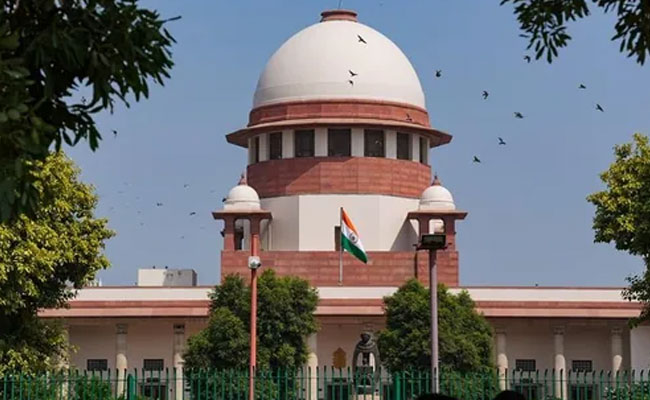
New Delhi: The Supreme Court of India on Wednesday refused to issue additional directions to curb hate speech across the country, holding that the existing legal framework is sufficient and that the real issue lies in implementation rather than absence of law.
A Bench comprising Justice Vikram Nath and Justice Sandeep Mehta said creation of criminal offences falls within the legislative domain and courts cannot legislate or compel Parliament and state legislatures to enact laws.
The Bench observed that constitutional courts can interpret the law and issue directions for enforcement of fundamental rights, but cannot step into the law-making role.
“At the highest, the court may draw attention to the need for reform. The decision whether and in what manner to legislate remains within the exclusive domain of Parliament and the state legislatures,” the court said.
The court held that the field of hate speech is not legally vacant and said concerns arise mainly from poor enforcement of existing provisions.
It also noted that the Bharatiya Nagarik Suraksha Sanhita (BNSS), 2023, provides a comprehensive mechanism to set criminal law in motion, meaning there is no legislative vacuum.
Referring to remedies already available under the earlier Code of Criminal Procedure (CrPC) and the BNSS, the court said police are duty-bound to register an FIR when a cognisable offence is disclosed, as laid down in the Lalita Kumari judgment.
It said if police fail to register an FIR, an aggrieved person can approach the Superintendent of Police under Section 154(3) of CrPC or Section 173(4) of BNSS, and thereafter move the magistrate under Section 156(3) CrPC or Section 175 BNSS, or file a private complaint under Section 200 CrPC or Section 223 BNSS.
The Bench further held that an order directing investigation under Section 156(3) CrPC does not amount to taking cognisance under Section 190 CrPC or the corresponding Section 210 of BNSS.
Even while declining fresh directions, the court acknowledged the seriousness of the issue.
It observed that hate speech and rumour-mongering directly affect fraternity, dignity and constitutional order.
The Bench urged legislative authorities to consider whether further policy or legal measures are needed in view of changing social challenges, including suggestions made in the 267th Report of the Law Commission in 2017.
The judgment came in a batch of petitions arising from events dating back to 2020, when multiple pleas were filed over alleged communal narratives spread through television channels and social media.
Among the earliest cases were challenges relating to content described as the “Corona Jihad” campaign and a programme aired by Sudarshan TV titled “UPSC Jihad”. During those proceedings, the court had restrained further telecast of the programme.
Later, more petitions were filed over speeches made at religious gatherings described as “Dharam Sansad” events.
These included pleas moved by journalist Qurban Ali and Major General S.G. Vombatkere seeking action against alleged hate speeches made at such forums.
During the pendency of the matter, the Supreme Court in 2023 had issued major directions asking all states and Union Territories to act proactively in cases involving communal hate speeches or remarks hurting religious sentiments.
It had directed police to register FIRs suo motu, without waiting for formal complaints.
Later, contempt petitions were also filed alleging poor implementation of those earlier directions.