Union cabinet sanctions 7 new battalions; 9,400 personnel for Sino-India LAC guarding ITBP
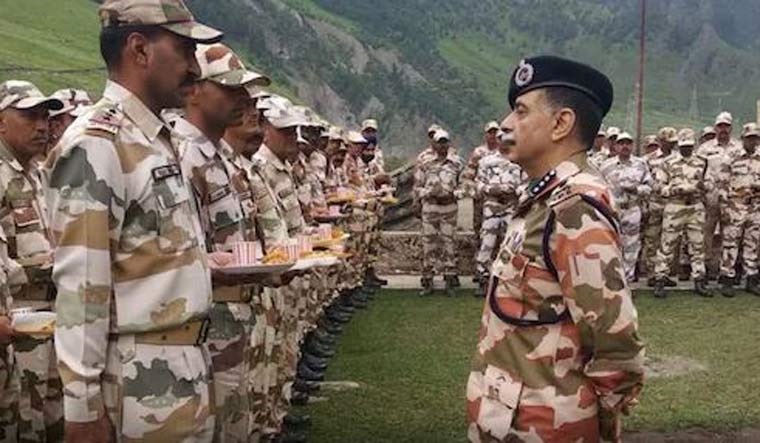
New Delhi, Feb 15: Seven new battalions of the Indo-Tibetan Border Police (ITBP) will be raised and a 4.1-km tunnel to provide all-weather connectivity to the border areas of Ladakh built with the government giving its approval on Wednesday, in a major move to bolster the country's defence along the China border.
The Cabinet Committee on Security (CCS) cleared the proposal for hiring of 9,400 fresh personnel for raising seven new border battalions apart from a new operational base for the ITBP, which guards the 3,488-km-long India-China border ranging from the Karakoram Pass in Ladakh to Jachep La in Arunachal Pradesh. The new personnel will be stationed mainly in Arunachal Pradesh.
The government decisions come amid the India-China military standoff along the Line of Actual Control(LAC) in eastern Ladakh that erupted in May 2020 and scuffles in the Tawang sector of Arunachal Pradesh in December last year.
The ITBP proposal was cleared during the CCS meeting that was chaired by Prime Minister Narendra Modi, Union Information and Broadcasting minister Anurag Thakur told reporters.
The new battalions and the sector headquarters are expected to be put in place by 2025-26, he said.
The Union Cabinet at its meeting chaired by Prime Minister Modi gave its nod for the construction of the 4.1-km Shinkun La tunnel on the Nimu-Padam-Darcha road link to provide all-weather connectivity to the border areas of Ladakh.
Thakur said the tunnel will be completed by December 2025 at a cost of Rs 1,681 crore.
The tunnel will provide all-weather road connectivity to Ladakh and this will be the shortest route to the border areas of the union territory, he said.
"The Cabinet Committee on Security (CCS) today approved the Shinku La tunnel for Ladakh area which will provide all-weather connectivity to the Ladakh region with the entire country.
"This (project) is also very important as far as the security and safety of the country is concerned.... It will also help in the movement of our security forces in that region," he added.
Sources said the tunnel project is a significant step in terms of security perspective as Nimu in Ladakh is close to Kargil as well as Leh and will help the armed forces in quicker deployment of forces and equipment in the region if there is any tense situation.
The ITBP, which has about 90,000 personnel in its ranks, was raised in the aftermath of the 1962 Chinese aggression.
According to the government sanction, the fresh manpower will be utilised for manning 47 new border posts and a dozen 'staging camps' or troops bases to be created along the LAC, largely in Arunachal Pradesh.
In order to ensure effective guarding of the LAC, these new bases were sanctioned in 2020 and now seven battalions comprising about 9,400 personnel and a new sector headquarters have been approved, a senior officer said.
Thakur said a non-recurring expenditure of Rs 1,808.15 crore is estimated to be spent for land acquisition, creation of office and residential buildings, and arms and ammunition while there will be a recurring annual expenditure of Rs 963.68 crore under the salaries and rations head for the fresh manpower.
Officials said the creation of 47 new border posts will lead to a 26 per cent increase in the strength of these bases while the induction of 9,400 fresh personnel will enhance the force's strength by 10 per cent. The force has 176 border posts at the LAC currently.
Before the new tunnel project in Ladakh, Thakur noted that the Atal tunnel was inaugurated and dedicated by Prime Minister Modi. The Atal tunnel links Manali to Leh and provides all-weather connectivity throughout the year.
Another tunnel which is under construction is the Zojila tunnel on the Srinagar-Kargil-Leh national highway which will be dedicated soon.
Thakur said after the Shinkun La tunnel is built it will help connect the Ladakh area, especialy the Zanskar valley, with the entire country.
Let the Truth be known. If you read VB and like VB, please be a VB Supporter and Help us deliver the Truth to one and all.
Late flourish masks CSK’s batting woes on lively Chepauk track, hosts post 158/7
Chennai (PTI): Bowlers calling the shots in a format dominated by big hitters is a rarity, but that script played out at Chepauk on Sunday as Gujarat Titans exploited a lively, bounce-friendly surface to stifle Chennai Super Kings before the hosts managed a late flourish to reach 158 for 7.
On a pitch that offered sharp carry, stroke-making demanded discretion and adaptability. Instead, CSK’s batters often opted for high-risk shots without fully assessing conditions, and paid the price with a flurry of miscued dismissals.
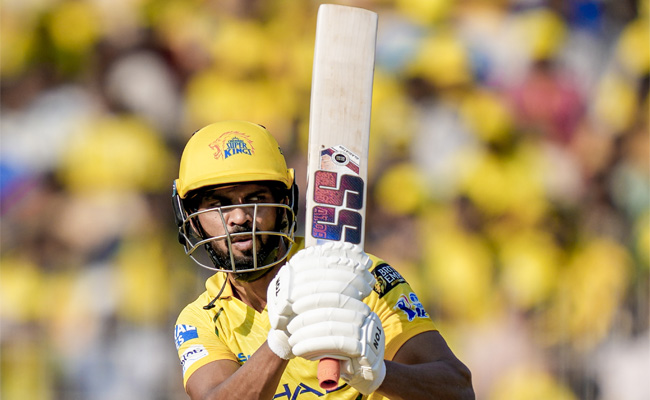
Invited to bat, CSK never quite found rhythm but skipper Ruturaj Gaikwad’s maiden half-century (74 not out) of the current IPL season lent a semblance of respectability to the total in a season where 200-plus scores have become commonplace.
Gaikwad's knock came off 60 balls with six fours and four sixes after a laboured start.
The tone was set early by GT pacer Mohammed Siraj, who extracted steep bounce and forced errors.
Sanju Samson (11) began watchfully, negotiating the first over before opening up against Kagiso Rabada to bring up his 5000 IPL runs milestone. However, Rabada’s bounce soon accounted for him as a hard slash outside off resulted in a faint edge that Jos Buttler pouched safely.
The dismissal triggered a collapse. Urvil Patel (4) fell in the same Rabada over attempting an ambitious pull, while Sarfaraz Khan (0) succumbed to Siraj’s extra lift, mistiming a short ball to offer a simple catch.
At 28 for 3 inside the Powerplay, CSK were already in trouble.
Gaikwad and Dewald Brevis (2) needed to rebuild, but the latter’s impatience against spinner Manav Suthar led to his downfall, holing out after failing to get to the pitch of the ball.
The mounting wickets forced Gaikwad into a shell — an approach that, while understandable, further stalled the momentum. His reluctance to improvise allowed dot balls to pile up, with CSK reaching 50 only in the 12th over.
The skipper eventually broke free, taking on Arshad Khan and Jason Holder with a couple of towering sixes, but the acceleration came too late.
Shivam Dube, dropped thrice on 6, 11 and 22, struggled for fluency before Arshad cleaned him up.
Kartik Sharma (15) and Jamie Overton (18) provided late impetus with a few lusty hits, but the damage had already been done.
On a pitch that rewarded discipline and smart shot selection, Titans' bowlers executed their plans to perfection, while CSK’s batters failed to read the conditions in time, a lapse that ultimately defined the innings.