Union Minister Pradhan pushes decolonisation of language, holistic education at Mysuru conference
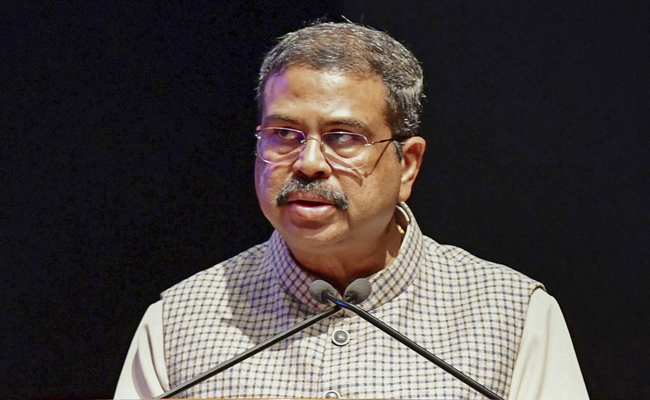
Mysuru (Karnataka) (PTI): Union Minister Dharmendra Pradhan on Thursday said that a strong emphasis has been placed on the decolonisation of language frameworks and knowledge systems, alongside a shift towards more indigenous perspectives in linguistic development.
Pradhan, who was in Mysuru, said he held substantive discussions with the team at the Central Institute of Indian Languages on its evolving mandate to advance the development and strengthening of Bharatiya (Indian) languages through research, innovation, and collaborative frameworks.
"The dialogue centred on widening CIIL’s engagement beyond the 22 Scheduled Languages to reflect India’s full linguistic diversity while deepening work in core linguistics and strengthening linkages with language technologists and Indian knowledge traditions," the Union Education minister said in a post on 'X'.
According to him, the importance of decentralised participation, structured national-level workshops, and wider dissemination through institutions such as the National Book Trust (NBT) was also discussed.
Furthermore, he underscored the need for stronger institutional capacity, measurable outcomes, and a long-term, coordinated approach to revitalising and expanding the ecosystem of Indian languages.
The minister also held interactions with vice-chancellors on the sidelines of the International Academic Conference on ‘Ekatma Manav Darshan (Vision of Holistic Humanity) – Bharat’s Worldview’ here.
Pradhan said the deliberations focused on advancing higher education through the effective implementation of the National Education Policy (NEP) 2020 under the leadership of Prime Minister Narendra Modi.
"NEP 2020 emphasises innovation, quality, and accessibility. The discussions also highlighted the importance of integrating Indian Knowledge Systems into academia while strengthening India’s expanding global education footprint, including the establishment of Indian campuses abroad," Pradhan said in another post.
Addressing the gathering at the conference, the minister noted that the current global situation has become a challenge not just for India but for the entire world.
"In many regions, due to the absence of fundamental ideas, a self-centred way of life, or rigid attachment to one’s own viewpoints, conditions of conflict have emerged—whether in developing nations or in the West," he said.
Stating that India’s core philosophy is broader than this, Pradhan said it emphasises coexistence and unity.
"Indian thought believes in oneness and harmony. This is what we call integral unity, where society, nature, and the universe are seen as interconnected. We have not viewed them in isolation," he added.
According to him, the practical application of this philosophy must reflect across all aspects of social life—whether in education, social policy, conduct, or behaviour.
"Our thinking must be guided by these foundational ideas: how we view nature, how we approach economic activity, how we perceive knowledge, and how we understand science. Today, we are trying to interpret all these dimensions in a complex and evolving context. Our systems and governance frameworks must be inclusive and serve all people," he added.
He also stressed that education plays a central role in transformation, highlighting that India has a vast student population, and issues such as the medium of instruction and language remain critical.
Even in urban schools, many students study in English-medium institutions, but at home they use different languages. This raises questions about comprehension and critical thinking, he said.
"There is a need to strengthen education in Indian languages and build critical thinking from the early stages. Research, methodology, and competency-based education must be improved. Foundational education in the mother tongue plays a key role in long-term learning outcomes," he said.
The minister added that reforms are being undertaken to address these challenges, including competency-based learning and curriculum changes from early classes.
The objective is to align India’s education system with its civilisational ethos while preparing students to meet contemporary challenges, he added.
Let the Truth be known. If you read VB and like VB, please be a VB Supporter and Help us deliver the Truth to one and all.
Udhayanidhi accuses BJP of not releasing funds for TN
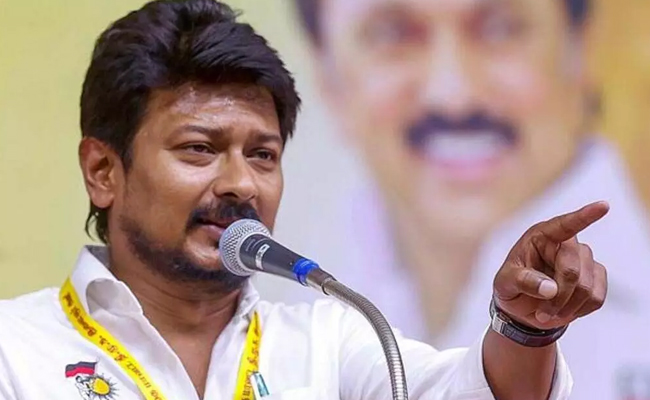
Gobichettipalayam (PTI): Tamil Nadu deputy chief minister Udhayanidhi Stalin on Saturday charged the BJP government at the Centre with not releasing funds to the state and accused it of "snatching" TN's rights.
Addressing a poll rally at Gobichettipalayam in the western Erode district, the DMK youth wing chief claimed the Centre has not released funds to the tune of Rs 3,000 crore for education.
"They (union government) have snatched all our rights," he charged.
With regard to the Centre's proposal for delimitation, he said chief minister M K Stalin was the first person in the country to raise the voice against the union government's move. He claimed that it was a "huge victory" for the INDIA alliance, as the bill was defeated for lack of majority after the opposition voted against it in the Lok Sabha.
Listing out various welfare measures implemented by the DMK government, he said the existing "Kalaignar Magalir Urimai Thogai" (monthly financial assistance for women) will be doubled to Rs 2,000 if DMK was voted to power again.
The deputy chief minister charged that the BJP and AIADMK have tried to stall it by moving the court. "At present more than 1.3 crore women have benefited from the scheme", he said.
"Similarly, the breakfast scheme for the government school students will be extended till Class VIII", he said adding "more than 35 lakh college students across the state will be getting free laptops once the DMK government is formed".
Udhayanidhi also pointed out at the "Illatharasi" poll promise, providing Rs 8,000 worth of coupons to non-income tax paying women where they could buy or replace any household appliances of their choice.
Elections to 234 Assembly seats in Tamil Nadu will be held on April 23 and the results declared on May 4 following counting of polled votes.