Unnao rape victim accident case: CBI drops murder charges against ex-BJP MLA Senger
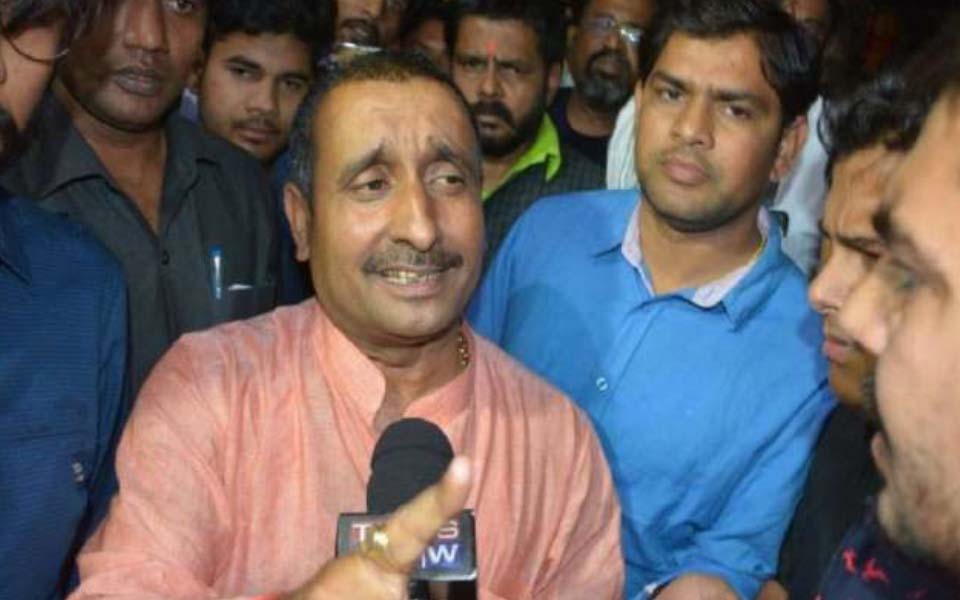
New Delhi, Oct 11: The CBI on Friday dropped murder charges against former BJP MLA Kuldeep Singh Sengar and his associates in its first charge sheet in the Unnao rape victim accident case in which two aunts of the woman were killed, officials said.
In the first charge sheet filed before a special CBI court in Lucknow in the evening, the agency charged Sengar and all other accused named in the FIR under IPC sections related to criminal conspiracy and criminal intimidation.
The FIR filed by the CBI had booked Sengar and nine other associates for alleged criminal conspiracy, murder, attempt to murder and criminal intimidation.
Sengar has been expelled from the BJP.
The woman, allegedly raped by Sengar in 2017 when she was a minor, battled for life after a truck rammed into the car she was travelling in with some family members and her lawyer in Rae Bareli district of Uttar Pradesh on July 28.
Truck driver Ashish Kumar Pal has been charged under IPC sections related to causing death by negligence, causing grievous hurt by act endangering life or personal safety of others and rash driving or riding on a public way, the officials said.
No charges of criminal conspiracy have been slapped against Pal in the CBI charge sheet, they said.
The agency also recommended to the Uttar Pradesh government departmental action against some officers but did not reveal their identity.
On the day of the accident, none of her security personnel of Uttar Pradesh Police were accompanying the woman. They were later suspended.
Two days after the accident, on July 30, the CBI booked Sengar, his brother Manoj Singh Sengar, Arun Singh, son-in-law of a Uttar Pradesh minister along with seven others.
The agency had taken over the FIR registered by Uttar Pradesh Police which was filed on the basis of statement given by the uncle of the woman.
In a critical condition, the victim was airlifted from a hospital in Lucknow and brought to the AIIMS for better care.
The victim, now 19-year old, was allegedly raped by the MLA on June 4, 2017 when she was a minor but her attempts to file a case did not materialise. Her father was arrested on alleged false charges levelled by the family of Sengar.
She had attempted self-immolation in front of Adityanath's residence to get the probe going in her case last year.
Next day, her father was allegedly assaulted inside the prison and he died of the injuries.
The news grabbed headlines following which the Allahabad High Court took suo motu cognisance of the case and handed over the matter to the CBI which has filed charge sheet against Sengar in July last year.
He was arrested on April 13 last year in connection with the rape case.
A four-term MLA, Sengar, who represents Bangarmau in the Uttar Pradesh Assembly, is considered an influential Thakur leader in the region.
The case in a special court hardly progressed since there were no judges to hear the matter.
The rape survivor wrote a number of letters to various authorities, including the Chief Justice of India, saying she was threatened for her life by Sengar's kin.
A letter dated July 12, written by the survivor and two of her family members, was also sent to the Allahabad High Court and other authorities of the Uttar Pradesh government.
Taking note of the letter, the Supreme Court on August 1 had directed the CBI to finish the probe within a week. This deadline was repeatedly increased on the request of the agency.
Let the Truth be known. If you read VB and like VB, please be a VB Supporter and Help us deliver the Truth to one and all.
EC can choose counting personnel, no further order needed: SC on TMC plea
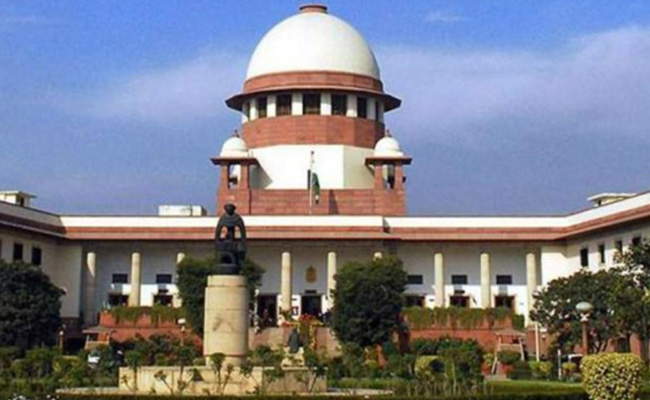
New Delhi (PTI): The Supreme Court on Saturday said no further order was necessary on the TMC's plea challenging the Calcutta High Court's dismissal of its petition against an Election Commission circular on the deployment of central government personnel for vote counting in West Bengal.
A special bench of Justices P S Narasimha and Joymalya Bagchi said the Election Commission can choose the counting personnel, and its April 13 circular, which provides for deployment of state government employees as well, cannot be said to be incorrect.
The poll body said the apprehensions of Trinamool Congress (TMC) of any wrongdoing is misplaced, as the circular very clearly states that there will be a mix of central and state government employees.
The Election Commission assured the court that the circular would be implemented in letter and spirit, and there would be state government employees also during the counting of votes on May 4.
At the outset, senior advocate Kapil Sibal, appearing for the TMC, said the circular was dated April 13, but they came to know about it on April 29.
ALSO READ: Anbumani asks PM Modi to ban sale of cigarettes for those born after 2009
He said there are four issues: One, the circular appointing Central employees was issued to DEOs on April 13, but came to their knowledge only on April 29; Two, the Election Commission says it has apprehensions of irregularity, despite having a Central nominee in the counting process; Three, the poll body already has a Central government officer at each counting table in the form of a micro observer, and four, the commission has not appointed state nominees even though the circular provides so.
Sibal submitted that the Chief Electoral Officer's communication states that there are apprehensions expressed from various quarters regarding possible irregularities in counting.
"That is like pointing a finger at the state government..." Sibal said, adding, "There must be some data. Where is (the proof of) the apprehension (raised) from each booth? They have not disclosed this. And why not tell us that they are going to have a Central government nominee?"
The bench, which held a special sitting, told Sibal that even if the Election Commission's circular had provided for the appointment of Central employees as both the counting supervisor and the counting assistant, the court could not have faulted the decision.
"The option is open for the Election Commission: whether the counting supervisor and assistant may be of the Central or the state government. When that option is open, we cannot hold that the notification is contrary to regulations. Even if the EC says that both of them can be Central government employees, we could not have faulted them. Because regulations say that either the Central government or state government officers can be appointed," Justice Bagchi told Sibal.
Sibal then submitted that the court may ask the Election Commission to follow the impugned circular in its entirety, which provides for a state government nominee.
"All we want is, in terms of the circular, the state government nominee should be there," he said.
Justice Bagchi asked if he wants compliance with the circular, then why is the TMC before the court.
Senior advocate D S Naidu, appearing for the Election Commission, submitted that the returning officer is a state government employee with overarching power to deploy personnel from any pool of government employees.
"We are saying that there will be state government employees during the counting of votes," Naidu submitted, adding that each candidate will also have their own counting agent.
"The TMC's apprehension of any wrongdoing is completely misplaced," he reiterated.
The bench then disposed of the plea, saying that no further order is necessary and reiterated that the Election Commission will follow its circular in letter and spirit.
Polling for the 294-member West Bengal Assembly was held in two phases -- April 23 and April 29. The counting of votes will be taken up on May 4.
On April 30, the Calcutta High Court dismissed the TMC's petition against the Election Commission circular, saying there was no illegality in the poll panel's decision to appoint counting supervisors and assistants from Central government and Public Sector Undertaking (PSU) employees, instead of the state government staff.
In the high court, the TMC had challenged an April 13 communication issued by the additional chief electoral officer of West Bengal that stated that at least one of the counting supervisors or assistants at each table should be a Central government or PSU employee.
The TMC's counsel had argued before the high court that the communication was issued without jurisdiction and was based on mere apprehension.
The EC's counsel had contended before the high court that the Representation of the People Act, 1951, allows delegation of the commission's functions and that the directive was valid.
The poll panel's counsel had also submitted that the communication was issued on April 13, but the petition was filed only on April 30, close to the counting date, alleging that the move was intended to stall the process.
The high court had not agreed with the TMC's allegation that its main opponent, the Bharatiya Janata Party (BJP), controls the employees of the Central government or PSUs, making them susceptible to suggestions and control by the Union government.
It had also noted that apart from the counting supervisors and assistants, micro-observers, counting agents of candidates, and other personnel would also be present in the counting hall.