UP: 3 killed in clashes during violent protest against Sambhal mosque survey
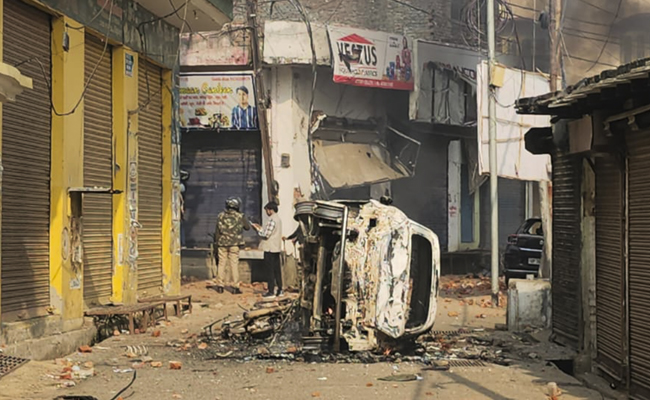
Sambhal (UP) (PTI): Three people were killed as protesters opposing a court-ordered survey of a Mughal-era mosque here clashed with security personnel on Sunday.
The protesters tried to torch vehicles and pelted stones at the police who used tear gas and batons to disperse the mob. "Gunshots were fired by the miscreants and some pellets struck our policemen. We are investigating where the shots were fired from, particularly in the Deepa Sarai area," an officer said.
Moradabad Divisional Commissioner Aunjaneya Kumar Singh said. "Three people identified as Naeem, Bilal and Nauman have been killed. Some policemen including the gunner of the superintendent of police have also been injured."
The trouble started on Sunday morning as a large group of people gathered near the mosque and started shouting slogans as the survey team began their work in the Shahi Jama Masjid.
Tension has been brewing in Sambhal over the past few days after the Jama Masjid was surveyed last Tuesday on the orders of a local court following a petition that claimed that a Harihar temple stood at the site.
Ten people have been detained and a probe has been launched, an official said, adding some people even tried to set afire some motorcycles parked on the roadside.
The official said the accused in the violence would be booked under the stringent National Security Act (NSA).
Samajwadi Party chief Akhilesh Yadav lashed out at the BJP, saying the ruling party, government and the administration orchestrated the violence "to divert attention from electoral malpractice".
According to the local administration, a second survey by an "Advocate Commissioner" as part of a court-ordered examination into the disputed site started around 7 am and a crowd began gathering there.
"Some miscreants in the crowd threw stones at the police team. The police used minor force and tear gas to bring the situation under control," Superintendent of Police Krishna Kumar Vishnoi said.
He said those who engaged in stone pelting and those who incited them will be identified and action taken against them.
"We are in the process of registering an FIR in the incident. The accused will also be booked under the NSA," the police officer added.
District officials said the survey work was planned in the morning to avoid interference with prayers in the mosque that is usually held in the afternoon. The survey team concluded its work for the day shortly after the stone pelting incident occurred.
District Magistrate Rajendra Pesia said, "Some miscreants resorted to stone pelting but the situation is peaceful now."
"Around 10 people have been detained in connection with the stone-pelting incident. They are being interrogated," he added.
Uttar Pradesh police chief Prashant Kumar told PTI that the situation was under control in Sambhal.
"We are monitoring everything. All police and civil administration officials are handling the situation on the spot. They are patrolling those areas. Anti-social elements will be identified very soon and strict action will be taken against them," the director general of police (DGP) said.
Videos of youths throwing stones at police, purportedly near the site of the survey in Sambhal have surfaced on the Internet.
Additional police units have been deployed near the mosque to ensure law and order and officials are closely monitoring the situation.
At a press conference in Lucknow, Akhilesh Yadav said, "A serious incident occurred in Sambhal. A survey team was deliberately sent in the morning to disrupt discussions about the elections. The intention was to create chaos so that no debate on election issues could happen."
"I don't want to go into the legal or procedural aspects, but the other side was not even heard. This was intentionally done to provoke emotions and avoid discussions on election rigging," he said.
"What happened in Sambhal was orchestrated by the BJP, the government and the administration to divert attention from electoral malpractices," the former UP chief minister alleged.
On Saturday, the Sambhal district administration bound down 34 people on a bond of up to Rs 10 lakh on apprehension of a breach of peace.
Subdivisional Magistrate Vandana Mishra told PTI on Saturday that among the people bound down is Mamlukur Rahman Barq, the father of the Samajwadi Party's Sambhal MP Zia ur Rahman Barq.
Supreme Court lawyer Vishnu Shankar Jain, who is a petitioner in the case, had said the Court of Civil Judge (Senior Division) ordered the constitution of an "Advocate Commission" to survey the mosque.
The court has said that a report should be filed after conducting a videography and photography survey through the commission, he had said.
The Central and Uttar Pradesh governments, the mosque committee and the district magistrate of Sambhal have been made parties in the petition concerning the mosque, Jain said last Tuesday.
Vishnu Shankar Jain and his father Hari Shankar Jain have represented the Hindu side in many cases related to places of worship, including the Gyanvapi Mosque-Kashi Vishwanath temple dispute.
Gopal Sharma, a local lawyer for the Hindu side, told PTI on Friday that in his petition filed in the court, he mentioned that "Baburnama" and the "Ain-e-Akbari" has confirmed that a Harihar temple was at the site where the Jama Masjid now stands.
He also claimed that the temple was demolished by Mughal Emperor Babur in 1529.
Samajwadi Party (SP) MP Zia Ur Rehman Barq had objected to the developments.
"The Jama Masjid of Sambhal is historical and very old. The Supreme Court had given the order in 1991 that whatever religious places are there in whatever condition since 1947, they will remain at their places," he had said.
The next date for hearing in this case is January 29.
Let the Truth be known. If you read VB and like VB, please be a VB Supporter and Help us deliver the Truth to one and all.
Bihar: Over 150 children fall ill after consuming 'mid-day meal' in Saharsa

Saharsa (PTI): More than 150 children were taken ill after allegedly consuming food that was part of the mid-day meal in a school in Bihar’s Saharsa district, a senior official said on Thursday.
The incident occurred at a middle school in Baluaha village of the district.
The official said that 115 children were undergoing treatment at the Sadar Hospital, while around 50 students were admitted to Mahishi Public Health Centre.
“We received information that several children fell ill after consuming the mid-day meal in Baluaha. The children were initially treated at the primary health centre, but later, many were referred to the Sadar Hospital,” Saharsa District Magistrate Deepesh Kumar told reporters.
“According to doctors, the health condition of the children has improved, but they will be kept under observation for some time. There is no need to panic. Some kids are having mild fever. They are being treated accordingly,” Kumar said.
Meanwhile, family members of some children claimed that a snake was found in the container in which cooked pulses was stored at the school.
Of the 545 students present in the school, 200 had already eaten their meals by the time the snake was spotted, and later complained of stomach ache and vomiting, they said.
Regarding the claims, the DM said food samples have been collected from the school.
“We will be able to comment on this only after the results of the tested samples arrive,” he said.