UPA regime delayed Chandrayaan-2: Ex-ISRO chief Madhavan Nair
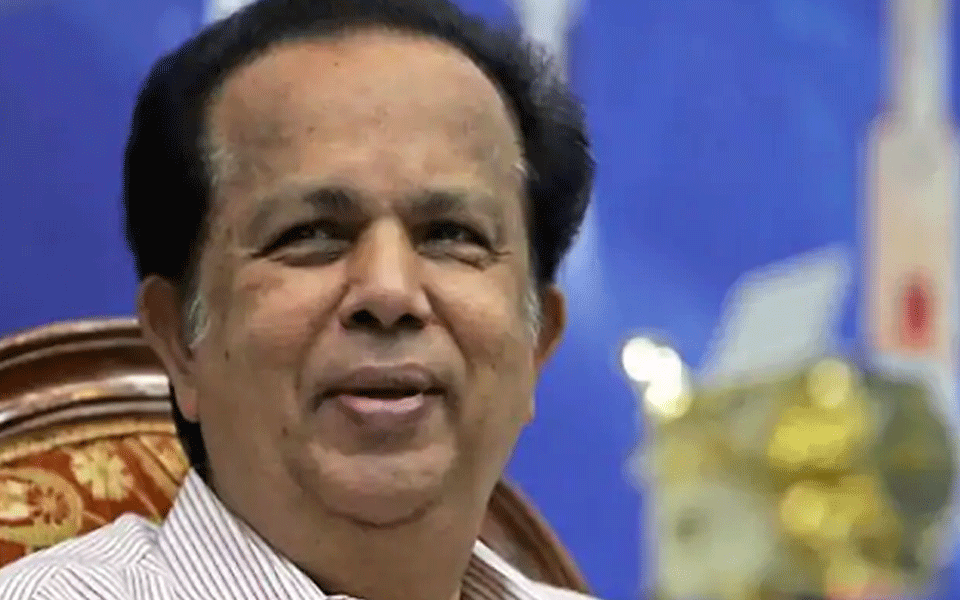
Hyderabad: Former ISRO chairman G Madhavan Nair on Wednesday claimed that the Chandrayaan-2 mission could have been carried out long ago but for the "political decision" of then UPA government to push the "Mangalyaan" venture with an eye on the 2014 Lok Sabha election.
The architect of Chandrayaan-1, India's first unmanned mission to the moon launched on October 22, 2008, served as the chairman of the Indian Space Research Organisation (ISRO) and the secretary in the Department of Space from 2003 to 2009.
He had said in August, 2009 that Chandrayaan-2 was slated for launch towards the end of 2012. In October last year, he joined the ruling Bharatiya Janata Party (BJP).
On Wednesday, Nair alleged that the UPA government wanted to show "some major event" (the Mangalyaan Mars orbiter mission) before the 2014 election. "With that objective, they (UPA government) went ahead (with the Mangalyaan mission)," he said.
Though the Mangalyaan launch took place during the UPA regime (November, 2013), the spacecraft reached the Mars orbit during the Narendra Modi government (September 2014), Nair noted.
"So, it did not serve the purpose (of the then UPA regime). More of a political thing (to take up the Mars mission, ahead of Chandrayaan-2) than technical," he said.
"Almost half the work (for Chandrayaan-2) was done earlier, but all those things were diverted for the Mars mission. So, we (ISRO) had to start from the scratch. Only after this (Modi) regime came (in 2014), they reinstated the old programme (Chandrayaan-2)," Nair told PTI.
He praised the ISRO, saying the space agency thereafter took "minimum time" to ready the mission, now due for launch next month. "It is a complex mission. Lot of things had to be developed, tested and put into operation.
"To have the lander safely touch down on the surface of the moon is the real challenging job (of the Chandrayaan-2 mission)," Nair said.
India's second mission to the moon, Chandrayaan-2, would be launched on July 15, ISRO Chairman K Sivan announced on Wednesday. The launch will take place at 2.51 am on board the GSLV MK-III vehicle from the spaceport of Sriharikota.
Let the Truth be known. If you read VB and like VB, please be a VB Supporter and Help us deliver the Truth to one and all.
Massive turnout in assembly polls across states, women voters outnumber men: EC data
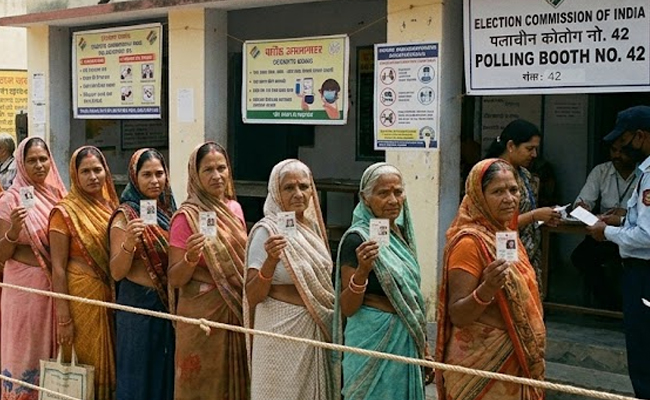
New Delhi (PTI): The recently-concluded assembly elections witnessed exceptionally high voter participation across states, with women voters outnumbering men in turnout percentages, according to Election Commission data.
West Bengal recorded the highest voter turnout among states, with 93.71 per cent polling in 293 constituencies where counting has been completed. The state saw over 6.38 crore votes cast, including postal ballots, against a total of more than 6.81 crore electors.
Women voters recorded a turnout of 93.8 per cent in the West Bengal Assembly polls, slightly higher than the 92.06 per cent participation among men.
The data for West Bengal does not include the figures for the Falta assembly constituency, which is scheduled for repolling.
Tamil Nadu registered an 85.01 per cent turnout, with nearly 4.8 crore votes polled from an electorate of 5.74 crore. Women voters recorded a turnout of 86.2 per cent, higher than the 83.77 per cent among men.
Assam also witnessed robust participation, with the final turnout touching 85.74 per cent. More than 2.15 crore votes were cast in the state, while female turnout at 86.53 per cent marginally exceeded the 84.95 per cent recorded among male voters.
Kerala registered a turnout of 78.11 per cent, with over 2.12 crore votes polled. Female voter participation stood at 81.17 per cent against 74.9 per cent among men.
Puducherry recorded a turnout of 89.82 per cent, with women voters again leading participation at 91.39 per cent. More than 8.5 lakh votes were polled in the Union territory.
Yet, women's representation among elected candidates remained modest.
Tamil Nadu elected 23 women MLAs (9.83 per cent) out of 234 members, West Bengal elected 37 women legislators (12.62 per cent) out of 293, while Kerala returned only 11 women MLAs (7.85 per cent) in the 140-member House.
Only two third-gender candidates contested the elections - one each from Tamil Nadu and Kerala, and both lost, forfeiting their deposits.
The elections also reflected extensive electoral mobilisation infrastructure. West Bengal had the highest number of polling stations at 85,092, followed by Tamil Nadu with 75,064 and Assam with 31,490.
In terms of candidates, Tamil Nadu saw the largest contest with 4,023 candidates in the fray across 234 constituencies, averaging 17 candidates per seat and peaking at 79 contestants in one constituency.
West Bengal pitted 2,920 candidates for 293 constituencies, while Kerala had the fewest contestants among the major states, with 883 candidates for 140 seats.
The data also showed relatively low NOTA votes across states. Tamil Nadu recorded the lowest NOTA share at 0.4 per cent of total votes polled, while Assam recorded the highest at 1.23 per cent. In West Bengal, 0.78 per cent of the total votes polled were NOTA, while it 0.77 per cent and 0.57 per cent of the electorate opted for None of the Above (NOTA) in Puducherry and Kerala, respectively.