Uproar over viral video of Hindutva leader saying he would have shot Ambedkar like Godse shot Gandhi
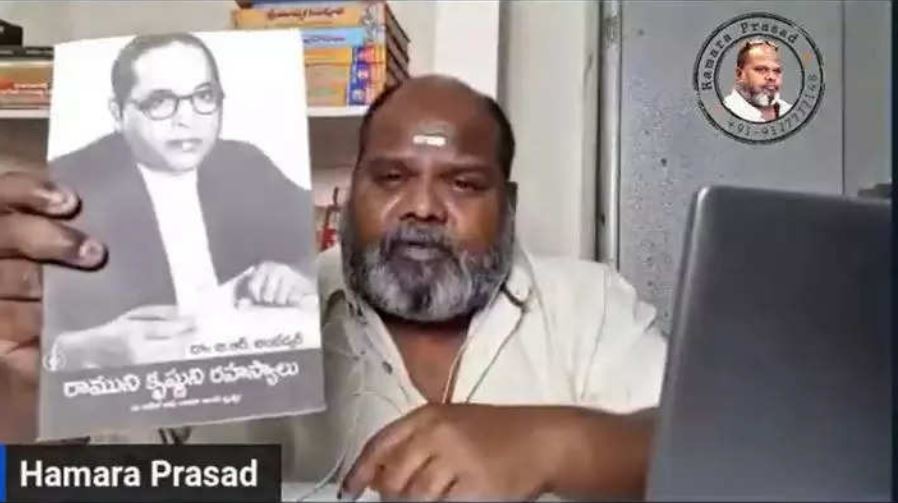
Hyderabad: A video of Hamara Prasad, the founder of Rashtriya Dalita Sena, a Hindutva organization is doing rounds across social media platforms wherein he can be seen saying he would’ve shot Dr. BR Ambedkar if he was alive when Ambedkar authored the book ‘Riddles in Hinduism: An exposition to enlighten the masses’.
In the video, Hamara Prasad while expressing displeasure over the book, says “This man (Ambedkar) apparently is an intellectual with 12 Degrees (Masters). A national leader should treat all the people of the country equally. Even if he suffers, he should not show his hatred against others.” Hamara Prasad also stated that Ambedkar has hurt the sentiments of crores of Hindus by writing such “garbage”. “Had I been born when Ambedkar was alive, and if I had come across this book, like how Godse shot Gandhi I would have shot Ambedkar.”
RS Praveen Kumar, the Telangana Chief of the Bahujan Samaj Party, in a tweet sought action against Prasad and asked the government to file a case against Prasad under sections 153 A (Promoting enmity between different groups on grounds of religion, race, place of birth, residence, language, etc., and doing acts prejudicial to maintenance of harmony) and the Preventive Detention Act and imprison him.
Dalit activist, Karthik Narayan, has also filed an online complaint with the Hyderabad cyber crime police for “creating and forwarding videos abusing Dr. BR Ambedkar and hurting the sentiments of the Scheduled Caste citizens.”
But, according to a report published in The News Minute, the Hyderabad Cybercrime Police has said that they are yet to receive any complaint against Prasad. The report also added that some Dalit activists have urged the Telangana police to register a case suo-motu and immediately arrest Hamara Prasad.
The book Riddles in Hinduism critically examines the Hindu religion. Describing the purpose of the book, Ambedkar writes in its introduction, “This book is an exposition of the beliefs propounded by what might be called Brahmanic theology. It is intended for the common mass of Hindus who need to be awakened to know in what quagmire the Brahmins have placed them and to lead them onto the road of rational thinking. The Brahmins have propagated the view that the Hindu civilization is Sanatan, that is, unchanging.”
“This view has been reinforced by many of European Scholars who have said that the Hindu civilization is static. In this book, I have attempted to show that this view is not in accord with facts and that Hindu Society has changed from time to time, and that oftentimes the change is of the most radical kind. In this connection, compare the Riddles from Himsa to Ahimsa and from Ahimsa back to Himsa. I want to make the mass of people realize that the Hindu religion is not Sanatan.”
Ambedkar in the book states that the “second purpose of this book is to draw the attention of the Hindu masses to the devices of the Brahmins and to make them think for themselves how they have been deceived and misguided by the Brahmins.”
ఒక వైపు ఓట్ల కోసం రోజూ అంబేద్కర్ జపం చేస్తున్న @BRSparty ఈ హమారాప్రసాద్ లాంటి మూర్ఖులు ‘బాబాసాహెబ్ బతికుంటే కాల్చి చంపేవాడిని’ అని కోట్లాది మంది మనోభావాలు దెబ్బతీసినా మీరు ఎందుకు వీడిని IPC153A,PD Act కింద జైలులో పెట్టడం లేదు?రాష్ట్రం అగ్నిగుండం అయ్యే దాకా ఆగుతరా? pic.twitter.com/DfRZpEHi7O
— Dr.RS Praveen Kumar (@RSPraveenSwaero) February 9, 2023
Let the Truth be known. If you read VB and like VB, please be a VB Supporter and Help us deliver the Truth to one and all.
Bihar: Over 150 children fall ill after consuming 'mid-day meal' in Saharsa

Saharsa (PTI): More than 150 children were taken ill after allegedly consuming food that was part of the mid-day meal in a school in Bihar’s Saharsa district, a senior official said on Thursday.
The incident occurred at a middle school in Baluaha village of the district.
The official said that 115 children were undergoing treatment at the Sadar Hospital, while around 50 students were admitted to Mahishi Public Health Centre.
“We received information that several children fell ill after consuming the mid-day meal in Baluaha. The children were initially treated at the primary health centre, but later, many were referred to the Sadar Hospital,” Saharsa District Magistrate Deepesh Kumar told reporters.
“According to doctors, the health condition of the children has improved, but they will be kept under observation for some time. There is no need to panic. Some kids are having mild fever. They are being treated accordingly,” Kumar said.
Meanwhile, family members of some children claimed that a snake was found in the container in which cooked pulses was stored at the school.
Of the 545 students present in the school, 200 had already eaten their meals by the time the snake was spotted, and later complained of stomach ache and vomiting, they said.
Regarding the claims, the DM said food samples have been collected from the school.
“We will be able to comment on this only after the results of the tested samples arrive,” he said.