Urdu council NCPUL faces backlash for promoting Savarkar through Urdu translation
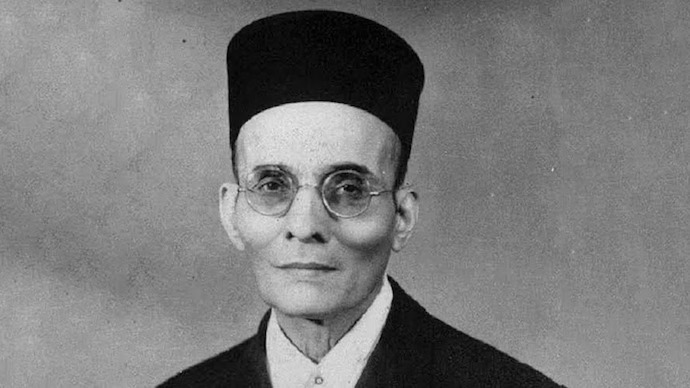
New Delhi: The Narendra Modi government has come under criticism for allegedly using state-backed cultural institutions to promote Hindutva ideologues, following the publication of an Urdu translation of a book glorifying Vinayak Damodar Savarkar by the National Council for the Promotion of Urdu Language (NCPUL), an autonomous body under the Ministry of Education.
The translated book, titled “Veer Savarkar aur Takseem Hind ka Alamiya,” is the Urdu version of “Veer Savarkar: The Man Who Could Have Prevented Partition” by Uday Mahurkar and Chirayu Pandit, originally published in 2021. The Urdu edition was launched at an event held at the Prime Minister’s Museum on Thursday.
At the launch, Law Minister Arjun Ram Meghwal described Savarkar as a “visionary deeply sensitive to national unity and integrity,” and claimed that “had Savarkar’s ideas been implemented, the country could have been saved from disintegration,” The Observer Post reported.
The translation was done by Prof. Mazhar Asif, Vice-Chancellor of Jamia Millia Islamia. The authors stated that their work sought to present “truthful and unbiased information” and to counter “misconceptions spread by a particular political ideology,” as quoted by The Observer Post.
However, historians and academics have sharply criticised the move. Prof. Nadeem Rezavi, secretary of the Indian History Congress and a history faculty member at Aligarh Muslim University, called the development “shocking,” accusing the government of attempting to rewrite history, The Observer Post reported.
“Savarkar was among the earliest proponents of the two-nation theory, even before the Muslim League adopted it in 1940,” Rezavi said. “In his 1937 address to the Hindu Mahasabha, Savarkar declared that India was home to two nations — Hindus and Muslims — a statement that deepened communal divisions and contributed to the atmosphere leading to Partition,” according to The Observer Post.
Rezavi also pointed out that under Savarkar’s leadership, the Hindu Mahasabha formed coalition governments with the Muslim League in Sindh and Bengal during the Quit India Movement. “He even supported Travancore’s bid for independence in 1947 as a counter to a secular Indian state,” he added, as reported by The Observer Post.
A former NCPUL official also criticised the council’s decision, saying it marked a “departure from its original mandate.” “The NCPUL was established to promote Urdu language and literature, not to propagate the legacy of divisive political figures,” the official said, The Observer Post noted.
Let the Truth be known. If you read VB and like VB, please be a VB Supporter and Help us deliver the Truth to one and all.
Mudigere: 22-yr-old youngster hangs herself to death after father scolds her for not making curry
Mudigere: A 22-year-old young woman, Soujanya Poojary, who was upset over an apparently trivial issue, has allegedly committed suicide by hanging herself at home in Devavrinda village of the taluk on Saturday evening.
On Saturday morning, Soujanya’s father Natesh Poojary handed her vegetables, instructed her to prepare curry using them and went out. When he returned home in the afternoon, however, he found that his daughter had not prepared the curry and scolded her. He also told her to get curry from a neighbour’s house and again went out.
Soujanya, after being treated harshly by her father, reportedly closed the door of the house and hanged herself to death inside.
Gonibeedu Police officers, who were informed of her death, have registered a case and are investigating.
(Assistance for overcoming suicidal thoughts is available on the state’s health helpline 104, Tele-MANAS 14416.)