US President Donald Trump announces 27 percent reciprocal tariff on India
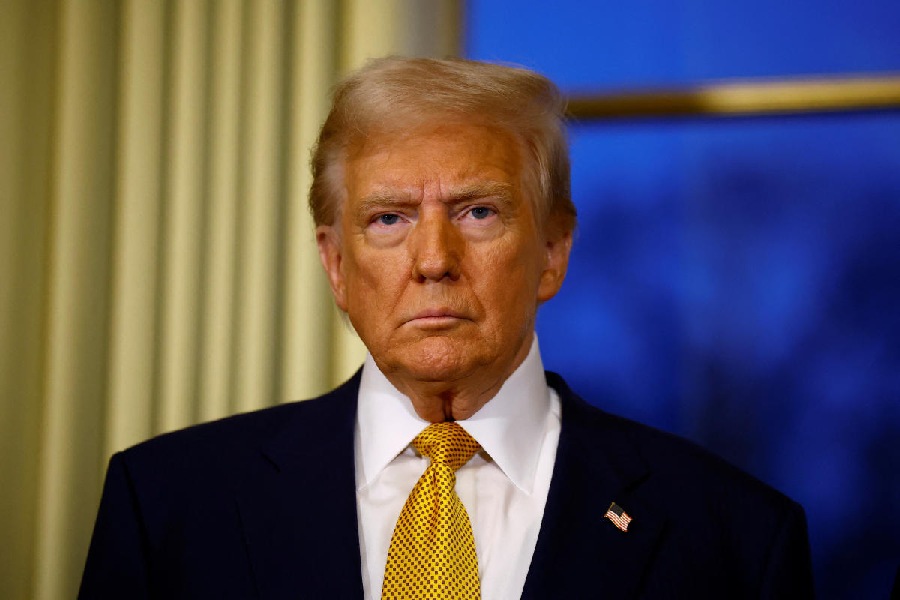
Washington/New Delhi (PTI): The US has announced 27 percent reciprocal tariffs on India saying New Delhi imposes high import duties on American goods, as the Donald Trump administration aims to reduce the country's trade deficit and boost manufacturing.
The move is expected to impact India's exports to the US. However, experts say that India is better-placed than its competitors who also face increased levies.
President Trump, in a historic measure to counter higher duties on American products imposed globally, announced reciprocal tariffs on about 60 countries.
"This is Liberation Day, a long-awaited moment. April 2, 2025 will forever be remembered as the day American industry was reborn, the day America's destiny was reclaimed, and the day that we began to make America wealthy again. We are going to make it wealthy, good, and wealthy," Trump said in his remarks from the Rose Garden at the White House on Wednesday.
He said that the United States charges other countries only a 2.4 percent tariff on motorcycles, but Thailand and others are charging much higher rates, like 60 percent, India 70 percent, Vietnam 75 percent, and others charge even higher rates.
As he announced the tariffs, he held up a chart that showed the tariffs that countries such as India, China, the UK, and the European Union charge, along with the reciprocal tariffs that these countries will now have to pay.
The chart indicated that India charged 52 percent tariffs, including currency manipulation and trade barriers, and America would now charge India a discounted reciprocal tariff of 26 percent. But according to the White House documents, there will be a 27 percent duty on India.
"India, very, very tough. Very, very tough. The prime minister just left. He's a great friend of mine, but I said, you're a friend of mine, but you're not treating us right. They charge us 52 percent. You have to understand, we charge them almost nothing for years and years and decades, and it was only seven years ago, when I came in, that we started with China," Trump said.
Describing the tariffs as a "mixed bag and not a set back", an official in India said the commerce ministry is analysing the impact of 27 percent reciprocal tariffs imposed by the US on India.
According to the official, the universal 10 percent tariffs will come into effect on all imports into the US from April 5 and from April 10, 27 per cent duty will come into play.
"The ministry is analysing the impact of the announced tariffs," the official said, adding there is a provision that if a country would address the concerns of the US, the Trump administration can consider reducing the duties against that nation.
India is already negotiating a bilateral trade agreement with the US. The two countries are aiming to finalise the first phase of the pact by fall (September-October) of this year.
"It is a mixed bag and not a setback for India," the official said.
Exporters' body FIEO stated that the duties on India will undoubtedly affect domestic players but early conclusion of the trade agreement would provide relief from these tariffs.
"We have to assess the impact, but looking at the reciprocal tariffs imposed on other countries, we are in a lower band. We are much better placed compared to our key competitors such as Vietnam, China, Indonesia, Myanmar, etc. We will definitely be affected by the tariffs, but we are much better placed than many others," Federation of Indian Export Organisations (FIEO) Director General Ajay Sahai told PTI.
From 2021-22 to 2023-24, the US was India's largest trading partner. The US accounts for about 18 per cent of India's total goods exports, 6.22 per cent in imports, and 10.73 per cent in bilateral trade.
With America, India had a trade surplus (the difference between imports and exports) of USD 35.32 billion in goods in 2023-24. This was USD 27.7 billion in 2022-23, USD 32.85 billion in 2021-22, USD 22.73 billion in 2020-21, and USD 17.26 billion in 2019-20.
In 2024, India's main exports to the US included drug formulations and biologicals (USD 8.1 billion), telecom instruments (USD 6.5 billion), precious and semi-precious stones (USD 5.3 billion), petroleum products (USD 4.1 billion), gold and other precious metal jewellery (USD 3.2 billion), ready-made garments of cotton, including accessories (USD 2.8 billion), and products of iron and steel (USD 2.7 billion).
Imports included crude oil (USD 4.5 billion), petroleum products (USD 3.6 billion), coal, coke (USD 3.4 billion), cut and polished diamonds (USD 2.6 billion), electric machinery (USD 1.4 billion), aircraft, spacecraft and parts (USD 1.3 billion), and gold (USD 1.3 billion).
Let the Truth be known. If you read VB and like VB, please be a VB Supporter and Help us deliver the Truth to one and all.
BCI urges CJI to take action against Andhra HC judge for sending young lawyer to 24-hour custody
New Delhi (PTI): The Bar Council of India on Wednesday sought the urgent intervention of Chief Justice of India Surya Kant following a "deeply disturbing" incident where a judge of the Andhra Pradesh High Court reportedly sent a young advocate to
24-hour judicial custody over a procedural lapse.
The Bar Council of India (BCI) Chairperson and senior advocate Manan Kumar Mishra, in a formal representation, termed the conduct of Justice Tarlada Rajasekhar Rao "grossly inappropriate" and "damaging to the confidence of the Bar".
“I most respectfully request your Lordship to kindly take immediate institutional cognizance of the matter and call for the video recording of the proceedings, the order passed, and the surrounding circumstances.
“I further request that appropriate administrative action may kindly be considered, including withdrawal of judicial work from the learned Judge pending review, his immediate transfer to some far off High Court, and his nomination for appropriate judicial training/orientation on court management, judicial temperament, Bar-Bench relations, and proportional exercise of contempt/judicial authority,” Mishra wrote.
This representation is made to preserve the “dignity, moral authority and public confidence of the judiciary”, he said, adding, “Judges command the highest respect not by fear, but by fairness, patience, restraint and constitutional humility”.
The communication urged the CJI to intervene at the earliest to ensure that the faith of Bar, particularly young advocates, in the protective and corrective role of the judiciary is restored.
The controversy stems from proceedings on May 5.
According to the BCI, a video circulating online shows Justice Rao rebuking a young advocate who was unable to produce a specific order copy during a hearing.
The letter said that despite the advocate "repeatedly seeking pardon and mercy" and claiming he was in physical pain, the judge remained "unmoved".
The judge allegedly told the lawyer, "now you will learn," and mocked his experience before directing the Registrar and police personnel to take him into custody for 24 hours.
The BCI chairperson said that the judge’s actions lacked proportionality and fairness.
"The dignity of the court is not enhanced when a lawyer is made to beg for grace in open court and is still sent to custody for a procedural lapse," the letter said.
"A young lawyer... is an officer of the Court, still learning, still growing, and entitled to correction without humiliation," it added.
The bar body said that such actions create a "chilling effect" on the legal fraternity, particularly among junior members, and undermine the mutual respect required between the Bench and the Bar.