US tariff hike may impact Indian Pharma industry

New Delhi: The US government's proposed 25% tariff on imports of automobiles, semiconductors, and pharmaceuticals could have significant repercussions for India's pharmaceutical industry, which heavily depends on exports to the American market.
While India's semiconductor sector is still developing and is expected to see minimal impact, the new tariffs could pose challenges for drug manufacturers. The US is the largest market for Indian pharmaceutical exports, accounting for $8.73 billion in FY24, or 31% of the industry’s total exports, according to the Pharmaceuticals Export Promotion Council of India (Pharmexcil).
Leading Indian pharma companies such as Sun Pharma, Dr. Reddy’s, and Cipla derive a substantial portion of their revenue from the US market. In fiscal 2024, North America contributed 47% of Dr. Reddy’s total sales, 32% of Sun Pharma’s revenue, and 30% of Cipla’s earnings.
Pharmexcil’s director-general Raja Bhanu highlighted that Indian firms play a crucial role in the US pharmaceutical supply chain, supplying four out of every ten prescriptions filled in the country. However, Pharmexcil chairman Namit Joshi downplayed concerns, stating that the competitiveness of Indian generic drug exports would help mitigate the impact of any tariff hikes.
Currently, Indian pharmaceutical imports into the US are not subject to import duties. The proposed tariffs, if implemented, could alter the cost dynamics of the industry and affect profit margins for Indian drugmakers.
Let the Truth be known. If you read VB and like VB, please be a VB Supporter and Help us deliver the Truth to one and all.
Ruckus outside counting centre in Mamata's constituency, TMC claims entry of car with BJP flag
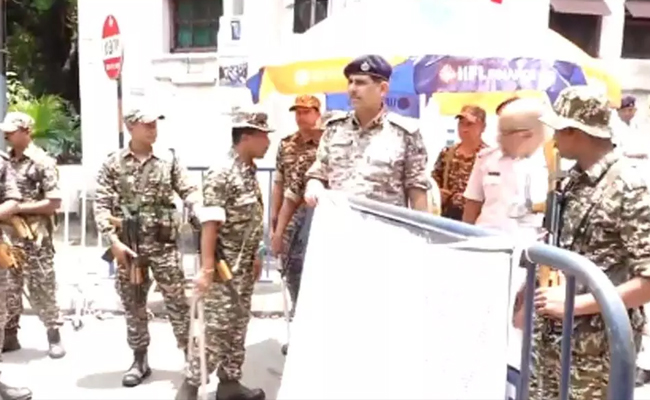
Kolkata (PTI): The counting centre at West Bengal Chief Minister Mamata Banerjee's Bhabanipur assembly constituency witnessed a ruckus a day ahead of the counting of votes, with TMC workers alleging two cars bearing the BJP's flag were allowed entry to the compound where EVMs are kept.
The incident comes close on the heels of a four-hour-long sit-in by Banerjee in front of the same counting centre at the Sakhawat Memorial Girls School on Thursday night, alleging unauthorised entry of persons into the strongroom.
With the polling now over, the wrangling for power in West Bengal has turned into a battle of nerves between the incumbent TMC and the BJP. Workers and leaders of both parties have been keeping a steely gaze on the security of strongrooms across the state where the electoral fate of the candidates is sealed.
Despite expressing her confidence in a "landslide victory", Banerjee has repeatedly aired her apprehensions of "counting malpractice and EVM tampering ahead of the day of results".
On Sunday morning, TMC workers camping 100 metres from the counting centre alleged that two cars with BJP flags entered the premises and went near the strongroom.
"The CAPF personnel at the spot are not allowing any vehicle or person to enter the premises of the counting centre without valid identity proof. Then how come this car, which we have not seen in the past few days, was allowed entry? Once we protested, the central forces asked us to move 100 metres away," a TMC activist said.
The TMC claimed that while the police personnel posted there promised the vehicle would be removed from the spot, it remained there for some time.
A senior Election Commission official said the car was passing by the Harish Mukherjee Road, and after checking by security forces and police, it was allowed to leave as nothing objectionable was found in it.
On Thursday night, two counting centres, including one at Sakhawat Memorial Girls School in the city, witnessed high drama after TMC leaders alleged a lack of transparency and possible malpractice at the strongrooms housing sealed EVMs of the assembly polls, which concluded on April 29.
TMC leaders and candidates, Sashi Panja and Kunal Ghosh, held a sit-in outside the Khudiram Anushilan Kendra counting centre on Thursday evening, alleging unauthorised activities inside the strongroom amid the absence of TMC agents
In Howrah, TMC protested renovation work by the public works department at a place adjacent to the strongroom, and the EC stopped the work temporarily.
On Saturday, the ruling party filed a complaint with the poll panel, alleging unauthorised sorting of postal ballot covers at the EVM strongroom in Khudiram Anushilan Kendra.
Similar scenes were witnessed on Saturday outside the strongrooms at Asansol College in Paschim Bardhaman and the Barasat Government College in North 24 Parganas districts, where TMC workers held protests, alleging that CCTV cameras were switched off for several minutes.
The EC turned down all allegations, saying the surveillance cameras were working in an uninterrupted manner.
BJP spokesperson Sajal Ghosh told reporters that the people of Bengal were finding it "hilarious" that the TMC, "which used to win elections through unfair means and strongarm tactics" were now coming up with all sorts of "frivolous charges".
"Are they scared of losing?" he posed.