Use of loudspeakers not essential part of any religion, says Bombay HC
orders action against violation
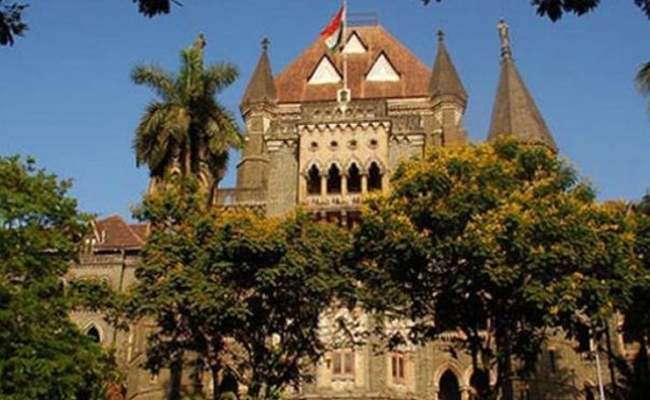
Mumbai (PTI): Use of loudspeakers is not an essential part of any religion, the Bombay High Court said on Thursday, directing the law enforcement agencies to take prompt action against loudspeakers that violate the noise pollution norms and rules.
A division bench of Justices A S Gadkari and S C Chandak said noise was a major health hazard and no one can claim that their rights are affected in any manner if he or she is denied permission to use loudspeakers.
The HC asked the state government to direct religious institutions to adopt mechanisms for controlling noise levels, including calibrated sound systems with auto-decibel limits.
The court passed its judgment on a petition filed by two housing associations from suburban Kurla - Jaago Nehru Nagar Residents Welfare Association and Shivsrushti Co-operative Housing Societies Association Ltd - alleging police inaction against noise pollution caused by loudspeakers installed on masjids in the area.
The petitioners contended that the use of loudspeakers for religious purposes, including the recitation of 'azaan' (Islamic call to prayer) disturbed the peace and violated the Noise Pollution (Regulation and Control) Rules, 2000, as well as provisions under the Environment (Protection) Act, 1986.
The bench in its order said Mumbai was a cosmopolitan city and obviously there are persons of different religions in every part of the city.
"It is in public interest that such permissions should not be granted. By denying such permissions, rights under Article 19 or 25 of the Constitution of India are not at all infringed. Use of loudspeakers is not an essential part of any religion," the HC said.
The court said it was the "bounden duty" of the state government and other authorities to enforce the law by adopting all the necessary measures, as may be prescribed by the provisions of law.
"In a democratic State, there cannot be a situation that, a person/group of persons/association of persons would say that, it will not follow or adhere to the law of the land and the law enforcers would be meek or silent spectators to it," the judgment said.
It added that common citizens are "hapless and helpless victims of these obnoxious use of loudspeakers and/or amplifiers".
The court said the police must act on complaints against loudspeakers violating the noise pollution rules without requiring identification of the complainant to avoid such complainants being targets or ill will and developing hatred.
"We direct the State to consider to direct all the concerned to have in-built mechanism to control decibel level in their loudspeakers/voice amplifiers/public address system or other sound emitting gadgets used by any religious place/structure/institution, irrespective of religion," the bench ordered.
The State may also seriously consider to issue directions for calibration and/or auto-fixation of decibel limit of loudspeakers/voice amplifiers/public address system or other sound emitting gadgets used by any or all the religions in their respective places of prayers or worship, the HC said.
The court also directed the Commissioner of Police, Mumbai, to issue instructions to all police stations to take prompt action in case of any complaint against loudspeakers at religious places.
"We take a judicial note of the fact that, generally people/citizens do not complain about the things until it becomes intolerable and a nuisance," the bench said.
Reminding the authorities that ambient noise levels must not exceed 55 decibels during the day and 45 decibels at night in residential areas, the court added that cumulative noise from all sources must adhere to these limits.
"The law does not permit that, every individual loudspeaker will emit 55 or 45 decibels of noise aggregating to more than what is prescribed under the said Rules. That would amount to frustrating the intention of the Legislature," the court said.
The court said the police may also withdraw permissions granted to the said trusts/institutions for the use of loudspeakers, if repeated violation of the provisions of the said Noise Pollution Rules are brought to their notice.
Let the Truth be known. If you read VB and like VB, please be a VB Supporter and Help us deliver the Truth to one and all.
Karnataka: GBA city corporation polls likely between June 14 and 24
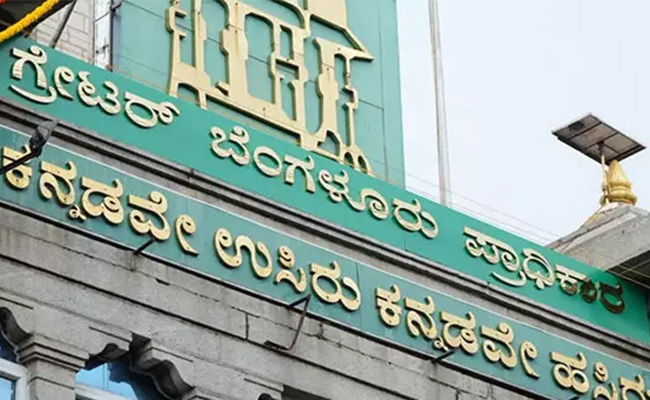
Bengaluru (PTI): Karnataka State Election Commissioner G S Sangreshi on Friday said elections to the five city corporations under the GBA will be held anytime between June 14 and June 24.
He said the exact date for the polls will be announced after a week, asserting that the power to postpone the elections, as requested by GBA authorities, lies with the Supreme Court.
The Supreme Court had directed the Karnataka government and the State Election Commission to conduct Bengaluru local body elections by June 30.
On Friday, the SEC held a consultation meeting with the GBA Chief Commissioner and commissioners of the five city corporations regarding the election schedule, as per the provisions of the GBA Act.
“During the meeting, I informed GBA officials that only the election date has to be fixed, as all other measures and formalities for conducting the polls have already been completed,” Sangreshi said.
“They requested the Commission to consider factors such as rains, exams, census work, SIR, and manpower shortages while fixing the date and sought additional time,” he added.
Speaking to reporters after the meeting, he said, “I told them this meeting was not for seeking time. Elections to the five corporations under the GBA must be held before June 30, as directed by the Supreme Court, and a compliance report must be submitted to the court. I do not have the power to postpone the elections as requested.”
The Supreme Court has already given a “final opportunity,” and both the SEC and the government must comply with its directions, the State Election Commissioner said.
He asked GBA officials to suggest suitable dates between June 14 and June 24.
“While stating that they are ready for elections, the officials highlighted operational challenges, including manpower shortages. However, I have informed them that the elections will have to be held between June 14 and June 24. After a week, I will announce the final date,” he said.
Reiterating that he does not have the power to postpone the elections, Sangreshi said the authority rests with the Supreme Court, and elections must be conducted as scheduled.
“We have consulted the GBA as per the rules. It is up to them to suggest a date within the given window. If they need more time, they must approach the court. Our responsibility is to fix the date and complete the polls before June 30,” he said.
The matter regarding manpower and other concerns raised by GBA officials is already before the Supreme Court, and the State Election Commission has also filed a petition in this regard. The case is yet to be heard.
“Since the matter has not come up for hearing, the earlier order remains binding. Therefore, preparations are underway,” he added.
The tenure of the previous elected body under the erstwhile Bruhat Bengaluru Mahanagara Palike (BBMP) ended on September 10, 2020, and since then, a government-appointed administrator has been managing its day-to-day affairs.
Bengaluru was divided into five municipal corporations—Central, East, West, North, and South—under the Greater Bengaluru Authority in September 2025, replacing the BBMP.
Sangreshi had earlier said that elections to the five corporations would be conducted using ballot papers instead of Electronic Voting Machines.
This follows the Congress government’s decision last September to recommend the use of ballot papers in all future panchayat and urban local body elections, citing concerns over declining public confidence in EVMs.
The state government subsequently enacted the Karnataka Gram Swaraj and Panchayat Raj (Amendment) Act, 2026, paving the way for the use of ballot papers in local body elections.