Uttarakhand flood: 2019 study warned Himalayan glaciers melting at alarming speed
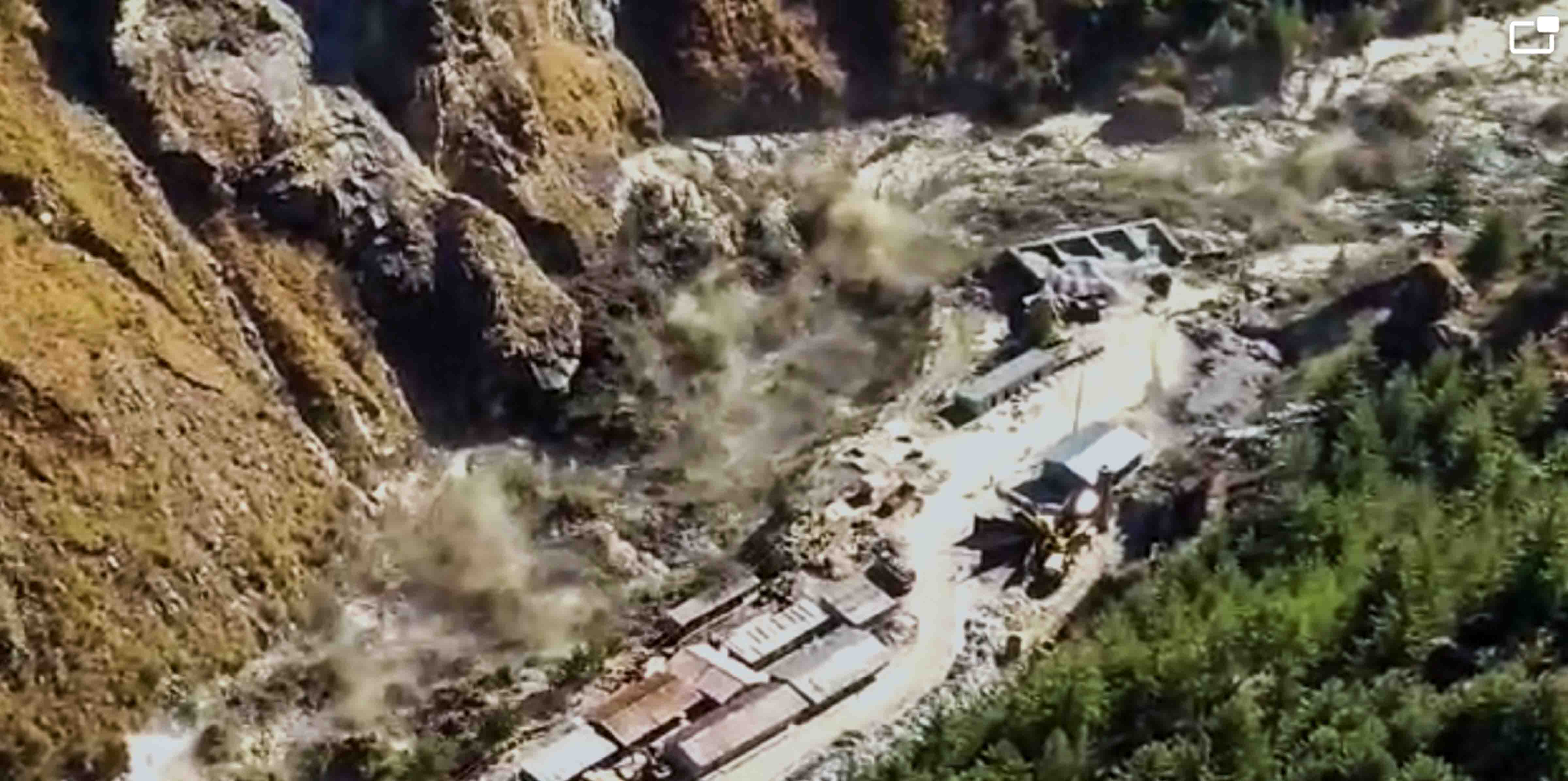
New Delhi, Feb 7: A part of the Nanda Devi glacier broke off in Uttarakhand's Chamoli district on Sunday, leading to massive floods, recalling a 2019 study that warned about the dangers of climate change and said Himalayan glaciers have been melting twice as fast since the start of this century.
The glacier collapse at Joshimath led to a massive flood in the Alaknanda river system and caused large-scale devastation in the upper reaches of the ecologically fragile Himalayas.
Two years earlier in June 2019, a study spanning 40 years of satellite observations across India, China, Nepal and Bhutan, indicated that climate change is eating the Himalayas' glaciers.
The study, published in the journal Science Advances in June 2019, shows that glaciers have been losing the equivalent of more than a vertical foot and half of ice each year since 2000 -- double the amount of melting that took place from 1975 to 2000.
"This is the clearest picture yet of how fast Himalayan glaciers are melting over this time interval, and why," said Joshua Maurer, a PhD candidate at Columbia University in the US.
While not specifically calculated in the study, the glaciers may have lost as much as a quarter of their enormous mass over the last four decades, said Maurer, lead author of the study.
The study synthesised data from across the region, stretching from early satellite observations to the present.
The data indicates that the melting is consistent in time and space, and that rising temperatures are to blame, the researchers said.
Temperatures vary from place to place, but from 2000 to 2016 they have averaged one degree Celsius higher than those from 1975 to 2000, they said.
Researchers analysed repeat satellite images of some 650 glaciers spanning 2,000 kilometres from west to east.
Many of the 20th-century observations came from declassified photographic images taken by the US spy satellites.
They created an automated system to turn these into three dimensional (3D) models that could show the changing elevations of glaciers over time.
The researchers then compared these images with post-2000 optical data from more sophisticated satellites, which more directly convey elevation changes.
They found that from 1975 to 2000, glaciers across the region lost an average of about 0.25 metres of ice each year in the face of slight warming.
Following a more pronounced warming trend starting in the 1990s, starting in 2000 the loss accelerated to about half a metre annually.
Researchers noted that Asian nations are burning ever-greater loads of fossil fuels and biomass, sending soot into the sky, adding much of it eventually lands on snowy glacier surfaces, where it absorbs solar energy and hastens melting.
They compiled temperature data during the study period from ground stations and then calculated the amount of melting that observed temperature increases would be expected to produce.
The team then compared those figures with what actually happened.
"It looks just like what we would expect if warming were the dominant driver of ice loss," Maurer said.
The Himalayas are generally not melting as fast as the Alps, but the general progression is similar, the researchers said.
The study did not include the huge adjoining ranges of high-mountain Asia such as the Pamir, Hindu Kush or Tian Shan, but other studies suggest similar melting is underway there as well.
The researchers noted that some 800 million people depend in part on seasonal runoff from Himalayan glaciers for irrigation, hydropower and drinking water.
The accelerated melting appears so far to be swelling runoff during warm seasons, but scientists project that this will taper off within decades as the glaciers lose mass.
This, the researchers said, will eventually lead to water shortages.
The study shows that "even glaciers in the highest mountains of the world are responding to global air temperature increases driven by the combustion of fossil fuels," said Joseph Shea, a glacial geographer at the University of Northern British Columbia in Canada, who was not involved in the study.
"In the long term, this will lead to changes in the timing and magnitude of streamflow in a heavily populated region," said Shea.
Let the Truth be known. If you read VB and like VB, please be a VB Supporter and Help us deliver the Truth to one and all.
Maharashtra sets up state vaccination task force to strengthen immunisation programme

Mumbai (PTI): The Maharashtra government has set up a State Vaccination Task Force to strengthen the regular immunisation programme and review the progress of related campaigns, a health department official said on Monday.
The State Vaccination Task Force will comprise at least 29 members and will be headed by the administrative head of the health department, he informed.
The government has also constituted separate district-level and municipal vaccination task forces to improve implementation and address challenges at the grassroots level, he said.
Municipal task forces, chaired by respective civic commissioners, have been constituted in view of the vast urban population in Maharashtra and the role of civic bodies in implementing different health programmes.
The district-level task forces will function under the chairmanship of collectors.
"Complete immunisation of children at the appropriate age is an extremely simple, cost-effective and highly effective measure to reduce child mortality and the prevalence of diseases among kids. Immunisation is a powerful tool for reducing illness in children," maintained the official.
To ensure full vaccination of all children, the state government implements various campaigns from time to time as per the central government guidelines, he pointed out.
"Active participation and cooperation of other relevant government departments are essential (in making these campaigns successful)," according to the official.
The state-level body will review the regular immunisation programme, associated campaigns and vaccine-preventable diseases in detail. It will also conduct focused assessments of high-risk districts and municipal corporations, including vacancies at district, municipal and sub-district levels, availability of cold chain equipment, resource gaps and training requirements, he noted.
The state task force will review allocation and utilisation of funds for immunisation and ensure timely action by officers concerned based on reports from district and municipal task forces and state-level monitoring mechanisms, the official said.
It will also ensure active coordination and participation of other government departments in immunisation drives, while district and municipal task forces will carry out similar functions at their respective levels, the official added.