Uttarakhand flood: Lake formed due to blocking of stream joining Rishi Ganga, says report
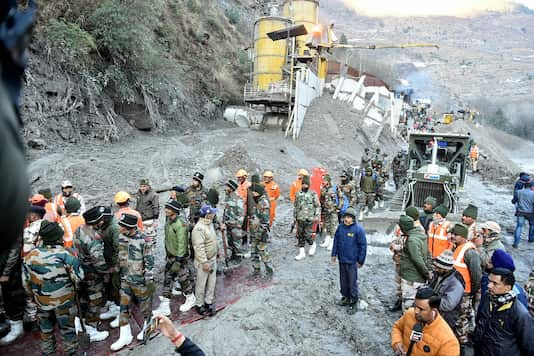
Dehradun/New Delhi, Feb 12: The debris brought by the avalanche in Uttarakhand earlier this week has blocked a stream that joins the Rishi Ganga river forming a temporary lake which if breached can cause further damage in the valley, said a report by the Wadia Institute of Himalayan Geology.
According to its director Kalachand Sain, a team of scientists from the institute conducted an aerial survey of the upper reaches of the Rishi Ganga just a day after the Sunday avalanche and spotted the new glacial lake there.
The team took some photographs of the lake taken from a helicopter. It seems that the recent avalanche has led to its formation in the higher stretches of the Rishi Ganga's catchment area, he said.
"Our scientists are examining the size of the lake, its periphery and the volume of water it contains to ascertain how big and immediate the danger from it is," Sain told PTI.
According to the report by the Wadia Institute of Himalayan Geology (WIHG), an organisation of the Department of Science and Technology, the assessment of the actual magnitude of risk involved due to this impoundment of water requires a detailed survey.
"The catastrophic floods on Sunday also brought sediments in the Rishi Ganga river. Since the width of the river is very less in the upper stretches, the sediments have blocked a stream forming a lake which may breach and cause further damage in the valley," Sain said.
A portion of the Nanda Devi glacier broke off in Uttarakhand's Chamoli district on Sunday, triggering an avalanche and a deluge in the Alaknanda river system that washed away hydroelectric stations and endangered lives of people living along the banks.
According to WIHG, a mass of rock weakened over a period of time due to freezing and thawing of snow must have led to the creation of a "weak zone" triggering its collapse which brought down sediments. The avalanche was also accompanied by a thick pack of snow and ice that overlaid the rock surface, it stated.
This resulted in the formation of a temporary dam that eventually breached, causing the deadly floods in Chamoli district on Sunday.
The incident occurred adjacent to the Raunthi glacier. The area also has glaciers that feed the Rishi Ganga river, which ultimately joins the Dhauli Ganga.
The steep slopes of the mountains in the region further increased the intensity of the crash. The stretch of the avalanche was about three kilometres with an average slope of 37 degrees, before reaching the "Raunthi Nala/Gadhera" floor at an altitude of about 3,600 metres.
Meanwhile, Chamoli District Magistrate Swati S Bhadauria said an eight-member team of the scientists of the Geological Survey of India has been formed to inspect the lake and submit its report to the district administration at the earliest.
Let the Truth be known. If you read VB and like VB, please be a VB Supporter and Help us deliver the Truth to one and all.
Maharashtra sets up state vaccination task force to strengthen immunisation programme

Mumbai (PTI): The Maharashtra government has set up a State Vaccination Task Force to strengthen the regular immunisation programme and review the progress of related campaigns, a health department official said on Monday.
The State Vaccination Task Force will comprise at least 29 members and will be headed by the administrative head of the health department, he informed.
The government has also constituted separate district-level and municipal vaccination task forces to improve implementation and address challenges at the grassroots level, he said.
Municipal task forces, chaired by respective civic commissioners, have been constituted in view of the vast urban population in Maharashtra and the role of civic bodies in implementing different health programmes.
The district-level task forces will function under the chairmanship of collectors.
"Complete immunisation of children at the appropriate age is an extremely simple, cost-effective and highly effective measure to reduce child mortality and the prevalence of diseases among kids. Immunisation is a powerful tool for reducing illness in children," maintained the official.
To ensure full vaccination of all children, the state government implements various campaigns from time to time as per the central government guidelines, he pointed out.
"Active participation and cooperation of other relevant government departments are essential (in making these campaigns successful)," according to the official.
The state-level body will review the regular immunisation programme, associated campaigns and vaccine-preventable diseases in detail. It will also conduct focused assessments of high-risk districts and municipal corporations, including vacancies at district, municipal and sub-district levels, availability of cold chain equipment, resource gaps and training requirements, he noted.
The state task force will review allocation and utilisation of funds for immunisation and ensure timely action by officers concerned based on reports from district and municipal task forces and state-level monitoring mechanisms, the official said.
It will also ensure active coordination and participation of other government departments in immunisation drives, while district and municipal task forces will carry out similar functions at their respective levels, the official added.