Uttarkashi tunnel collapse: Rescuers to drill through rubble to create escape passage for trapped
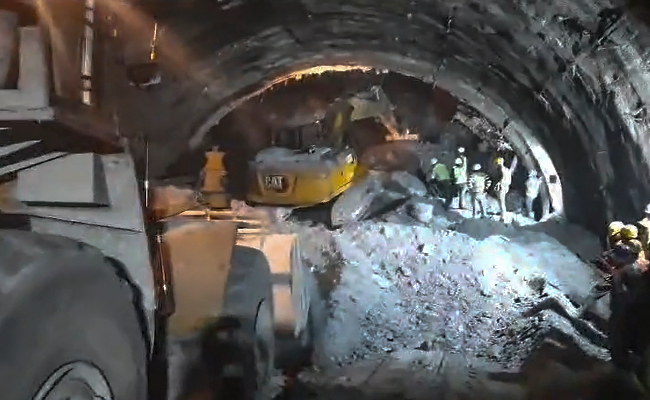
Uttarkashi (U'khand) (PTI): Rescuers at the under-construction tunnel collapse site here Tuesday initiated the process of inserting large-diameter mild steel pipes through the rubble using an auger machine to rescue the 40 workers trapped for two days now, officials said.
The pipes will be pushed in using the horizontal drilling equipment to create an escape passage for the workers, who are safe and are being provided with oxygen, water and light food items such as dry fruits, they said.
Disaster Management Secretary Ranjit Kumar Sinha said authorities have set a target of rescuing the trapped labourers by Tuesday night or Wednesday.
The officials said a part of the tunnel being built between Silkyara and Dandalgaon on the Brahmakhal-Yamunotri National Highway caved in on Sunday morning following a landslide.
They said that the mild steel (MS) pipes and the auger machine arrived at the spot in the early hours of Tuesday.
A platform is being prepared for the auger drilling machine, the officials said, adding that the MS pipes have a diameter of 900 mm.
Contact is being maintained with the trapped labourers and the assurance that a huge rescue operation is being carried out by various agencies to evacuate them has also boosted their morale, NHIDCL Executive Director Col (retd.) Sandip Sudehra said.
The National Highways & Infrastructure Development Corporation Limited (NHIDCL) is the agency engaged in building the tunnel.
Uttarkashi's Chief Medical Officer RCS Panwar said a six-bed temporary hospital has been set up near the tunnel and 10 ambulances with medical teams stationed to provide immediate medical care to the trapped workers after their evacuation.
According to a list of the trapped workers issued by the District Emergency Operation Centre, 15 are from Jharkhand, eight from Uttar Pradesh, five from Orissa, four from Bihar, three from West Bengal, two each from Uttarakhand and Assam, and one from Himachal Pradesh.
Let the Truth be known. If you read VB and like VB, please be a VB Supporter and Help us deliver the Truth to one and all.
Several Gurugram schools receive hoax bomb threats

Gurugram (PTI): Several Gurugram schools received another hoax bomb threat emails on Wednesday morning, prompting police to launch searches on the premises.
Police said the email was sent by the 'Khalistan National Army', with threats issued to Haryana Chief Minister Nayab Singh Saini to declare April 29 as the "40th Khalistan Declaration Day". It also threatened to bomb the Red Fort in Delhi.
Police said it was a hoax as no suspicious items were found after an intensive search.
Several schools, including Shri Ram, Amity, and the HDFC school, received threatening emails at 8.33 am, when classes had already begun, police said.
The school administrations became aware of the threats around 9 am and immediately informed the police, a senior police officer said.
The schools immediately implemented emergency protocols, with many declaring a holiday and asking parents to take their children home safely, the officer said.
A large number of anxious parents gathered outside the schools, as police and bomb squad teams reached the spots and started checks.
"Around 10 schools have approached the police from morning until now over bomb threats. Police teams are alert, and searches are underway on all the premises", the officer said.
As soon as the information about this email was received, police in Gurugram and Delhi swung into action and started investigation.
Schools immediately implemented emergency protocols upon receiving the mail. Many schools declared a holiday and sent messages to parents, asking them to take their children home. Large crowds of parents gathered outside the schools.
The schools were sanitised by sending a bomb disposal squad as well as a dog squad.
A senior police officer said that police teams thoroughly searched the school premises, classrooms, buildings, and surrounding areas. No suspicious objects or explosive materials were found during the investigation.
"Police teams are seriously investigating the entire matter. Cyber experts are being consulted to determine the authenticity of the email, its source, and the identity of the sender", added the officer.
This is the third time since January that schools have received fake bomb threats.
In March, at least a dozen schools in the city received bomb threat emails, which later turned out to be hoaxes.
Similarly, on January 28, as many as 13 schools received hoax bomb threats via email, forcing authorities to evacuate campuses and suspend classes.
Last month, police arrested a Bangladeshi national whose email ID was allegedly used to make a bomb threat for some payment.