Vacancy, inadequate infrastructure in consumer fora deprive citizens of grievance redressal: SC
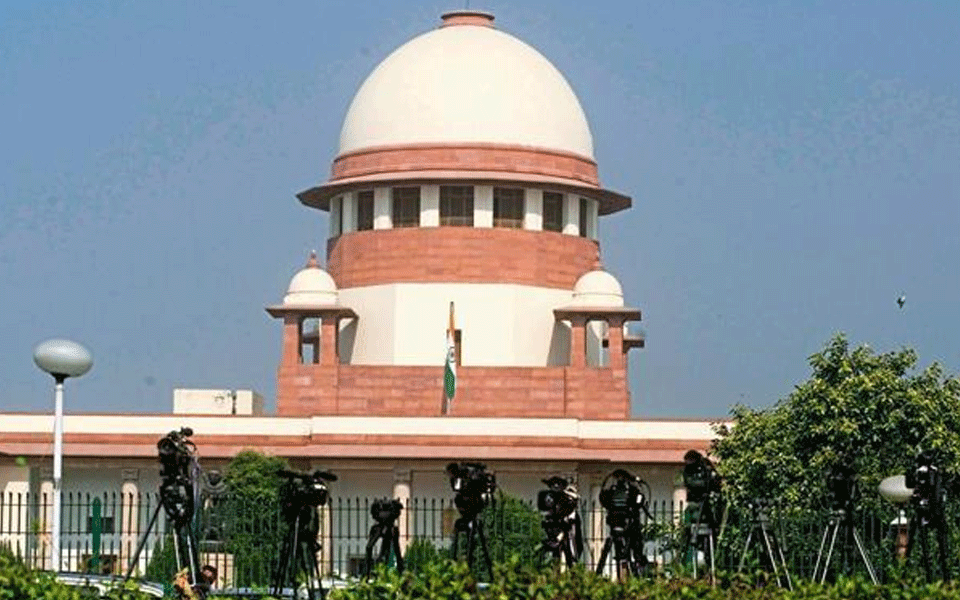
New Delhi: Consumer rights are "important rights" and non-manning of posts and inadequate infrastructure in district and state consumer commissions across the country would deprive the citizens of redressal of their grievances, the Supreme Court has said.
The apex court said this while hearing a plea that has raised the issue of alleged inaction by governments in appointing the president, members and staff in the district and state consumer disputes redressal commissions and the lack of adequate infrastructure to run these fora.
A bench of justices Sanjay Kishan Kaul and Hrishikesh Roy said the issue raised in the plea is important but the petitioner, a law student, has filed a "very sketchy petition" and it does not show proper ground work.
"We have given a thought to the matter and consider it too important an issue to be thrown out because of the laxity in collection of material and placing the same before us and thus, consider it appropriate that the same should be converted into a suo motu proceeding to enquire into the issue placed before us," the bench said.
The top court appointed senior advocate Gopal Shankaranarayan and lawyer Aaditya Narain as amicus curiae to assist it in the matter.
"We expect them to obtain the requisite material, analyse the same and facilitate the data to be placed before us and thus, consider it appropriate to issue notices to all the respondents before us, who would be able to show as to how many posts are occupied, how many are vacant and what is the nature of infrastructure which has been made available as consumer rights are important rights and non-manning of posts and inadequate infrastructure would deprive citizens of a redressal of the grievances," the bench said in its order passed earlier this week.
The apex court has posted the matter for hearing on February 22.
The plea filed before the top court has sought directions to the Centre, states and Union territories to fill up the vacant posts of presidents and members in the consumer commissions, saying the "inaction" in making the appointments is causing pendency of cases and has led to violation of the right to a speedy disposal of cases.
The petition, while alleging that directions passed by various high courts regarding filling up of vacancies in district and state consumer commissions have been "ignored" by the authorities concerned, has said there is a lack of proper infrastructure to run these commissions smoothly.
It has also sought a direction to the authorities concerned to provide proper infrastructure and staff to the consumer commissions and file a detailed report regarding this before the top court.
Let the Truth be known. If you read VB and like VB, please be a VB Supporter and Help us deliver the Truth to one and all.
Vartha Bharati–Sankalp predictions align closely with Karnataka bypoll results
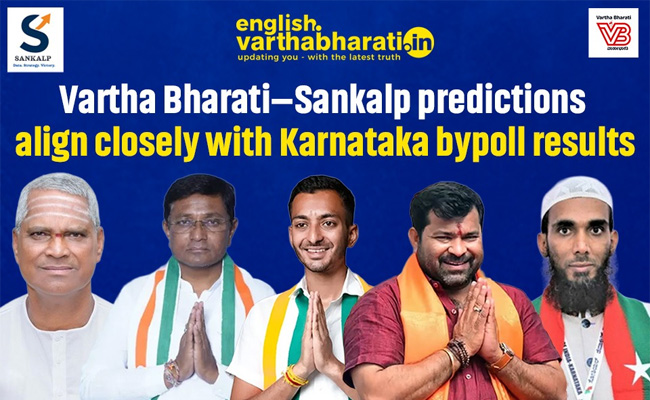
Bengaluru: The Vartha Bharati–Sankalp election analysis has shown a high level of accuracy in predicting the outcome of the recent Karnataka Assembly by-elections held in May 2026, correctly calling winners in both constituencies and closely estimating vote share trends.
The by-elections were held in Bagalkot and Davanagere South, drawing significant political attention as both seats were seen as key tests for the ruling Congress and opposition BJP.
According to the analysis, Vartha Bharati–Sankalp had made three major projections ahead of the results the winning party, vote share percentages, and margin of victory.
In both constituencies, the platform accurately predicted that the Congress would emerge victorious. The outcome matched the projections, with Congress candidates winning in Bagalkot and Davanagere South.
In terms of vote share, the predictions were largely in line with the final results. In Bagalkot, the BJP’s vote share was forecast in the range of 40 to 46 per cent, while the actual figure stood at 42.9 per cent. The Congress vote share, however, exceeded expectations, with the party securing 55.4 per cent against a projected range of 43 to 48 per cent.
The margin of victory in Bagalkot turned out to be significantly higher than anticipated. While the projection had placed the margin between 2,000 and 3,500 votes, the final margin was around 22,332 votes.
In Davanagere South, the predictions also remained largely accurate. The Congress vote share was projected between 43 and 51 per cent, and the final figure stood at 43.9 per cent. The BJP was expected to secure between 42 and 50 per cent but ended with 40.3 per cent.
The analysis had also identified the role of SDPI as a potential spoiler in the constituency. While its vote share was estimated around 6 per cent, the party eventually secured around 12 per cent of the vote.
The margin of victory in Davanagere South was predicted to be between 1,500 and 2,600 votes. The actual margin was higher at around 5,708 votes, though the contest remained relatively close as anticipated.
Overall, the performance of Vartha Bharati–Sankalp stood out for correctly identifying the winning parties in both seats and maintaining close accuracy in vote share estimates, with only limited deviations in specific cases.