Vaccination strategy equitable, "overzealous" intervention to have consequences: Centre to SC
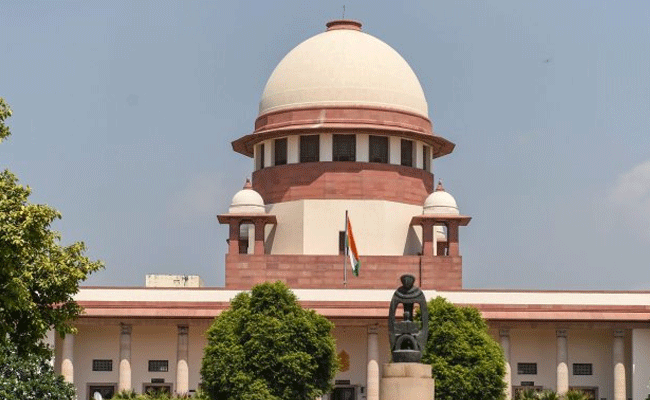
New Delhi: The vaccination strategy for COVID-19 has been formulated by the Centre in a "just, equitable, non-discriminatory" manner and any "overzealous" judicial intervention may result in unforeseen consequences, the government has told the Supreme Court.
In an affidavit filed by the Centre in response to the points raised by the top court, it said as vaccination of the entire country is not possible in one stretch due to the very suddenness of the pandemic, limited availability of vaccine doses and the vulnerability are the prime considerations.
The submission was made in a suo motu by the apex court case for ensuring essential supplies and services during the COVID-19 pandemic.
The top court has taken up issues such as the projected demand for oxygen in the country at present and in the near future, how the government intends to allocate it to "critically affected" states and its monitoring mechanism to ensure supply.
The central government submitted that the vaccination policy conforms to the mandate of Article 14 and Article 21 of the Constitution and was made after several rounds of consultations and discussions with experts.
State governments and vaccine manufacturers require no interference by the top court as dealing with a pandemic of this magnitude, the Executive does have room for free play in the joints, in the larger public interest, it said.
"Any overzealous, though well-meaning judicial intervention may lead to unforeseen and unintended consequences in absence of any expert advice or administrative experience, leaving doctors, scientists, experts and executive very little room to find innovative solutions on the go," the Centre told the apex court in its 200-page affidavit.
It submitted that in the times of such grave and unprecedented crisis which the nation is fighting the disaster of an unprecedented magnitude, the executive functioning of the government needs the discretion to formulate policy in the larger interest.
"It is submitted that in view of the unprecedented and peculiar circumstances under which vaccination drive is devised as an executive policy, the wisdom of the executive should be trusted," it said.
The government told the apex court that the price factor of vaccines will not have any impact on the ultimate beneficiary namely, the eligible person getting the vaccine since all state governments have already declared their policy decision that each State will be administering the vaccine to its residents, free of cost.
"Thus, while it is ensured that the two vaccine manufacturers are not unduly enriched from out of public money, the citizens are not supposed to make any payment for getting both doses of the vaccine," the Centre said.
The Centre said that the apex court in a plethora of judgements has laid down the parameters for judicial review of executive policies, which can only be struck down or interfered with on the grounds of manifest arbitrariness, allowing sufficient play in the joints to the executive, to function in accordance with its Constitutional mandate.
On the issue of invoking compulsory licensing of provisions under the Patents Act to ensure availability of vaccines and drugs, the government told the apex court that the main constraint is in availability of raw materials and essential inputs and therefore, any additional permissions and licenses may not result in increased production immediately.
The affidavit stated that the Ministry of Health is making all efforts to enhance the availability of antiviral drug Remdesivir through ramping up of production and sourcing through imports.
"However, in view of the current constraints on the availability of raw materials and other essential inputs, the mere addition of more production capacity may not lead to the desired outcomes of enhanced supplies," it said.
The Centre submitted that when there is a surge in cases and in demand of patented medicines/ drugs/ vaccines from all over the world the solution needs to be found out essentially at an executive level engaging at diplomatic levels.
"Any exercise of statutory powers either under the patents act 1970 read with Trips agreement and Doha declaration or in any other way can only prove to be counter-productive at this stage, the central government is very actively engaging itself with global organisations at a diplomatic level to find out a solution in the best possible interest of India," it said.
Let the Truth be known. If you read VB and like VB, please be a VB Supporter and Help us deliver the Truth to one and all.
Oath-taking ceremony of first BJP govt in Bengal on May 9; Modi, Shah likely to attend
Kolkata (PTI): The oath-taking ceremony of the first BJP government in West Bengal will be held at Brigade Parade Ground here on May 9, marking the saffron camp’s arrival in power in a state after decades on the political fringes.
The ceremony, scheduled to begin at 10 am, is expected to witness the presence of Prime Minister Narendra Modi, Union Home Minister Amit Shah, BJP president Nitin Nabin, several Union ministers and chief ministers of BJP- and NDA-ruled states, party sources said.
“The new BJP government will take oath on May 9 at 10 am at Brigade Parade Ground,” state BJP president Samik Bhattacharya announced on Wednesday.
Even as the BJP leadership kept its cards close to the chest on the chief ministerial face, Leader of the Opposition Suvendu Adhikari has emerged as a frontrunner in internal discussions after cementing his position as the party’s principal mass leader in Bengal politics.
Adhikari, once among Mamata Banerjee’s closest lieutenants and a key architect of the TMC’s rural expansion in districts such as Purba Medinipur, crossed over to the BJP ahead of the 2021 assembly elections and went on to defeat Banerjee in Nandigram in one of Bengal’s fiercest political battles.
Five years later, he again found himself at the centre of Bengal’s political churn by beating Banerjee in her own turf at Bhabanipur by over 15,000 votes.
Other names for the CM post doing the rounds include Bhattacharya, Union minister Sukanta Majumdar and former Rajya Sabha MP Swapan Dasgupta, though party insiders indicated that the leadership was inclined towards projecting a “bhumiputra” face rooted in Bengal’s linguistic and cultural ethos.
During the campaign, Shah repeatedly asserted that the BJP’s chief minister in Bengal would be a “son of the soil”, born and educated in the state, in an attempt to blunt the TMC’s sustained attack that the BJP represented an “outsider” political culture alien to Bengal’s social and intellectual traditions.
The BJP bagged 207 of the 294 assembly seats in the recently concluded elections, ending the Trinamool Congress’s uninterrupted 15-year rule and scripting the saffron party’s biggest breakthrough in a state where it once struggled to open its electoral account.
Significantly, the swearing-in ceremony will be held on the 25th day of Baisakh in the Bengali calendar — observed across the state as Rabindra Jayanti, the birth anniversary of Rabindranath Tagore — lending the event a deeper cultural symbolism.
According to BJP leaders, the choice of the date is aimed at embedding the party’s historic rise within Bengal’s cultural imagination and countering the long-standing perception battle over identity and belonging.
Over the last decade, the BJP has steadily attempted to appropriate and reinterpret icons of Bengal’s cultural nationalism — from Tagore and Swami Vivekananda to Netaji Subhas Chandra Bose and Syama Prasad Mookerjee — as part of a broader ideological effort to expand its emotional and political footprint in the state.
Party insiders said the leadership was also conscious of the need to balance Bengal’s competing regional aspirations while choosing the chief ministerial face, with discussions also taking place around whether greater representation should be accorded to north Bengal, a region where the BJP has made substantial electoral gains over successive elections.
A meeting of the newly elected BJP MLAs has been convened on May 8 evening, party sources said, though the leadership remained tight-lipped over the final choice.
The Brigade Parade Ground ceremony is expected to mark not merely a transfer of power, but a defining moment in Bengal’s political history, the culmination of the BJP’s long ideological and organisational march from the margins to the centre of power in a state that had for decades resisted the saffron surge seen elsewhere in India.