Vadra says 'witch hunt' against him after ED attaches assets

New Delhi : Robert Vadra, Congress president Rahul Gandhi's brother-in-law, Saturday termed as "witch hunt" the Enforcement Directorate's action of attaching assets of a firm linked to him, and claimed that it showed "complete misuse of assertion of power".
Vadra alleged "relentless harassment" a day after the Enforcement Directorate (ED) said it has attached assets worth Rs 4.62 crore of a firm linked to him in connection with the Bikaner land scam money laundering case.
"I have had nothing to hide and I am surely not above the law. I have deposed for almost 6 days; ranging from 8 to 12 hours per day with a 40 minute lunch break, and have been escorted to the washroom," Vadra said in a Facebook post.
He said he has completely cooperated and adhered to the rules whenever called in any part of the country.
"Attachment of my work place -- my office and areas that are sub judice, shows a complete misuse of assertion of power, a complete vindictive & vicious witch hunt," he alleged.
"When truth sustains and prevails, I suppose an apology is all that will suffice. Will stay determined for justice for me," Vadra said.
The ED has issued a provisional order for attachment of the assets under the Prevention of Money Laundering Act (PMLA).
It had grilled Vadra in this case in Jaipur twice earlier this week. His mother Maureen was also asked to depose but was allowed to go after completion of brief legal procedures.
Vadra was also questioned by the ED for three consecutive days last week in connection with a probe into allegations of money laundering to purchase assets abroad.
Let the Truth be known. If you read VB and like VB, please be a VB Supporter and Help us deliver the Truth to one and all.
Anbumani asks PM Modi to ban sale of cigarettes for those born after 2009
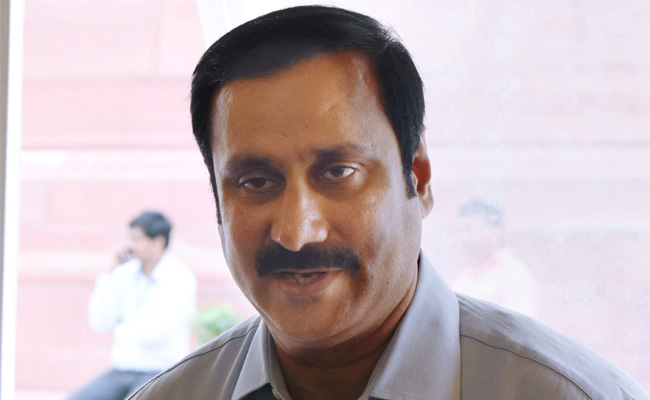
Chennai (PTI): PMK leader Anbumani Ramadoss on Saturday urged Prime Minister Narendra Modi to take legislative measures to prohibit smoking and the sale of cigarettes to individuals born on or after January 1, 2009, thereby creating a smoke-free generation.
Anbumani, former Union minister for health and family welfare, said, "Once implemented, it (ban on cigarettes) will ensure that future generations are legally prevented from ever accessing tobacco products", he said in a letter to Modi.
"I write to you with a deep sense of urgency and responsibility, drawing your kind attention to a critical public health issue that continues to endanger the lives of millions of Indians, particularly among the younger generation who are affected by cigarette smoking", he claimed.
Stating that India unfortunately bears a disproportionately high burden of tobacco-related morbidity and mortality, he said, adding that, according to global health estimates, nearly 267 million Indians, approximately one in five citizens, use tobacco.
"Each year, tobacco consumption directly accounts for over 1.35 million deaths, while exposure to second-hand smoke contributes to a total of approximately 2.3 million deaths annually", he said, adding, "these figures are alarming and reflect a public health crisis of immense magnitude".
He pointed out that Scientific evidence unequivocally establishes tobacco use as a leading cause of cancer and numerous non-communicable diseases, including cardiovascular ailments, chronic respiratory diseases such as COPD, and multiple forms of malignancies. "In India alone, tobacco is responsible for nearly 40–50 per cent of all cancer cases, with over 4.7 lakh deaths annually attributed to tobacco-induced cancers", he added.
"In this context, I strongly urge the Union government to consider enacting a transformative law similar to that of the United Kingdom, that permanently prohibits the sale and consumption of tobacco products for individuals born on or after a specified year (such as 2009). Such a generational ban would mark a decisive step towards eliminating tobacco use in India over time", he said.