Vajpayee continues to be 'critical', leaders visit AIIMS

New Delhi, Aug 16 : Former Prime Minister Atal Bihari Vajpayee's condition continues to be critical on Thursday as a bulletin is expected shortly from the AIIMS where he has been admitted for the last nine weeks.
"Vajpayee's condition has worsened over the last 24 hours. His condition is critical and he is on life support system," said the last statement issued by AIIMS late on Wednesday.
On Thursday, Vice President M. Venkaiah Naidu visited the 93-year-old Bharatiya Janata Party (BJP) stalwart, who had been the Prime Minister for three terms.
His visit at 6.30 a.m. was followed by Bharatiya Janata Party President Amit Shah at 8.30 a.m. Later Union Health Minister J.P. Nadda reached All India Institute of Medical Sciences (AIIMS), too.
On Wednesday, a host of political leaders including Prime Minister Narendra Modi had visited the AIIMS to take stock of the situation and enquire about Vajpayee's condition.
Vajpayee, a diabetic patient, is undergoing treatment at AIIMS since June 11. He was admitted to the hospital for what doctors described as a routine check-up.
The 1924-born leader is under the supervision of Dr Randeep Guleria, a pulmonologist and currently the Director of AIIMS. Guleria has served as personal physician to Vajpayee for over three decades.
Union Home Minister Rajnath Singh and Shah had also visited Vajpayee on Saturday.
Let the Truth be known. If you read VB and like VB, please be a VB Supporter and Help us deliver the Truth to one and all.
For supporters, ''Thalapathy'' Vijay becomes ''Muthalamaichar'' Vijay
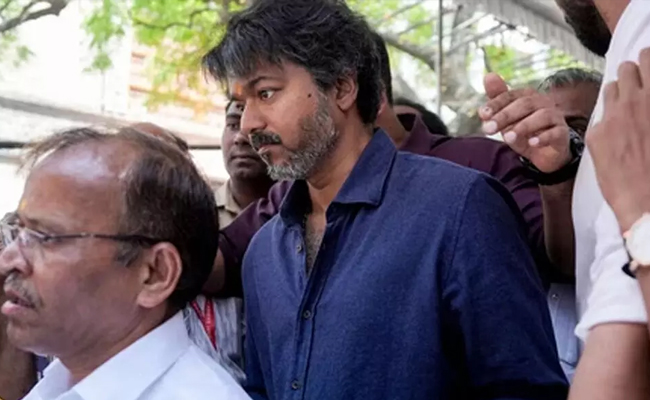
Chennai (PTI): As actor-politician Vijay-led TVK appeared inching towards the majority mark of 118 Assembly seats out of the total 234 segments in Tamil Nadu, celebrations by party workers and fans erupted across the state.
Amid chants of 'TVK' and 'Vijay,' party workers gathered outside the party headquarters at Panaiyur near here and distributed sweets and hailed the party founder as "Muthalamaichar (Chief Minister) Vijay, who continues to be popular as "Thalapathy (Commander, his film title)."
Meanwhile, visuals of Vijay's father Chandrashekar and some family members expressing joy and happiness appeared in some television channels. Vijay's party is leading in at least 108 seats out of the total 234 segments.