Vedanta Sterlite Plant May Reopen As NGT sets aside TN govt order to close its Sterlite plant
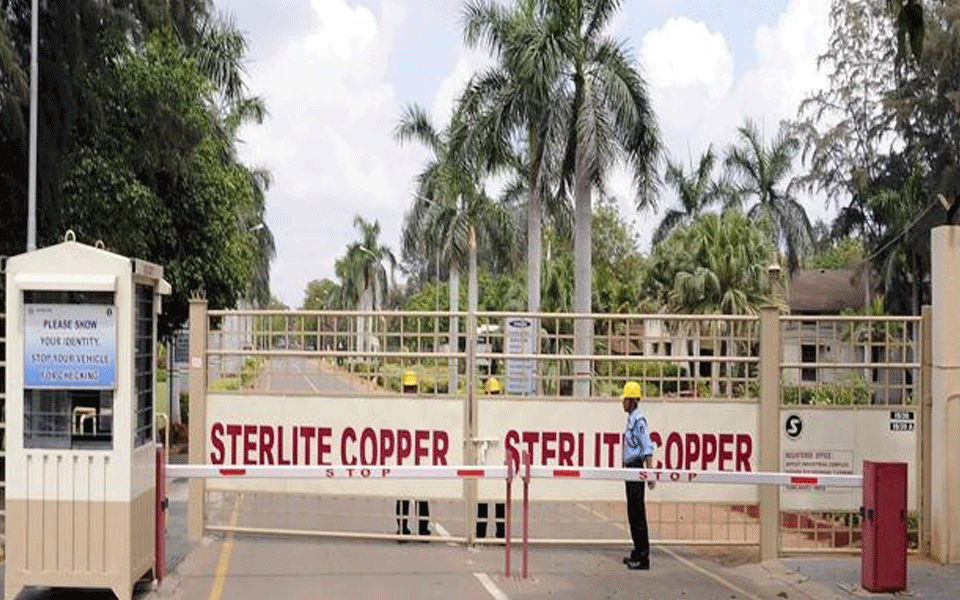
New Delhi, Dec 15: The National Green Tribunal on Saturday set aside the Tamil Nadu government order for closure of mining company Vedanta Ltd's sterlite copper plant at Tuticorin, which was at the centre of massive protests over alleged pollution, saying it was "non sustainable" and "unjustified".
A bench headed by NGT Chairperson A K Goel asked the Tamil Nadu Pollution Control Board (TNPCB) to pass a fresh order of renewal of consent and authorisation to handle hazardous substances, subject to appropriate conditions for protection of environment in accordance with law within three weeks from Saturday.
The tribunal, which had reserved its verdict on December 10, allowed the appeal of the company challenging closure of its plant at Tuticorin in Tamil Nadu.
The green panel said the company should spend within three years Rs 100 crore on welfare of inhabitants of the area as it had offered to do. The bench also suggested that the company take steps for safeguarding environment, like creating a dedicated website where the stakeholders can lodge their environment related grievances.
"Since we have independently held the impugned orders to be non-sustainable and closure to be unjustifiable, only further question for consideration is whether suggestions of the Committee... should be accepted and, if so, to what extent, the bench said.
It said the company will also be entitled to restoration of electricity for its operations, subject to complying with various directions issued by the tribunal for the firm.
The Tamil Nadu government had, on May 28, ordered the state pollution control board to seal and "permanently" close the mining group's copper plant following violent protests over pollution concerns.
Earlier in April, TNPCB had rejected Sterlite's plea to renew the 'Consent To Operate' certification, saying the company had not complied with the stipulated conditions.
At least 13 people were killed and several injured on May 22 when police had opened fire on a huge crowd of people protesting against environment pollution being allegedly caused by the factory.
The tribunal had earlier set up an independent committee to look into the allegations of environmental pollution by Vedanta-owned Sterlite copper factory.
The committee, headed by former Meghalaya High Court Chief Justice Tarun Agrawal, had said that no notice or opportunity of hearing was given to Vedanta before the closure of the plant.
The tribunal in its judgement said it does not find any merit in the objection raised on behalf of the state government or TNPCB that appointing of such a committee amounted to delegation of judicial functions.
"This tribunal is certainly entitled to ascertain facts on the ground by a fair and credible expert mechanism. Section 19 of the NGT Act is to the effect that the tribunal is not bound by procedure laid down by the CPC but is to be guided by the principles of natural justice. The tribunal can regulate its own procedure. It is not bound by rules of evidence under the Evidence Act," it said, adding that it does not see any reason not to look into the report of the committee.
The tribunal noted that during the earlier hearing, the company's counsel had made a statement that it was willing to spend a further amount of Rs 100 crores on welfare activities for inhabitants of the area as a goodwill measure.
The amount may be spent on projects like water supply, hospital and health services and skill development in the area, the counsel had said.
"We take the statement on record and in view of the said statement, we direct the appellant unit (company) to spend the amount of Rs 100 crore within a period of three year for welfare of the inhabitants in the area. The action plan prepared for utilisation of the amount be got approved from MoEF&CC which may also oversee the compliance thereof," the tribunal said. The bench also said the company may on "precautionary principle" take various steps in the larger interest of safeguarding environment.
The steps to be taken by the company include creating a dedicated and interactive website with participatory public forum wherein the affected stakeholders can lodge their environment related grievance for time bound redressal and disposal by the unit.
The website should be widely publicised and have links with the website of the district administration, TNPCB and CPCB which shall be the oversight body to monitor such public grievances and its timely disposal, the tribunal said.
The company should regularly monitor the ground water quality as mandated by TNPCB and upload the data in comprehensible form without fail on the website, it said.
The tribunal added that failure of timely analysis and uploading of the same shall result in appellant unit paying environmental compensation at the rate of Rs 10 lakh for every default with the District Legal Services which shall maintain a separate account for the same and supervise its spending in matters like environmental education and awareness.
"The appellant unit shall also deposit a sum of Rs 2.5 crores as a token amount for their failures for Extended Procedures Liability for inappropriate handling 3.5 lakhs M.T of Copper Slag on patta lands with the State Legal Services Authority for creating and maintaining the environmental awareness in the area through the District Legal Services Authority by preparing a comprehensive action plan," it said.
On August 9, the tribunal had allowed Vedanta to enter the administrative unit inside its sterlite copper plant at Tuticorin.
Let the Truth be known. If you read VB and like VB, please be a VB Supporter and Help us deliver the Truth to one and all.
Man arrested for duping Delhi resident of Rs 2 lakh in online car sale fraud

New Delhi (PTI): Police have arrested a 32-year-old man for allegedly duping a Delhi resident of Rs 2 lakh on the pretext of selling a second-hand car online, an official said on Saturday.
The accused, identified as Aman Sethi, a resident of Shiv Puri Extension in east Delhi, allegedly impersonated an employee of a reputed online car sale platform to gain the victim's trust, the police said.
The case came to light after a complaint was lodged by Harish, a resident of Trilokpuri, following which an FIR was registered on April 16 under relevant sections of the Bharatiya Nyaya Sanhita (BNS). Sethi was arrested on Friday.
According to the complainant, the accused contacted the victim and offered to sell a second-hand car. He allegedly convinced him to transfer Rs 2 lakh as booking and processing charges.
After receiving the money, the accused neither delivered the vehicle nor refunded the amount and stopped responding to calls.
A police team conducted a detailed financial and technical investigation and traced the money trail to a bank account in the accused's name.
"Analysis of KYC details, account activity and digital footprints helped identify the suspect," a senior police officer said.
The police said the accused had vacated his known address and was evading arrest, but was eventually tracked down through technical surveillance and local intelligence after multiple raids in Delhi-NCR.
During interrogation, Sethi allegedly tried to mislead investigators but was confronted with evidence and subsequently arrested. Further probe revealed his involvement in a similar cheating case registered at the Krishna Nagar police station, indicating a pattern of such offences.
The police said the accused targeted people searching for second-hand cars online by posing as an employee of vehicle sale platforms, sharing photographs and details of vehicles, and demanding advance payments in personal bank accounts.
Two debit cards, two mobile phones and SIM cards allegedly used in the offence have been recovered from his possession, the police added.