Vice President Venkaiah Naidu invokes Nehru in Serbian parliament
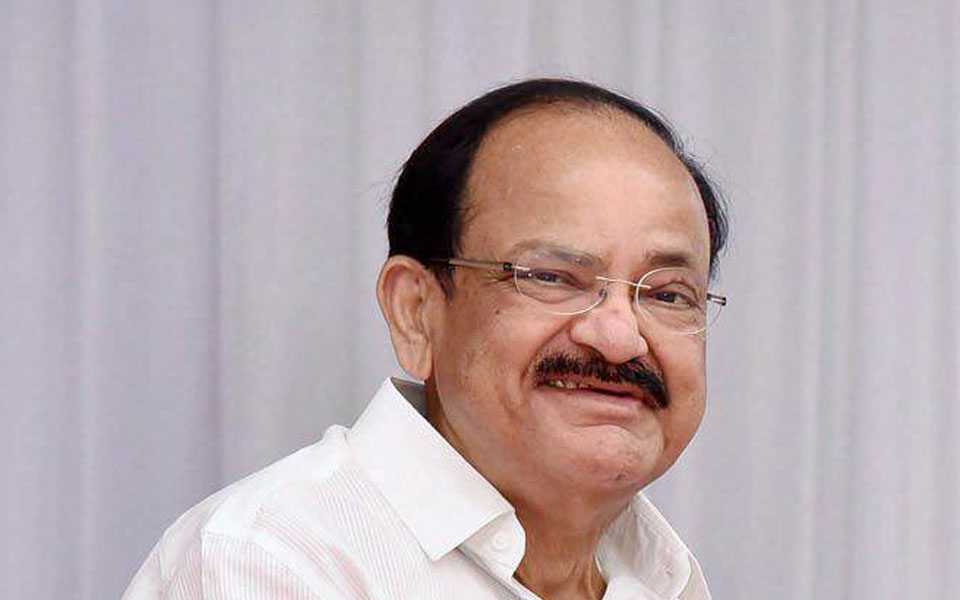
Belgrade, Sep 16: Observing that the Indian parliament has evolved as a democratic forum that listens and responds to diverse concerns, Vice President M. Venkaiah Naidu has invoked first Prime Minister Jawaharlal Nehru in the Serbian parliament to highlight the importance of democracy for participatory development.
On the occasion of International Day of Democracy, Naidu on Saturday addressed the special session of the National Assembly of Serbia wherein he recalled the shared vision with which leaders of both the countries played a key role in launching the Non Aligned Movement (NAM).
"Our ties started on a strong foundation of a shared global view of Non-Aligned Movement and we together created a large platform for the third world. The changes in global geo-politics now again give us an opportunity to work together for mutual benefit and for sharing prosperity with others," said Naidu addressing Serbian lawmakers.
Recalling Nehru's 1961 address at Conference of Non-Aligned nations in Belgrade, Naidu said: "His call which rings so true and relevant even today was to build in our own countries societies where freedom is real.
"Freedom is essential, because freedom will give us strength and enable us to build prosperous societies," he said quoting Nehru and added: "We must strive to strengthen our democratic polities and internalize the concepts of freedom, dialogue, inclusion and rule of law in our governance structures."
Giving an detailed account of the growth and consolidation of parliamentary democracy in India, Naidu said the Indian parliament has "evolved as a democratic forum that attentively listens to complex voices from different parts of the vast country and responds to diverse concerns with agility".
The Vice President also had detailed discussions with Serbian President Aleksandar Vucic and Prime Minister Ana Brnabic on various bilateral and multilateral issues.
He gave a detailed account of India's progress in various fields including an enabling, predictable and reform oriented financial and investment eco-systems offering mutually beneficial partnerships.
Voicing concerns over the menace of terrorism, he called for early finalisation of draft Comprehensive Convention on International Terrorism (CCIT).
Let the Truth be known. If you read VB and like VB, please be a VB Supporter and Help us deliver the Truth to one and all.
CM Siddaramaiah alleges ‘criminal conspiracy’ in Sringeri recount, vows legal action
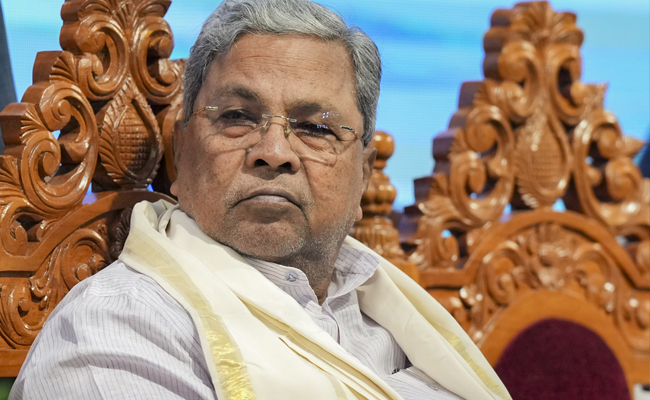
Bengaluru (PTI): Alleging a “criminal conspiracy” by BJP candidate D N Jeevaraj in the Sringeri Assembly poll recounting, Karnataka CM Siddaramaiah on Tuesday said the outcome was manipulated after valid postal ballot votes in favour of Congress leader T D Raje Gowda were tampered with during the recounting process.
Following a Karnataka High Court order on an election petition filed by Jeevaraj, challenging Raje Gowda’s election, the reverification and recounting were conducted on Saturday.
After the reverification and recount of postal ballots for the Sringeri Assembly constituency, votes polled in favour of Raje Gowda were reduced by 255, the returning officer said.
A report on the matter has been submitted to the Election Commission of India for further action, the officer added.
Congress leader Raje Gowda had won the 2023 Assembly polls from Sringeri by 201 votes, defeating his nearest rival Jeevaraj.
Addressing a press conference in Bengaluru, Siddaramaiah said the High Court had directed the recounting of postal ballots and that irregularities were noticed during the exercise conducted on May 2.
“This is a clear case of criminal conspiracy,” Siddaramaiah said, alleging that valid votes cast in favour of Raje Gowda were altered after being accepted by counting agents of all parties, including Congress, BJP, and JD(S).
He claimed that during the recounting of postal ballots, 255 votes were initially accepted as valid by all agents but were later tampered with by subordinate officials.
“There is a second mark on the votes polled in favour of Raje Gowda. They had accepted these as valid votes. Subsequently, another mark was made by officials. This is a clear case of criminal conspiracy,” he said.
When asked who was behind the alleged conspiracy, the CM replied, “It was hatched by Jeevaraj and others. It is planned.”
Siddaramaiah further alleged that the returning officer acted improperly by declaring the result despite the presence of an Election Commission observer during the recounting.
“Immediately after the counting, the returning officer announced the result. He should not have done so; this is against the law,” he said.
He pointed out that Raje Gowda had originally won by 201 votes, but after the recounting, the BJP candidate was declared the winner by 52 votes.
“The BJP has committed a criminal act of conspiracy. This is not vote chori but vote dacoity,” he alleged.
The CM said a police complaint had already been filed by Raje Gowda’s election agent, Sudhir Kumar, and emphasised the need for electoral integrity.
“We want transparency and free and fair elections. That is what our Constitution mandates,” he added.
Stating that the government would pursue legal remedies, Siddaramaiah said, “We are preparing an appeal challenging the returning officer’s announcement in a court of law.”
Responding to a separate query on elections in other states, the CM said there appeared to be an anti-incumbency factor in West Bengal, while results in Tamil Nadu were “surprising,” adding that Vijay’s party was emerging as the largest there.
Following the victory of party candidates in Bagalkote and Davanagere South, Siddaramaiah expressed confidence about future electoral prospects in Karnataka.
“Even in 2028, we will win the Assembly elections. We will come back,” the CM said.
Siddaramaiah added that he would order a forensic examination into the alleged tampering of postal ballots.