Video on money transactions goes viral amid MP polls
fake says Union minister's son, gets FIR registered
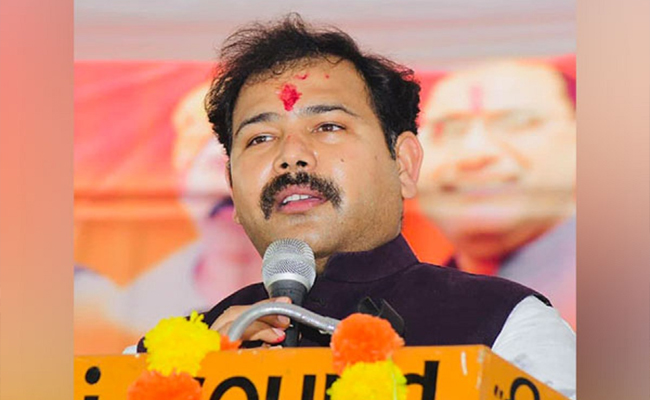
Morena/Bhopal (PTI): A video purportedly showing the son of Union Minister Narendra Singh Tomar and a "middleman" talking about several crore rupees went viral on social media amid Assembly polls in Madhya Pradesh and set the ruling BJP and opposition Congress on collision course on Monday.
While Tomar's son Devendra Pratap Singh Tomar termed the video as fake and got an FIR registered with the Civil Lines police station here, Congress leaders sought a probe by the Enforcement Directorate as well as action from the Election Commission of India.
In the purported video being linked to Devendra Tomar, the alleged middlemen is heard talking about arranging four to to five accounts for transferring funds to the tune of crores of rupees.
Union agriculture minister Narendra Singh Tomar is contesting Assembly polls from Dimni.
"A case under IPC section 469 (forgery for the purpose of harming reputation) has been registered against unidentified persons and the matter is under investigation," City Superintendent of Police (CSP) Rakesh Gupta said.
Incidentally, the issue was highlighted by Congress general secretary Priyanka Gandhi at a poll rally during the day.
"Yesterday, a video was released of the country's agriculture minister's son. You must have seen them talking about thousands of crores...100 crore," she told the gathering.
Speaking to reporters in Bhopal, Congress spokesperson Supriya Shrinate questioned the delay on the part of the ED, Central Bureau of Investigation and Income Tax department in beginning a probe into the video.
Shrinate urged the ECI to take swift action in the matter in view of the Assembly polls in the state.
Assembly polls will be held in MP on November 17, while votes will be counted on December 3.
Let the Truth be known. If you read VB and like VB, please be a VB Supporter and Help us deliver the Truth to one and all.
Rickelton's ton in vain as SRH beat MI by 6 wickets

Mumbai (PTI): Ryan Rickelton's whirlwind unbeaten ton was overshadowed by Heinrich Klaasen's unbeaten 65 as Sunrisers Hyderabad defeated Mumbai Indians by six wickets in an IPL match here on Wednesday.
Chasing an imposing 244-run target, Travis Head (76 off 30) and Abhishek Sharma (45 off 24) shared 129 runs for the opening wicket to set the platform for SRH.
Klaasen (65 not out off 30 balls) then displayed his all-round hitting abilities to guide SRH home with the help of Nitish Kumar Reddy (21) and Salil Arora (30 not out off 10) in 18.4 overs.
Earlier, Rickelton's knock powered MI to 243 for five.
MI rode on a 93-run stand between Rickelton (123 not out off 55 balls) and Will Jacks (46 off 22) in 7.1 overs for the opening stand to power the side.
MI skipper Hardik Pandya scored a valuable 31 off 15 balls before being dismissed.
Praful Hinge (2/54), Eshan Malinga (1/29), Sakib Hasan (1/39) and Nitish Kumar Reddy (1/31) were the wicket-takers for SRH.
Brief Scores:
Mumbai Indian: 243 for 5 in 20 overs (Ryan Rickelton 123 not out; Praful Hinge 2/54).
Sunrisers Hyderabad: 249 for 4 in 18.4 overs (Travis Head 76, Heinrich Klaasen 65 not out; AM Ghazanfar 2/51).