Vinod Kambli's Wife Hit Me With Sandals, Alleges Singer's Father

MUMBAI: Former batsman Vinod Kambli's wife has been accused of assaulting a man at a popular mall in Mumbai on Sunday The man, who happens to be the father of playback singer Ankit Tiwari, has filed a complaint against Mr Kambli and his wife.
Fifty-nine-year-old Raj Kumar Tiwari alleged that Mr Kabli's wife Andrea Hewitt assaulted him in the mall where he and his family were spending their Sunday.
CCTV footage from the children's gaming area at Inorbit mall in north Mumbai's Malad shows a man in white t-shirt walking past a woman, who is purportedly Mr Kambli's wife. The man's hands can be seen brushing against her. The woman is then seen hitting the man on his head and confronting him. Ankit Tiwari's father was accompanied by a young girl who is reportedly his grand-daughter.

The singer's father has alleged that Ms Hewitt took her sandals off to beat him. The man says his younger son was injured after he was assaulted by Vinod Kambli's bodyguards, according to Mid-Day.
The former cricketer and his wife, however,alleged that it was the singer's father who deliberately brushed his hand against her. "Some miscreants tried to touch my wife inappropriately, When questioned, brought his sons n tried to come to blows. Sadly, women safety on question once again," Mr Kambli tweeted yesterday, tagging Mumbai Police.
"I've also made a complaint before them. Where is it," Mr Kambli said this morning, replying to a tweet.
The police are now investigating the matter and will take further action after their preliminary investigations. No arrest has been made so far.
Let the Truth be known. If you read VB and like VB, please be a VB Supporter and Help us deliver the Truth to one and all.
Bridge portion collapses on Jammu outskirts; 3-4 labourers feared trapped, 1 rescued
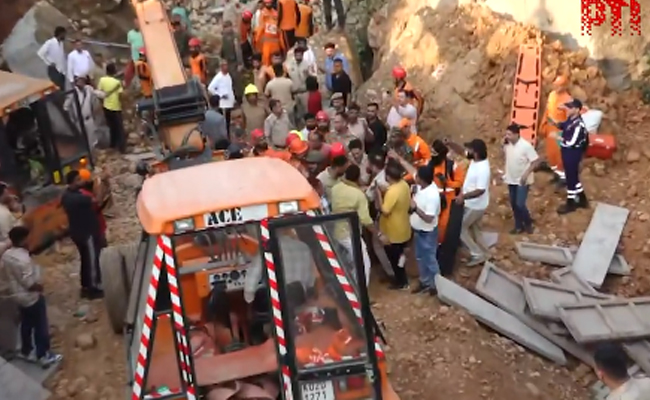
Jammu (PTI): A portion of a small bridge collapsed in the Bantalab area on the outskirts of Jammu city on Friday, trapping at least three to four labourers under the debris, while one injured worker was rescued, official sources said.
Authorities have closed the road link following the collapse of the portion of the bridge.
The incident occurred when labourers were carrying out repair work on a retaining wall near the bridge that was damaged in last year's flash floods, the sources said.
According to the sources, a section of the bridge suddenly gave way, burying workers engaged at the site under the rubble.
Police, Army and State Disaster Response Force (SDRF) teams launched rescue operations to extricate those buried under the debris. They pulled out one injured labourer and shifted him to a hospital, the sources said.
Family members of the labourers present at the site said around six workers engaged at the site at the time of the incident came under the debris when the structure collapsed. The family members said while two of the labourers managed to escape, four got trapped.
The sources said those trapped included the husband of a woman labourer, a mason, an unmarried labourer and a relative of the contractor.
There was no official confirmation on the exact number of persons trapped under the debris till the filing of this report.
The rescue operations are ongoing.