VP Dhankhar slams Supreme Court over Emergency-era verdict, says darkest in judicial history
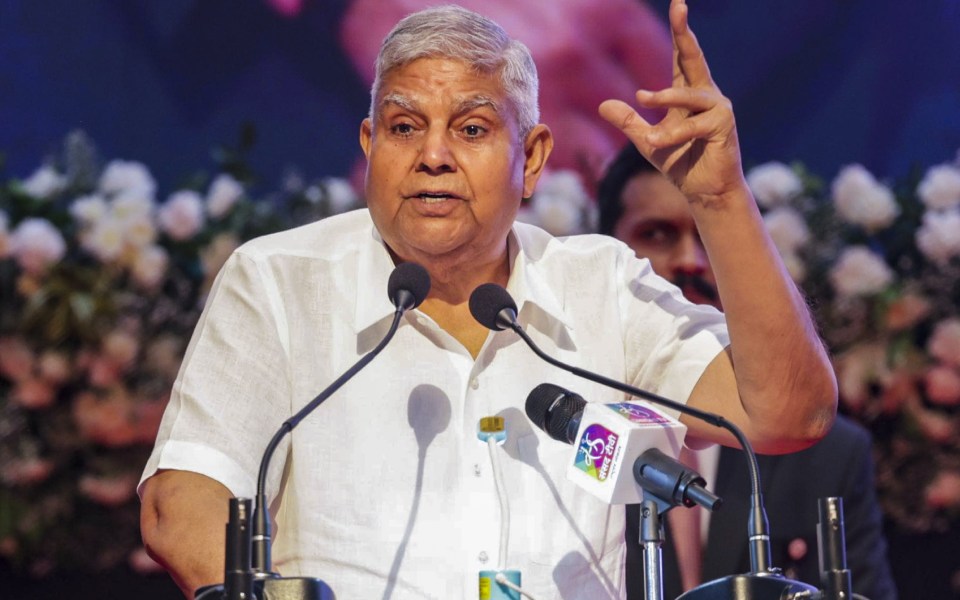
New Delhi, Jun 20 (PTI): Vice President Jagdeep Dhankhar on Friday slammed the Supreme Court for its verdict delivered during the Emergency, dubbing it as the "darkest" in the judicial history of the world.
According to an official statement, he said the judgment of the Supreme Court overruling that of nine high courts legitimised dictatorship and authoritarianism.
Dhankhar also questioned the then president Fakhruddin Ali Ahmed for signing the proclamation of Emergency on the "instance" of then prime minister Indira Gandhi and not the entire council of ministers.
Addressing a group of Rajya Sabha interns here, the vice president said, "A president cannot act on the advice of an individual, the prime minister. The Constitution is very categorical.
"There is a council of ministers headed by the PM to aid and advise the president. This was one violation, but what was the result? More than 1,00,000 citizens of this country were put behind bars in hours," he said.
Referring to the role of the judiciary during the Emergency, Dhankhar said, "That was a time when the fundamental essence of democracy capsized in times of distress. People look up to the judiciary.
"Nine high courts in the country have gloriously defined that emergency or no emergency, people have fundamental rights and there is access to the justice system. Unfortunately, the Supreme Court overturned all nine high courts and gave a judgment which will be the darkest in the history of any judicial institution in the world that believes in the rule of law," he further said.
Dhankhar pointed out that the decision was that "it is the will of the executive to have Emergency for as much time as it thinks fit".
In the 1976 ADM Jabalpur case, a five-judge Constitution bench, by a majority of 4-1, upheld the suspension of fundamental rights during the national emergency.
The majority verdict of the then chief justice of India A N Ray and Justices M H Beg, Y V Chandrachud and P N Bhagwati held that the right to seek legal remedy for violations of Article 21 was suspended during the Emergency.
Justice H R Khanna dissented and held that the right to life and liberty is inherent and not merely a gift from the Constitution.
The top court also ruled that during an Emergency, there are no fundamental rights.
"So the judgment of the Supreme Court legitimised dictatorship, authoritarianism and despotism in this land," Dhankhar said.
The vice president said the present government has "wisely" decided to observe June 25 every year as 'Samvidhan Hatya Diwas'.
Emergency remained in force between June 25, 1975 and March 21, 1977.
Let the Truth be known. If you read VB and like VB, please be a VB Supporter and Help us deliver the Truth to one and all.
4 workers die after being buried under coal slurry in Jharkhand's Dhanbad

Dhanbad (Jharkhand) (PTI): At least four workers died after being buried under coal slurry in Jharkhand's Dhanbad district on Saturday, a police official said.
The incident took place at Moonidih coal washery in the command area of Bharat Coking Coal Limited (BCCL).
"Bodies of all four workers were dug out of debris during a rescue operation," Putki police station in-charge Waqar Hussain told PTI.
The incident took place when coal slurry was being loaded into trucks by workers, during which a large chunk of slurry fell and trapped several workers underneath, officials said.
The deceased have been identified as Manik Bauri, Dinesh Bauri, Deepak Bauri, and Hemlal Gope.
Meanwhile, the family members of the deceased and local villagers placed the bodies in front of the washery gate and began a protest.
They demanded compensation, jobs for dependents and action against those responsible for the incident.
Police and administration officials are trying to pacify the protesters, an official said.