Water from suspended Indus Water Treaty to be supplied to Delhi, Haryana, Rajasthan: Khattar
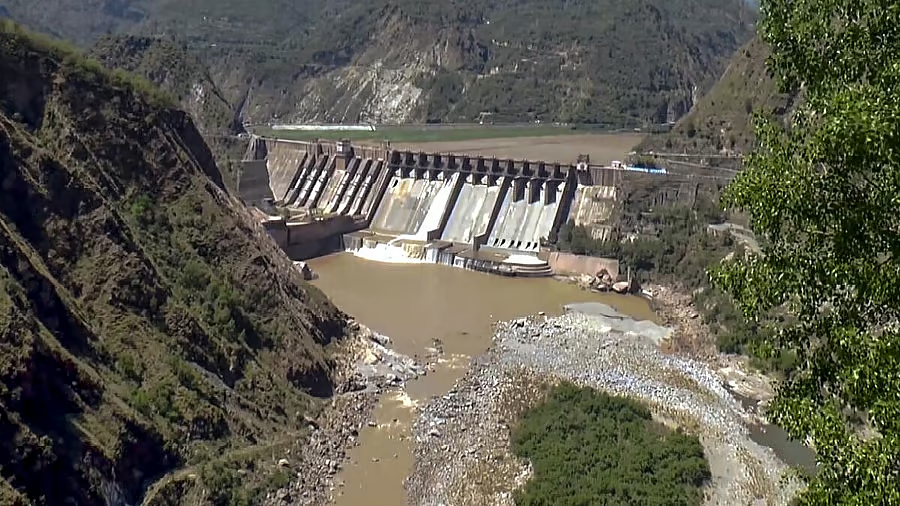
New Delhi (PTI): Union minister Manohar Lal Khattar announced on Friday that the water saved due to the suspension of the Indus Waters Treaty with Pakistan will be made available to Delhi, Haryana, and Rajasthan within the next one to one and a half years.
Remarking that sometimes disasters can prove to be blessings in disguise, stating, "aapda mein bhi avsar," Khattar explained that following the Pahalgam terror attack, the Indus Waters Treaty with Pakistan was "suspended."
"The large quantity of water that was discharged towards Pakistan will now be brought and supplied to Delhi, Haryana and Rajasthan in the coming one or one and a half years," the minister said, addressing a programme to launch the drainage master plan of the national capital.
India decided to suspend the decades-old treaty in response to the terror attack in Pahalgam in April, which resulted in the deaths of 26 people, mostly tourists. India informed Pakistan of its decision to keep the Indus Waters Treaty in abeyance, citing Pakistan's breach of the treaty's conditions.
The treaty, in effect since 1960, governed the distribution and use of the Indus River and its tributaries between India and Pakistan. The Indus river system includes the main river, the Indus, along with its tributaries: the Ravi, Beas, Sutlej, Jhelum, and Chenab.
Under the treaty, India was granted exclusive rights to the water of the Sutlej, Beas, and Ravi -- amounting to an average annual flow of about 33 million acre-feet (MAF).
The water of the western rivers -- the Indus, Jhelum and Chenab -- amounting to an average annual flow of around 135 MAF, which was largely allocated to Pakistan, has now been stopped and is available to be used by India.
Let the Truth be known. If you read VB and like VB, please be a VB Supporter and Help us deliver the Truth to one and all.
Blast at railway track in Patiala was attempted detonation, killed operator: Punjab Police

Chandigarh (PTI): A blast that took place at a railway track near the Shambhu area in Punjab's Patiala was an attempted detonation, a senior police officer said on Tuesday.
The person who was trying to carry out the detonation on Monday has died, Patiala SSP Varun Sharma said.
The blast took place near the Shambhu-Ambala rail track. Police earlier said that an unidentified body, which was blown into pieces, was recovered from the spot.
Initially, it was considered a low-intensity blast. However, investigation has revealed that it was an attempted detonation.
The explosion occurred at around 10 pm at the rail track dedicated for freight trains, police said.
The explosion also caused some damage to the track.
ALSO READ: All arrangements in place for second phase of polling in West Bengal on April 29: Poll official
"Late night, we had received information about a low intensity explosion at a railway track near Shambhu-Haryana border. Immediately, I, along with the deputy inspector general of police and other senior officials, rushed to the spot to take stock of the situation.
"We found that it was not a low intensity explosion but an attempted detonation," the SSP said.
During the attempt, the person who was trying to carry out the detonation died, and his body has been recovered, he said.
Police said they have recovered a SIM card from the spot.
"After getting whatever scientific evidence including a SIM card from the spot, police have launched technical investigation," Sharma said.
"We expect that we will soon unravel the whole conspiracy," he said.
He further said the Government Railway Police, the Railway Protection Force and other agencies are involved in investigation.
Earlier in January, a blast on a dedicated freight corridor railway track in the Fatehgarh Sahib district's Sirhind had damaged the engine of a train and left a loco pilot injured.