Wayanad Landslides: 'Komban' elephant shelters elderly woman, family in Mundakkai overnight
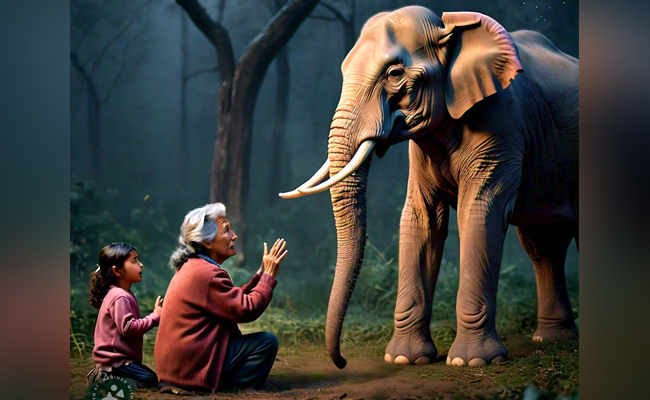
Meppadi/Wayanad: An elderly woman and her family were sheltered by a tusker in a coffee plantation, while escaping the landslides in Mundakkai of Wayanad, Mathrubhoomi reported on Friday. Death toll has crossed 350, with over 200 still missing, in one of the most tragic and devastating landslides India has ever seen.
Tuesday, July 30, 2024. Around 01:00 IST, the first in a series of catastrophic landslides hit Mundakkai in Meppadi Gram Panchayat. Sujatha, who was in deep sleep beside her granddaughter Mridula, woke up with a start when her house was hit by the flash floods. The scenic hill station where she had lived for a large part of life had turned into a nightmare. Land was nowhere in sight and it was water all around, as if it was a sea. She saw trees floating by. When she peered outside, she was in time to witness her neighbour's two-storey house collapse which destroyed her house too. Pulling Mridula out of the collapsing walls and covering her with a cloth, Sujatha swam through the flooding water.
Crying for help, she continued swimming while desperately clasping her granddaughter’s little hand. None heard her shouts, but she could hear screams from every direction; more than 3000 villagers of Meppadi were in the same waters. Finally, after what seemed like an eternity, she pulled her granddaughter and herself to the hard ground.
Gigeesh, her son-in-law emerged from the nearby house, dragging her daughter Sujitha along with their son Suraj who sustained severe injuries. Sujitha had a broken back. Despite everything, Sujatha was glad that her daughter's family had survived. But they were nowhere safe. Fearing for their lives amidst the torrential rain and the flash floods, they rushed up a coffee plantation that seemed safer. It was then that Sujatha saw the elephant, a tusker, blocking their path.
Only 2 weeks before Sujatha's misery, a 50-year-old man named Raju of the Kuruman tribe was killed by a wild elephant near Kalpetta. Raju was attacked by a wild tusker, similar to the one that stood before these poor victims now, when he was returning home from the fields on a Sunday night. Sujatha thought it was all over: saved from a falling mountain, floating trees, rolling boulders and a devastating flood, now they would be trampled under the feet of this unpredictable giant. But fate had different plans for her that day.
Sujatha took one look at the terrified faces of her two grand children who were just out of the claws of death. And then she faced the wild tusker and cried out, "We have come from a great tragedy, don't do anything to us. We are afraid. There is no light and there is water all around. We somehow came swimming. Don't do anything to us". For people who don't believe in miracles, there was one unfolding that day in the darkness of a coffee shrub covered hill, in Mundakkai, beside which the earth lay jumbled in destructive flash floods and landslides. The elephant's eyes filled up with water as if it could sense all their pain and distress. With two other elephants nearby, the tusker guarded them till dawn. Sujatha's daughter couldn't stand as her back was badly hurt. She liad down in the wet floor. Huddling together with her grand children, the elderly woman sat at the feet of the gentle giant.
Gigeesh, her son-in-law was all occupied with the survivors to rescue whomever they could. His hands were full of blood by breaking doors open, remembers Sujatha. Everyone had more than their fair share of gashes and wounds that day. But, they were alive. Sujatha couldn't stand. All the struggles to survive had turned her legs into lead. While recounting that horrific night with reporter Sravan Krishna of Asianet News, she called the kind elephant that gave them a sanctuary as 'moopar', a term of respect used in Malayalam for an honorable person. When the rescue teams arrived in the morning, it was all strange faces. None were left in her village to lead the rescue efforts. And the tusker had remained with the shivering souls until the teams came in.
No village, no house was left in Mundakkai, once thriving with a population of thousands, when the rescue team brought them back from the coffee plantation hill. She remembers how their heads, ears and the whole bodies were covered in mud. They were taken to a house where they could clean themselves up and a new dress, her only one now, was issued. A vehicle took them safely to the relief camp in Meppadi. When she reached the camp, she was in a kind of a trauma. The image of her village, once a place of scenic beauty with misty mountains, enticing valleys and heavenly green tea plantations, now turned bare and raw, by the forces of nature, stood before her eyes. Home was a lost world now and she did not know who she was.
"Cries, screams and that ear-shattering crashing sound... I can’t forget it. I am still afraid. That fear hasn't left me yet. When I sleep here, all I think about is would this place be flooded too... Only god knows how my baby, my three children and I were saved. There was a family of 6-7 children in my neighbourhood. No one was left. Everyone is gone... If I didn't know to swim, none of us would have been alive today... We have none to help us. All are buried under the soil, not even their bones were found", she tells Sravan Krishna with teary eyes and breaking voice, all the while never letting go of the reporter’s hands.
Meteorologists say that an active monsoon offshore trough is the cause for continued heavy rains across North Kerala and the entire Konkan region from last two weeks. The continued rains saturated the soil before the tragedy struck. On Monday July 29, a deep mesoscale cloud system formed over the Arabian Sea leading to extremely heavy rain in Wayanad, Calicut, Malappuram and Kannur, which resulted in the natural disaster. High resolution satellite images of Wayanad, taken after the landslides, show the presence of an old landslide at Punchirimattom on the Vellarimala hills, 1550 metres above sea level, where the current landslides originated.
With 86,000 sq miles of land devastated and nearly 8 kms of Iruvaiphuzha River covered in debris, it’s a daunting task for the combined forces of Indian Army, NDRF, SDRF and other emergency services to bring the situation back to normal. Madhav Gadgil report on the conservation of Western Ghats, submitted to the Centre in 2011, had specifically warned against rampant quarrying and construction works in Ecologically Sensitive Areas (ESA) like Meppadi which was one of 18 such localities identified in Kerala by the panel.
Wayanad is worst-affected in increasing human-animal conflict in the whole of Kerala. With 36.48% forest cover, Wayanad recorded highest elephant density, when compared to other districts, in 2010. However, things have changed over time. The number of elephants in the wild went down from 249 to 178 this year, in the district.
Forest officials attribute the dropping pachyderm population to climatic changes characterized by extreme dry period followed by late summer rains. The district's forests form a part of a greater green cover that straddles the Western Ghats region across two other Southern states. It adjoins Nagarhole Tiger Reseve, Bandipur National Park, and Biligiri Rangana Betta Tiger Reserve in Karnataka, and Mudumalai Tiger Reserve and Sathyamangalam Forest in Tamil Nadu.
From late January to mid-February this year, three people were killed by wild elephants in Wayanad. Raging protests, necessitated a visit by Rahul Gandhi, who was Wayanad MP then, to take a break from the sensational Bharat Jodo Nayay Yatra and visit the families of victims on February 18. The three deaths totaled the number of people killed by elephants for the past 13 months to seven. In 2022, a Kerala government report said that 319 deaths were reported in the state by wild animal attacks during the past decade. Among them, Wayanad reported 41 deaths by elephant attacks alone.
Increasing commercial forestry with cultivation of acacia, mangium and eucalyptus, all non-native species, and invasive species of plants like lantana put a severe pressure on the natural habitat of the elephants, while reducing foraging options for the giants. Trees like acacia also dry out the water resources in the forest. Added to the food and water shortage, the unattended farms and plantations adjoining forest areas, which lack labourers due to high wages, attract the elephants into closer proximity of humans. Blocking of elephant corridors, traditional migratory paths, by increasing human settlements is considered as one of the major reasons for the conflict.+
Both heartwarming and heart-wrenching at the same time!#WayanadLandslide pic.twitter.com/FW0HzDjQV3
— MalayalamReview (@MalayalamReview) August 2, 2024
Let the Truth be known. If you read VB and like VB, please be a VB Supporter and Help us deliver the Truth to one and all.
Two injuries, one DNF, a DQ as India end messy World Relays campaign

Gaborone (Botswana) (PTI): Amoj Jacob and Ragul Kumar got injured during the men's 4x400m and 4x100 races respectively as India ended their World Athletics Relays campaign in disappointment on the second day of competitions here on Sunday.
The Indian camp had high hopes of making the 2027 World Championships in the men's 4x400m relay but the team did not finish (DNF) the race as Jacob suffered cramps and pulled out of the race after taking the baton from the first leg runner Dharamveer Choudhary. Rajesh Ramesh and Vishal TK were to run in the third and fourth legs.
Those teams which could not qualify for the 2027 Beijing World Championships by reaching the final round of each of the six relay events on Saturday were given another chance in the second qualification round on Sunday.
The top two teams in each of the two heats (in all six relay events) booked the Beijing ticket on Sunday.
India will now have to try and qualify for the World Championships through the Top Lists of the World Athletics, which is a long and tedious process.
In the men's 4x100m race, third leg runner Ragul Kumar fell down the track after failing to hand over the baton inside the exchange zone to fourth leg runner Gurindervir Singh, which clearly showed the lack of coordination among the runners.
Harsh Santosh Raut and Animesh Kujur ran the first two legs.
The Indian quartet was disqualified and Kumar was seen being taken away from the Field of Play with the help of the volunteers.
It was a comedy of errors in the case of the women's 4x100m race, which saw the baton being dropped during an exchange between first leg runner Tamanna and second runner Nithya Gandhe, though the Indians finished the race in 53.09 seconds.
Gandhe started running quite a distance, but after realising that the baton was not in her hand, she turned and ran back to pick it up.
The only silver-lining for the Indian contingent was the national record time in the mixed 4x100m relay race, though the quartet of Ragul Kumar, Nithya Gandhe, Animesh Kujur and Sneha SS finished sixth in heat number two with a time of 41.35 seconds, bettering the previous national mark of 42.30 seconds set in March in Chandigarh.
The mixed 4x400m relay quartet of Theerthesh P Shetty, Kumari Saloni, Nihal William and Rashdeep Kaur ended at fifth in heat number one with a time of 3 minutes and 19.40 seconds.
On Saturday, all the five Indian relay teams had failed to make it to the respective final rounds and thus missed out on the 2027 World Championships berths.