Wayanad landslides: Studies point to deadly mix of climate change, environmental neglect
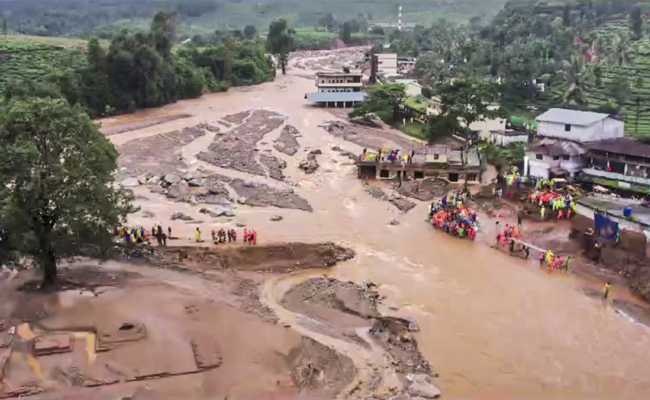
New Delhi (PTI): Climate change, fragile terrain and loss of forest cover created the perfect recipe for the devastating landslides in Kerala's Wayanad district that claimed 123 lives, according to studies conducted over the years.
Extremely heavy rain triggered a series of landslides in the hilly areas of Wayanad early Tuesday. While 128 people were injured, many are feared trapped under the debris.
According to the landslide atlas released by the Indian Space Research Organisation's (ISRO) National Remote Sensing Centre last year, 10 out of the 30 most landslide-prone districts in India were in Kerala, with Wayanad ranked 13th.
It said 0.09 million square kilometres in the Western Ghats and the Konkan hills (Tamil Nadu, Kerala, Karnataka, Goa and Maharashtra) were prone to landslides.
"The vulnerability of inhabitants and households is more significant in the Western Ghats due to the very high population and household density, especially in Kerala," the report read.
A study published by Springer in 2021 said all landslide hotspots in Kerala were in the Western Ghats region and concentrated in Idukki, Ernakulam, Kottayam, Wayanad, Kozhikode and Malappuram districts.
It said about 59 per cent of total landslides in Kerala occurred in plantation areas.
A 2022 study on depleting forest cover in Wayanad showed that 62 per cent of forests in the district disappeared between 1950 and 2018 while plantation cover rose by around 1,800 per cent.
The study, published in the International Journal of Environmental Research and Public Health, said around 85 per cent of the total area of Wayanad was under forest cover until the 1950s.
According to scientists, climate change was increasing the possibility of landslides in the Western Ghats, one of the eight "hottest hotspots" of biological diversity in the world.
S Abhilash, director of the Advanced Centre for Atmospheric Radar Research at Cochin University of Science and Technology (CUSAT), told PTI that warming of the Arabian Sea was allowing the formation of deep cloud systems, leading to extremely heavy rainfall in Kerala in a short period and increasing the possibility of landslides.
"Our research found that the southeast Arabian Sea is becoming warmer, causing the atmosphere above this region, including Kerala, to become thermodynamically unstable," Abhilash said.
"This atmospheric instability, allowing the formation of deep clouds, is linked to climate change. Earlier, this kind of rainfall was more common in the northern Konkan belt, north of Mangalore," he added.
Research by Abhilash and other scientists published in the npj Climate and Atmospheric Science journal in 2022 found that rainfall over the west coast of India was becoming more convective.
Convective rainfall is often characterised by intense, short-duration showers or thunderstorms in a small area.
Another study by Abhilash and scientists from the Indian Institute of Tropical Meteorology and the India Meteorological Department, published in Elsevier in 2021, found that one of the hotspots of heavy rainfall in the Konkan region (between 14 degrees north and 16 degrees north) seemed to have shifted southward, with likely fatal consequences.
"An increase in rainfall intensity may suggest a rising probability of landslides in the high to mid-land slopes of the Western Ghats in eastern Kerala during the monsoon seasons," the study said.
The landslides also brought to the fore the unheeded warnings of the "Western Ghats Ecology Expert Panel" set up by the government under ecologist Madhav Gadgil.
The panel submitted its report to the Centre in 2011, recommending that the entire hill range be declared an ecologically sensitive area and divided into ecologically sensitive zones based on their ecological sensitivity.
It recommended a ban on mining, quarrying, new thermal power plants, hydropower projects and large-scale wind energy projects in ecologically sensitive zone 1.
The recommendations have not been implemented even after 14 years due to resistance from state governments, industries and local communities.
Let the Truth be known. If you read VB and like VB, please be a VB Supporter and Help us deliver the Truth to one and all.
Two injuries, one DNF, a DQ as India end messy World Relays campaign

Gaborone (Botswana) (PTI): Amoj Jacob and Ragul Kumar got injured during the men's 4x400m and 4x100 races respectively as India ended their World Athletics Relays campaign in disappointment on the second day of competitions here on Sunday.
The Indian camp had high hopes of making the 2027 World Championships in the men's 4x400m relay but the team did not finish (DNF) the race as Jacob suffered cramps and pulled out of the race after taking the baton from the first leg runner Dharamveer Choudhary. Rajesh Ramesh and Vishal TK were to run in the third and fourth legs.
Those teams which could not qualify for the 2027 Beijing World Championships by reaching the final round of each of the six relay events on Saturday were given another chance in the second qualification round on Sunday.
The top two teams in each of the two heats (in all six relay events) booked the Beijing ticket on Sunday.
India will now have to try and qualify for the World Championships through the Top Lists of the World Athletics, which is a long and tedious process.
In the men's 4x100m race, third leg runner Ragul Kumar fell down the track after failing to hand over the baton inside the exchange zone to fourth leg runner Gurindervir Singh, which clearly showed the lack of coordination among the runners.
Harsh Santosh Raut and Animesh Kujur ran the first two legs.
The Indian quartet was disqualified and Kumar was seen being taken away from the Field of Play with the help of the volunteers.
It was a comedy of errors in the case of the women's 4x100m race, which saw the baton being dropped during an exchange between first leg runner Tamanna and second runner Nithya Gandhe, though the Indians finished the race in 53.09 seconds.
Gandhe started running quite a distance, but after realising that the baton was not in her hand, she turned and ran back to pick it up.
The only silver-lining for the Indian contingent was the national record time in the mixed 4x100m relay race, though the quartet of Ragul Kumar, Nithya Gandhe, Animesh Kujur and Sneha SS finished sixth in heat number two with a time of 41.35 seconds, bettering the previous national mark of 42.30 seconds set in March in Chandigarh.
The mixed 4x400m relay quartet of Theerthesh P Shetty, Kumari Saloni, Nihal William and Rashdeep Kaur ended at fifth in heat number one with a time of 3 minutes and 19.40 seconds.
On Saturday, all the five Indian relay teams had failed to make it to the respective final rounds and thus missed out on the 2027 World Championships berths.