We are completely immune, says SC; flags half-baked running commentary on pending cases
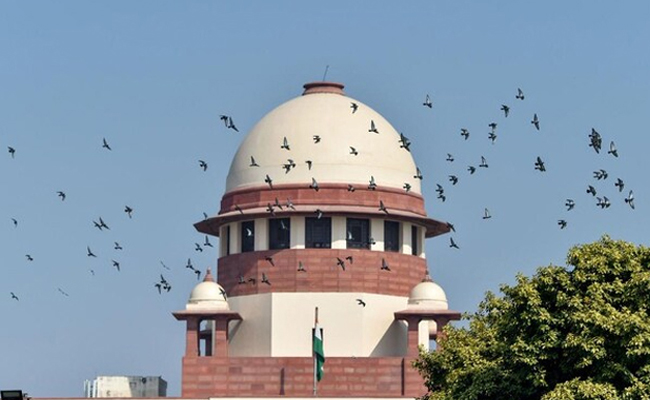
New Delhi (PTI): Observing that half-baked truth and ill-informed running commentary on sub-judice cases affect public perception, the Supreme Court on Friday asserted that it is "completely immune" from reporting of cases for the sake of publicity or narrative building.
The observations were made by a bench comprising Chief Justice Surya Kant and Justices Joymalya Bagchi and Vipul M Pancholi during the hearing of a case concerning the repatriation of certain individuals deported to Bangladesh, when Solicitor General Tushar Mehta took strong exception to a news article published in an English daily on the issue.
"There is a concurrent and simultaneous narrative-building exercise going on. I am sure it does not affect your lordships. There are certain tabloids which are normally known and used for narrative building exercises. Unfortunately, today, to my amazement and shock, I read a front page story in a reputable and dependable newspaper like..., it must have escaped the editorial attention," the law officer said.
During the proceedings, the court was informed that Sunali Khatun, a pregnant woman, and her eight-year old son have come back to India and currently, she is getting medical attention at her father's residence in Birbhum in West Bengal.
ALSO READ: Shivakumar will become CM after ongoing winter session of Karnataka legislature: Cong MLA
The bench fixed January 6 to hear the Centre's appeal against a Calcutta High Court judgement that directed the repatriation of certain individuals deported to Bangladesh on the alleged ground that the due process was not followed.
During the proceedings, the solicitor general Tushar Mehta, appearing for the Centre, raised the issue of the news report.
Terming the reportage as "tabloid-like", the top law officer said, "I do not want to escalate ... but attempts are made to build a particular kind of narrative" in a bid to influence the outcome.
The law officer said he was sure that the bench is not influenced by any such reports, but it does cast doubt about the intention to build a particular kind of narrative.
"My faith was shaken," Mehta said.
"We are completely immune from publicity and pseudo-publicity stunts. Narratives should not affect the lives of individuals," Justice Bagchi said, adding that the judges hardly get time to see newspapers.
Referring to the names of leading English newspapers, the top law officers said they cannot be reduced to "the level of these tabloids, where you plant stories. It is for the newspaper to decide".
Advising the law officer to "just ignore them", the CJI, however, said, "Ideally, ill-informed running commentary on sub-judice matters should not be made."
"The problem is half-baked distorted facts and ill-informed facts are being reported," he said.
"Reporting that a matter is coming up (for hearing) is fine. But if you thrust your opinion, then that is an issue. The issue is with half-baked truth and ill-informed opinion which affects public perception," the CJI added.
The CJI assured the law officer saying, "we do not accept pleadings which are outside."
"Once the judgment is passed, any constructive criticism is always most welcome," the CJI added.
Senior advocate Kapil Sibal, appearing for the West Bengal government, referred to the media's role in recent times in countries like the UK and the US, and said immigration issues are part of a "global discourse" and comments and public discourses are held on social media and other platforms.
"People write opinions in the US and England on immigration. As long as you don't attribute motive, it is not sacrilege," Sibal said.
At the outset, senior advocate Sanjay Hegde brought to the court's attention the plight of another deportee, Sweety Bibi, who remains stuck with her husband and two children.
ALSO READ: Six bodies recovered so far from site of Arunachal accident, many still missing
Hegde offered to provide documents proving their Indian citizenship. He urged the solicitor general to take up the other case on humanitarian grounds, saying, "that side of the border is very difficult for Indians."
The law officer assured Hegde that he will look into the issue and the verification may take sometime.
The court said once documents are verified, modalities for their return could be considered in a time-bound manner.
The case involves families who had been working as daily wagers in Delhi's Rohini area for two decades.
They were detained by police on June 18 on suspicion of being illegal Bangladeshi immigrants and deported on June 27.
The Calcutta High Court, in its impugned order, had observed that the deportation violated the Union Home Ministry’s own protocols, which require an inquiry by the state government before deportation.
The high court had noted that the "overenthusiasm" in deporting the detainees disturbed the "judicial climate".
Sibal reiterated this point during the hearing and said, "The Union does no inquiry for 30 days before deporting them."
Let the Truth be known. If you read VB and like VB, please be a VB Supporter and Help us deliver the Truth to one and all.
Punjab CM Mann meets President Murmu, seeks cancellation of membership of 6 RS members
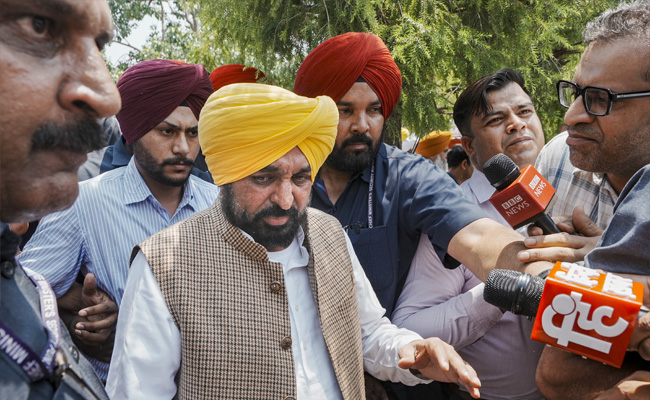
Chandigarh (PTI): Chief Minister Bhagwant Mann on Tuesday met President Droupadi Murmu, demanding the termination of the membership of six Rajya Sabha MPs from Punjab who defected to the BJP and also pressed for the introduction of a constitutional provision allowing for the recall of members.
Accompanied by party MLAs and ministers, Mann visited Rashtrapati Bhavan in Delhi.
This meeting followed a significant setback for the Aam Aadmi Party (AAP) on April 24, when seven of its 10 Rajya Sabha MPs -- Raghav Chadha, Ashok Mittal, Sandeep Pathak, Harbhajan Singh, Rajendra Gupta, Vikramjit Sahney and Swati Maliwal -- quit and merged with the BJP, alleging that the party had strayed from its principles, values and core morals. Six of the seven MPs who left AAP hailed from Punjab.
After he met with the President, Mann addressed the media here, describing the departure of the seven MPs as a "murder" of the Constitution. He stated, "Seven MPs merging with another party is completely unconstitutional. I spoke to Rashtrapati ji in detail."
Mann pointed out that he told the President that the BJP holds only two MLA seats (in Punjab), yet now has six MPs in the Rajya Sabha. He questioned, "How can this be possible? Isn't it a mockery of the Constitution?
"If they are such revolutionaries at heart, then they should have resigned from their six seats. The AAP could have sent someone else," Mann said, taking a swipe at them.
He emphasised the need for a recall provision in the Constitution, referencing MP Raghav Chadha's previous demands for such a measure when members fail to meet public expectations.
"Have you lived up to the expectations of the people?" Mann challenged the MPs during his statement.
Mann also presented a letter to the President, signed by all AAP MLAs. He differentiated between the terms 'elected' and 'selected,' stating, "They were 'selected.' Therefore, their membership should be cancelled."
The President assured Mann that she would consult constitutional experts before responding.
Earlier in the day, Mann, along with party MLAs, departed for Delhi from Chandigarh.
Speaking to reporters in Chandigarh, Mann affirmed that all AAP MLAs stand united with the party. "Only I have been given time for the meeting," Mann said.
"The President is the guardian of the Constitution. She is the constitutional head of the country," he added.
Later in a post on X in Hindi, Mann said, "Our struggle to protect Punjab's rights and interests continues. Today, along with all AAP MLAs, I have left to discuss Punjab's burning issues and present the state's strong voice before the President.
As your public servant, our government remains fully committed to Punjab's prosperity and the safeguarding of the rights of every section of society."
The MLAs and ministers gathered at the chief minister's residence in the morning before heading to Delhi, carrying placards that read 'Punjab Mann De Naal' and 'Punjab's Traitors.'
The legislators left for Delhi in buses.
Mann had previously sought an appointment with the President to meet with party MLAs and demand the "recall" of the Rajya Sabha MPs who defected to the BJP. However, only Mann was given a time slot for the meeting.