We are not man-eating tigers, states should not fear us: Supreme Court
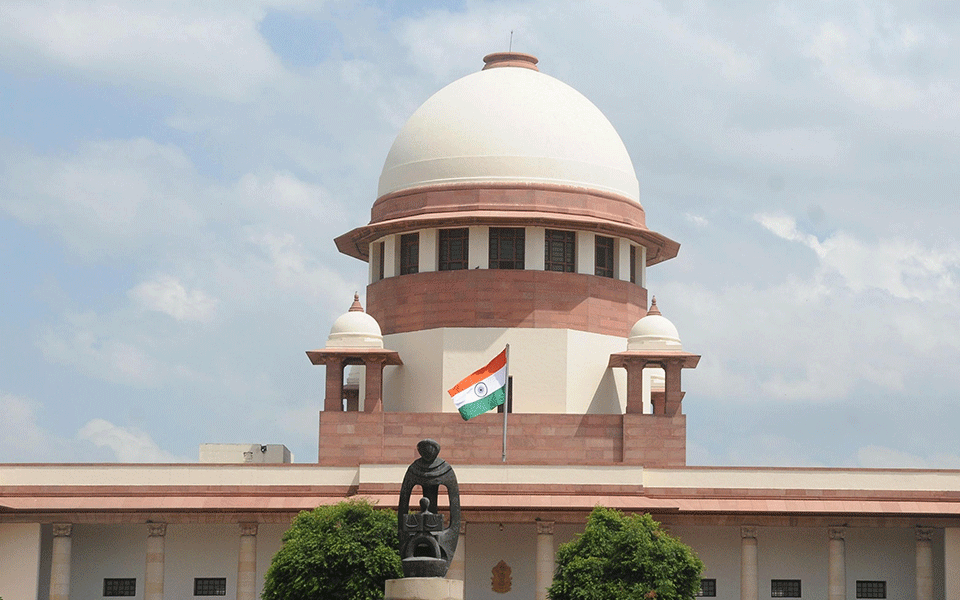
New Delhi, Sept 21: States should not fear if a matter is pending before the Supreme Court as it is not a “man-eating tiger”, the top court has said.
“We are not a tiger or something. We are not man-eating tigers. They (states) should not have fear,” a bench of Justices Madan B Lokur and Deepak Gupta observed.
The court’s observation came when senior advocate Mukul Rohatgi, appearing for a private firm, argued that a petition filed against the company, alleging illegal mining in Andhra Pradesh, was aimed at pressurising the state government.
The counsel for Andhra Pradesh placed on record a recent order passed by the state government suspending mining operations by the Trimex Group. Rohatgi said this was not a case of illegal mining and the state has taken this decision as the apex court was hearing the matter.
Advocate Prashant Bhushan, appearing for petitioner and former senior bureaucrat EAS Sarma, said the state has only ordered suspension of the licence, but they should cancel it and recover the money from the company.
“The petition has been filed to pressurise the state to take a call. There is no case at all to say that it is illegal. We have to challenge it (order passed by the state),” Rohatgi said.
When he claimed that the state government’s order has made the “attempt” by the petitioner “successful”, the bench observed “a state government is not such helpless that one or two persons can coerce them.”
It posted the matter for further hearing on September 27.
On July 9, the apex court had sought the reply of the Centre, Andhra Pradesh and the firm on the petition seeking a court-monitored SIT or CBI probe into the alleged illegal mining being carried out by the company in Andhra Pradesh.
Sarma, a former secretary to the union government, has alleged in his plea that the group was involved in illegal and unlawful activities, including mining and export of various minerals such as Monazite which is a prescribed substance as per the notifications issued under the Atomic Energy Act, 1962.
Claiming that such illegal mining has destroyed the environment and tree cover of the region, the plea has sought termination of the group’s mining licence for violating various laws and sought a probe into the alleged illegal mining in the area.
It has also demanded a direction to the authorities to recover from the company the allegedly illegally accumulated wealth through illegal mining and related activities and launching of prosecutions under sections of the 1957 Mines and Minerals (Development and Regulation) Act.
The money recovered should be used for the restoration of the environment, the plea has sought.
Courtesy: www.hindustantimes.com
Let the Truth be known. If you read VB and like VB, please be a VB Supporter and Help us deliver the Truth to one and all.
Akeal Hosein bosses powerplay overs with 'skill and mental fortitude'

New Delhi (PTI): For a spinner who bowls majority of his overs in the powerplay, Chennai Super Kings' West Indian import Akeal Hosein relies as much on mental fortitude as his skills to excel in the most unforgiving phase of the game.
With just two fielders in the deep in the first six overs, the margin for error is miniscule and the pressure is sky high.
However, Hosein thrives in that tense environment. The left-arm spinner returned with frugal figures of 3-0-15-1 in the powerplay to play a crucial role in his team's eight-wicket win over Delhi Capitals in an IPL match here on Tuesday.
"You need both of them (skill and mental toughness). Especially when you come upon pitches that aren't conducive to spin and it's just about being disciplined as well," he said.
"Having two fielders out in the power play. It's not a job that you can go searching for wickets or you can be too greedy. It's just about sticking to the plan," he explained.
Hosein got the all-important wicket of an in-form K L Rahul, who was foxed by the West Indian as he stepped out to smash him for an inside out six.
Hosein's inclusion in the playing eleven after not being picked in the initial phase of the tournament has allowed CSK to win more games. On Tuesday, the pitch offered him a bit of help and he ended up dominating the batters.
After the win over DC, Hosein was asked about his recipe for success in the powerplay.
"...it's a bit scripted because you only have two guys out so it's just about being disciplined and trying to do the job for the team. At the end of the day if you don't get wickets and you bowl economically in the power play, that's a damn good job you've done for the team," said Hosein.
He has taken seven wickets in five games at an impressive economy rate of 7.25.
Fully aware that the batter is a mere couple of hits away from putting the pressure back on him, Hosein says practising for high-pressure situations helps him stay in the present.
"I think homework is very important. You want to have that head-start when you come up against whichever batter you're going to face. And like I say it's just about making assessments as quickly as possible.
"You might come up on a pitch that is spinning. You might come up against one that isn't spinning. Thankfully I can spin the ball. So it's just about picking which deliveries will give you the most success on a particular day and against a particular batter," said Hosein.
He got rid of Rahul first ball from the other end, something that was decided by captain Ruturaj Gaikwad. Post powerplay, Noor Ahmad took over the mantle from Hosein and maintained the pressure on DC batters.
"Getting the opportunity to bowl first for me is just about again making that assessment as quickly as possible and then passing on that information to Noor or even to the seamers as well if it was a bit of spin or if it's gripping or whatever the case is.
"So conversations with myself and Noor have been fantastic. Really happy for him that he's getting some success," he added.