We want to conclude ASEAN-India trade in goods deal by this year: Malaysian PM
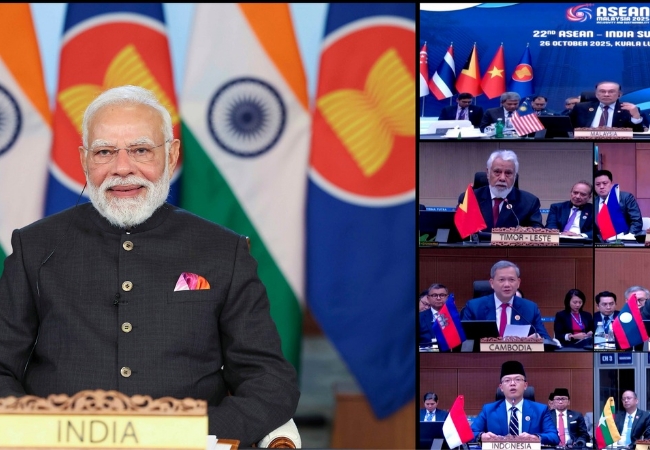
New Delhi (PTI): The comprehensive strategic partnership between India and the ASEAN grouping is emerging as a powerful foundation for global stability and growth amid uncertainties, Prime Minister Narendra Modi said on Sunday.
In a virtual address at the India-ASEAN (Association of Southeast Asian Nations) annual summit, Modi reaffirmed New Delhi's strong support to the grouping's centrality in the Indo-Pacific.
ASEAN is considered one of the most influential groupings in the region, and India and several other countries, including the US, China, Japan and Australia, are its dialogue partners.
Malaysia is hosting the annual ASEAN summit and related meetings in Kuala Lumpur in its capacity as the current chair of the grouping.
In his remarks, Malaysian Prime Minister Anwar Ibrahim said there has been "some real progress" in the ASEAN-India Trade in Goods Agreement (AITIGA) and that the grouping wants to conclude it by this year.
Modi declared 2026 as the "ASEAN-India year of maritime cooperation". The prime minister also welcomed Timor-Leste as the newest member of ASEAN.
"India and ASEAN together represent nearly one-fourth of the world's population. We not only share geography; we are also bound by deep historical ties and shared values," Modi said.
"We are companions in the Global South. We are not only commercial partners but also cultural partners. ASEAN is a cornerstone of India's Act East Policy."
The prime minister said India has always fully supported ASEAN centrality and ASEAN's outlook in the Indo-Pacific.
"Even in this era of uncertainties, the India-ASEAN Comprehensive Strategic Partnership has continued to make steady progress. And this strong partnership of ours is emerging as a robust foundation for global stability and development," he said.
The prime minister said both sides are steadily advancing cooperation in areas of education, tourism, science and technology, health, green energy and cybersecurity.
"We will continue to work together to preserve our shared cultural heritage and strengthen people-to-people ties," he said.
"The 21st century is our century, the century of India and ASEAN. I am confident that the ASEAN Community Vision 2045 and the goal of Viksit Bharat 2047 will build a bright future for all of humanity," he said.
India is committed to working shoulder-to-shoulder in this direction, he said.
Modi said the ASEAN Summit's theme of "Inclusivity and Sustainability" is clearly reflected in the joint efforts, whether it is digital inclusion or ensuring food security and resilient supply chains amid current global challenges.
"India fully supports these priorities and is committed to advancing them together," he said.
"India has stood firmly with its ASEAN friends in every disaster. Our cooperation in HADR (Humanitarian Assistance and Disaster Relief), maritime security and the blue economy is growing rapidly," he said.
"In view of this, we are declaring 2026 as "ASEAN-India Year of Maritime Cooperation," he noted.
The ASEAN-India dialogue relations started with the establishment of a sectoral partnership in 1992. This graduated to full dialogue partnership in December 1995 and summit level partnership in 2002.
The ties were elevated to a strategic partnership in 2012.
The two-way relations between India and ASEAN have been on a significant upswing in the last few years, with focus being on boosting cooperation in the areas of trade and investment as well as security and defence.
In his comments, the Malaysian prime minister said that the India-ASEAN relationship remained a "force for stability and mutual prosperity".
Let the Truth be known. If you read VB and like VB, please be a VB Supporter and Help us deliver the Truth to one and all.
Man booked for duping 7 persons of Rs 91 lakh on promise of awarding govt works

Mumbai (PTI): The Mumbai police have registered a case against a man for allegedly duping seven persons of Rs 91 lakhs on the promise of awarding them works of different government departments, an official said on Tuesday.
The accused was identified as Satish Kadam, a resident of Nanded in Marathwada region, an official said.
A complaint was filed by Hanumant Vadje, who alleged that the accused cheated him and six others of around Rs 91 lakh by promising to give them various works of Urban Development and Social Justice Department, he said.
The fraud occurred between 2024 and 2026, with Kadam collecting money in cash and into his accounts, police said, adding he had returned some amount to them partially.
Multiple cheques issued by the accused bounced, prompting the victim to lodge a complaint at the Marine Drive police station. Based on the complaint, a case of cheating and criminal breach of trust was registered against him.
The case is under further investigation, the official said.