Were 300 terrorists killed in the IAF air strikes in Balakot?
Here’s what IAF has to say.
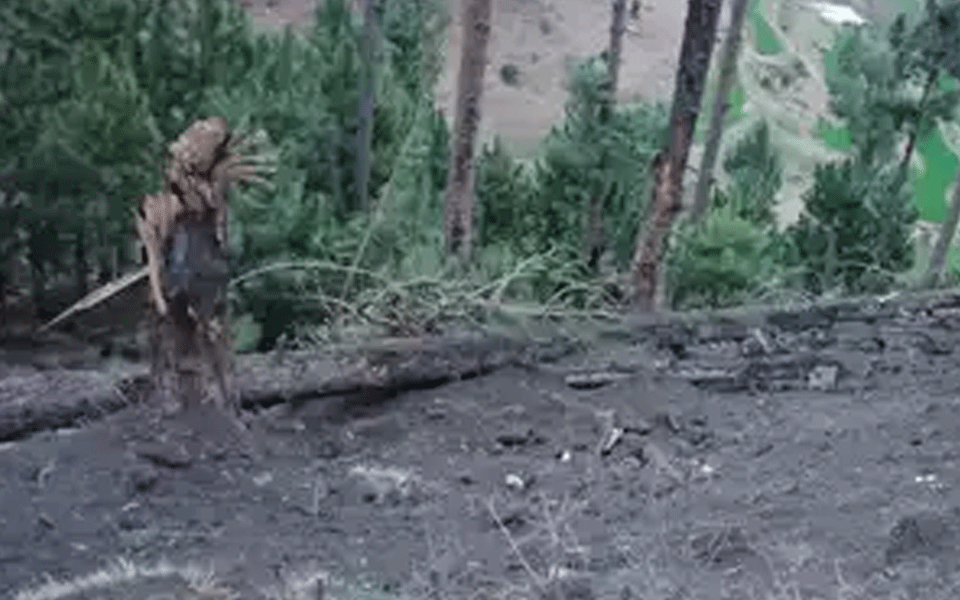
New Delhi: As soon as the news of IAF’s airstrike on Jaish’s training camps across the border in Balakot went viral, media channels hurried and immediately concluded that over 300 terrorists were killed in the air strikes.
Various media channels citing their respective ‘sources’ went on to claim several figures and number claiming it to be the number of terrorists and trainees who were killed in the air strikes.

It started with 200 and went on up to 400 as hours passed by after the strikes. Many channels also reported that IAF ‘eliminated’ Maulana Yousuf Azhar, who is the brother-in-law of Masood Azhar, chief of terror group Jaish-e-Mohammed.
No official data or military sources were quoted all this while by any news channel.
However, according to a report published in News Laundry on Thursday, during the joint press conference of Indian Armed Forces, which had Army’s Major General Surindar Singh Mehal, Navy’s Rear Admiral Dalbir Singh Gujral and Air Vice Marshal RGK Kapoor of IAF, the officials refused to confirm the exact number of terrorists killed in the strikes.
According to the report, Ajit Dubey of ANI enquired about the number of terrorists killed. To which RGK Kapoor termed it ‘premature’ to give an exact figure.
“There is fairly credible evidence with us which proves that there was damage to the camps. The weapons hit the intended target and they caused the damage that was intended. However, it will be premature to say what is the number of causalities we have been able to inflict on those camps and what is the number of death” RGK Kapoor was quoted as saying.
This statement from the official ‘source’ has now raised questioned about the credibility of ‘sources’ of news channels and has also pitched the question of ‘where did the figure of 300-400 came from’?


Let the Truth be known. If you read VB and like VB, please be a VB Supporter and Help us deliver the Truth to one and all.
4 workers die after being buried under coal slurry in Jharkhand's Dhanbad

Dhanbad (Jharkhand) (PTI): At least four workers died after being buried under coal slurry in Jharkhand's Dhanbad district on Saturday, a police official said.
The incident took place at Moonidih coal washery in the command area of Bharat Coking Coal Limited (BCCL).
"Bodies of all four workers were dug out of debris during a rescue operation," Putki police station in-charge Waqar Hussain told PTI.
The incident took place when coal slurry was being loaded into trucks by workers, during which a large chunk of slurry fell and trapped several workers underneath, officials said.
The deceased have been identified as Manik Bauri, Dinesh Bauri, Deepak Bauri, and Hemlal Gope.
Meanwhile, the family members of the deceased and local villagers placed the bodies in front of the washery gate and began a protest.
They demanded compensation, jobs for dependents and action against those responsible for the incident.
Police and administration officials are trying to pacify the protesters, an official said.