What does Republic Day mean when Constitutional rights are not given, says Wangchuk's wife
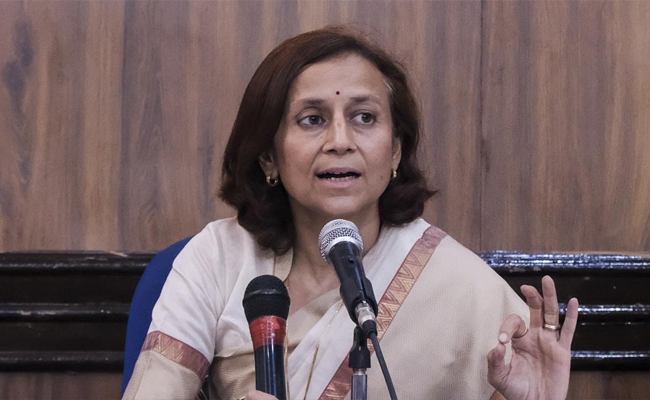
New Delhi (PTI): As the 77th Republic Day was celebrated across the country with displays of military might and cultural heritage, HIAL co-founder and wife of climate activist Sonam Wangchuk, Gitanjali J Angmo said it was the first time she did not feel motivated to watch the parade.
Questioning the meaning of Republic Day when rights guaranteed in the Constitution were not being granted, Angmo pointed out that it has been four months since Wangchuk was "unlawfully" arrested.
"It is 4 months... 120 days of Sonam Wanghuk's unlawful and illegal detention! For the first time ever since I can remember, I did not feel motivated to watch the Republic Day parade on TV which my mom and I had never missed," Angmo said.
"It is sad but I don't know how to feel proud of what is showcased anymore! What to believe and what not to! Where is the truth lying in all this narrative of the rise of India amongst the great nations of the world," she said.
Wangchuk, a Magsaysay Award-winning climate activist and educator, was detained under the stringent National Security Act (NSA) on September 26, two days after protests demanding statehood and Sixth Schedule status for Ladakh left four people dead and 90 injured in the Union territory.
"When Constitutional safeguards available are not given to a region that legitimately deserves it, how is it Republic Day? The Constitution guarantees to put out a point of view in democracy... When you do that, you are jailed... There is no respect for the Constitution that we are celebrating," Angmo told PTI.
"How much of taxpayers' money is spent on pageantry. It is for the nation, so that all can feel proud of our achievements... but has to be built on a solid foundation. When foundation is shakey, you can't inspire people based on pageantry," she said.
Angmo, the co-founder of the Himalayan Institute of Alternatives Ladakh (HIAL), said there is a "certain disillusionment".
"It is not just a personal thing... There is a lot of trust in the parade, and the military capabilities... there is a lot of pride. But how much of this is true and how much is a facade?" she asked.
"There is a certain disillusionment when we see the real issues are not being addressed... like pollution, no one is talking about it... unemployment, the state of education, schools being shut..." she said.
Citing an example, she said, "They talk about carbon neutral Ladakh, but something so tried and tested -- the passive solar building -- there is no thrust in ensuring all buildings that come up in Ladakh are built that way. All government buildings are being constructed as regular cement-mortar buildings".
After being arrested, Wangchuk was taken to jail in Jodhpur soon after he ended his 15-day fast over the demands pertaining to the Sixth Schedule and statehood for Ladakh, as violence erupted in Leh.
Let the Truth be known. If you read VB and like VB, please be a VB Supporter and Help us deliver the Truth to one and all.
Unidentified men set fire to TVK campaign office near Srirangam
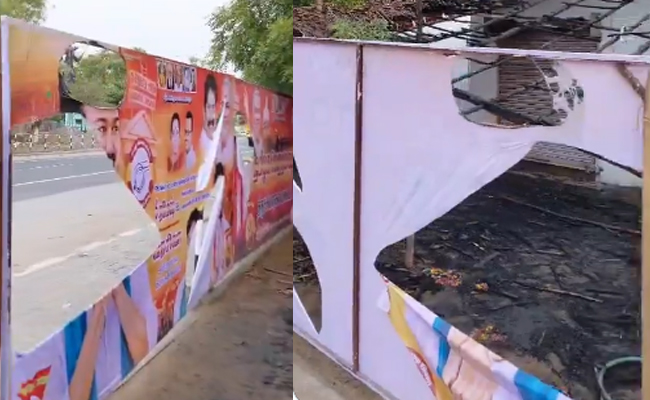
Tiruchirapalli (PTI): A campaign office of the actor Vijay-led TVK was allegedly torched by unidentified miscreants in Kamanayakkanpalayam village near Srirangam in the early hours of Friday, police said.
According to the police, the damage is minimal. Fire had engulfed the thatched roof providing shade at the entrance of the building that served as the party’s election office for the Srirangam constituency.
While on social media, a CCTV footage of two unidentified men fleeing on motorbike is being circulated as the culprits, police said the video footage is yet to be verified.
Based on a complaint lodged by TVK, the Pettaivaithalai Police have registered a case and initiated a search for the perpetrators.
திருவரங்கம் தொகுதியில் த.வெ.க வேட்பாளரின் தேர்தல் அலுவலகம் மர்ம நபர்களால் தீவைக்கப்பட்டு சேதப்படுத்தப்பட்டுள்ளது. @TNelectionsCEO @ECISVEEP#TVKVijay #தமிழகவெற்றிக்கழகம் pic.twitter.com/ImDZfTkuAq
— Thanjavur_District_Head (TVK) (@TVK_Thanjai) May 1, 2026