What is a ‘substantive motion’? BJP MP initiated one against Rahul Gandhi? Full details here
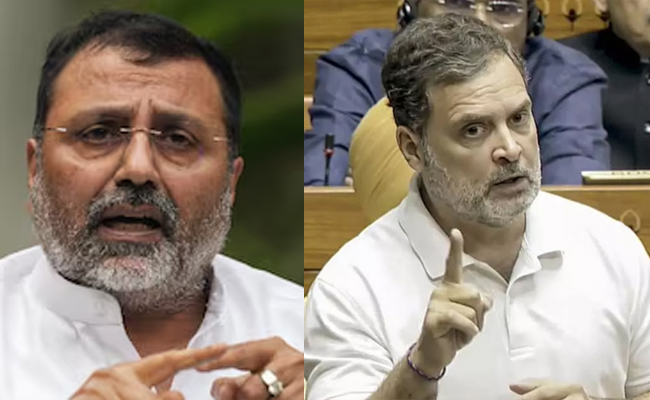
New Delhi: Bharatiya Janata Party (BJP) MP Nishikant Dubey on Thursday said he has initiated a substantive motion against Leader of Opposition in the Lok Sabha Rahul Gandhi, alleging that he was “hand in glove” with “anti-national” forces.
After Dubey raised the matter during the zero hour in the house, protests ensued leading to adjournment for the day.
In his notice, Dubey accused Rahul Gandhi of having engaged with the Soros Foundation, the Ford Foundation, and USAID, and had travelled to Thailand, Cambodia, Vietnam, and the United States to carry out “anti-India” activities.
Speaking to the presspersons outside Parliament, Dubey said he had demanded cancellation of Gandhi’s membership and sought that he be banned from contesting elections for life time.
Dubey had earlier, in February 2025, filed a privilege motion against Rahul Gandhi accusing him of distorting facts and attempting to undermine the prestige of the country through his speech in the Lok Sabha.
While Parliamentary Affairs Minister Kiren Rijiju had indicated that the government might move a privilege motion, but government sources on Thursday said no such decision had been taken.
Responding to the motion, Congress general secretary K. C. Venugopal stated that the Congress party was “not bothered about any motions.”
Venugopal criticised the removal of parts of Rahul Gandhi’s speech during the Lok Sabha debate on the India-U.S. interim trade deal, in which Gandhi had accused the government of compromising national interests.
He also defended the Congress’ move to submit a notice seeking the removal of the Lok Sabha Speaker, stating that the party had not been receiving justice from the Chair.
Responding to the BJP’s criticism, he asked what privilege Gandhi had violated and said that despite past action against him, voters had returned him to Parliament with a higher margin.
What is a substantive motion?
A substantive motion is a formal proposal brought before the Lok Sabha to get a clear and final decision from the House.
It is a complete proposal by itself and is not connected to any other matter being discussed. If the House approves it, the motion becomes the official opinion or decision of the Lok Sabha on that issue.
According to the Lok Sabha rules, such a motion can be taken up only if the Speaker allows it. The Speaker has full authority to accept or reject the proposal and also decides when and how it will be discussed.
If the Speaker admits the motion, members can debate it and then vote on it. In some cases, the matter may also be sent to a special committee to study the issue and submit a report.
A substantive motion forces the House to seriously consider a specific issue and take a clear stand. Since Rahul Gandhi is the Leader of the Opposition, which is a constitutional position, any action against him must follow a proper parliamentary process. A substantive motion provides that proper procedure.
Let the Truth be known. If you read VB and like VB, please be a VB Supporter and Help us deliver the Truth to one and all.
Meghalaya: Interstate ATM theft racket busted, 6 arrested

Shillong (PTI): An interstate racket involved in ATM thefts across several states has been busted, with the arrest of six persons in connection with a break-in at an electronic banking outlet in Meghalaya's Ri-Bhoi district, police said on Wednesday.
The accused were allegedly involved in breaking into an ATM of the Meghalaya Cooperative Apex Bank on April 5, 2024, they said.
Three of the accused were arrested from Barpeta in Assam, while the remaining were apprehended from Haryana, police said.
Ri-Bhoi SP Giri Prasad M said a special police team was constituted to investigate the case.
"With coordinated efforts and assistance from Assam and Haryana Police, we were able to apprehend the accused involved in the ATM break-in," he told PTI.
The case was registered at Umiam police station under sections of the Bharatiya Nyaya Sanhita (BNS).
According to police, the gang used gas cutters to break open the ATM safe and fled with the cash within minutes.
"The group is part of a larger network involved in similar ATM thefts across different states. Further investigation is underway to dismantle the entire network," the SP added.