When bank officials tried locating PM Modi for 32 years
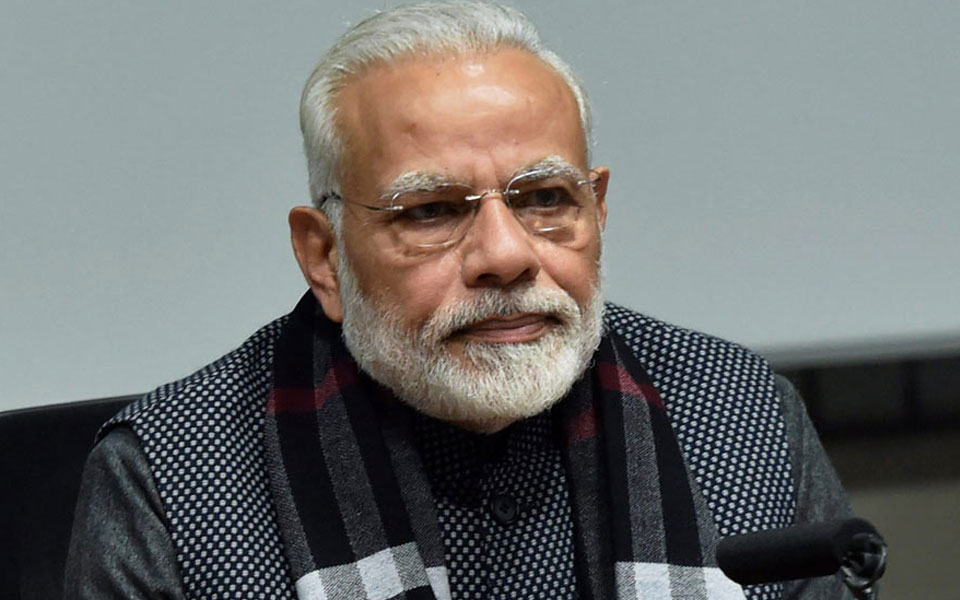
New Delhi : Never had enough money till I became an MLA for an operational bank account, Prime Minister Narendra Modi said on Saturday during his speech at the launch of India Post Payments Bank in New Delhi.
PM Modi said he had one account with Dena Bank during his school days when the bank opened for students a piggy bank account. His account remained empty, however, he added.
The prime minister added that the bank officials tried locating him for 32 years to close the account after he had left the village.
"After 32 years, they got to know I was at a particular place so the bank officials came there and said please sign, we need to close your account," PM Modi said adding that after he became MLA in Gujarat and started drawing a salary, he had to open an account. "Before that, there was no (operational) account," he said.
PM Modi on September 1 launched IPPB that will have 650 branches and 3250 access points across the country.
IPPB, the payments bank of Indian postal department that will take banking to doorstep of every citizen through an unmatched network of post offices and almost 3 lakh postmen and 'Grameen Dak Sewaks'.
"IPPB has been envisioned as an accessible, affordable and trusted bank for the common man, to help speedily achieve the financial inclusion objectives of the Central government. It will leverage the vast network of the department of posts, which covers every corner of the country with more than 300,000 postmen and Grameen Dak Sewaks. IPPB will hence significantly augment the reach of the banking sector in India," said a government statement.
"The IPPB will offer a range of products such as savings and current accounts, money transfer, direct benefit transfers, bill and utility payments, and enterprise and merchant payments. These products, and related services, will be offered across multiple channels (counter services, micro-ATM, mobile banking app, SMS and IVR), using the bank's state-of-the-art technology platform," the statement added.
courtesy : indiatoday.in
Let the Truth be known. If you read VB and like VB, please be a VB Supporter and Help us deliver the Truth to one and all.
26 killed, 61 injured in blast at fireworks factory in China
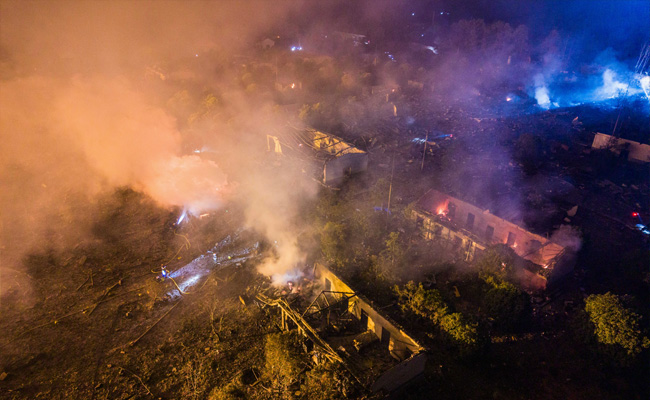
Beijing (PTI): At least 26 people were killed and 61 others injured in a massive explosion at a fireworks factory in China's Hunan province, officials said on Tuesday.
The explosion occurred on Monday afternoon at the plant operated by the Huasheng fireworks manufacturing and display company in Liuyang, a county-level city under Changsha, the provincial capital.
Videos circulating on Chinese social media showed massive destruction of property spanning several kilometres.
ALSO READ: Will of people supreme, says Mahua Moitra after BJP's landslide victory in Bengal
More than 480 rescuers, organised into five teams, have been deployed for relief operations, with three rescue robots pressed into service.
Officials said 26 people were killed and 61 others were injured. The injured have been rushed to hospitals for treatment, while a second round of search operations is underway.
China is a leading manufacturer and exporter of fireworks.
As the explosion site is located near two black powder warehouses, the rescuers have evacuated nearby residents and set up a buffer zone to prevent a secondary accident, the state-run Xinhua news agency reported.
The Ministry of Emergency Management has dispatched experts to the scene to guide rescue efforts.
The person in charge of the company has been detained by police and the cause of the accident is being investigated, the report said.