When Investigations Weren't Suiting Government: Alok Verma's Petition
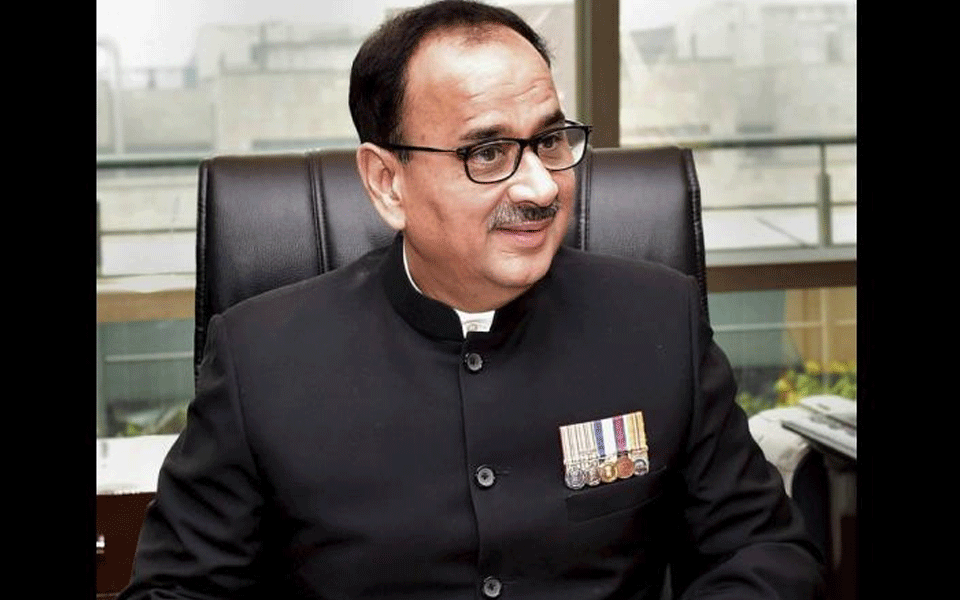
NEW DELHI: Alok Verma, the CBI chief who has been exiled into leave, has told the Supreme Court that the autonomy of the country's premier investigating agency is being compromised and by malintent that includes when "certain investigations into high functionaries do not take the direction that may be desirable to the government".
Mr Verma was replaced as the top boss of the CBI in a 1 am coup that saw the CBI headquarters in the capital being cordoned off by the police before the man chosen as the new CBI head, M Nageswar Rao, drove in and took charge.
Like Mr Verma, the CBI's No. 2 officer, Rakesh Asthana, has also been sent on leave; this was necessitated to "maintain the CBI's integrity", claimed Finance Minister Arun Jaitley today. The minister cited the public feud between Mr Asthana and Mr Verma - both men have accused each other of accepting bribes worth crores by men being investigated by the CBI. Earlier this week, the CBI named Mr Asthana as an accused in an FIR; yesterday, he asked the Delhi High Court to cancel that FIR or police case; it did not do that, but it banned the CBI from arresting him till Monday, when it will next hear the case.
Mr Verma has challenged his removal in the Supreme Court which will hear his case on Friday. His petition says that Mr Asthana "concocted evidence" against him to accuse him of corruption and that he was inevitably at odds with the opinion of majority officers in sensitive cases.
"Not all influence that is exerted by the political government would be found explicitly or in writing. More often than not it is tacit and requires considerable courage to withstand," says the petition. Mr Verma also promises to give details of "many cases that have led to the present circumstances".
The opposition has alleged that Mr Verma has been sent on leave - effectively sacked - because he was weighing an inquiry into India's purchase in 2015 of 36 Rafale fighter jets from France; earlier this month, Mr Verma personally met with Arun Shourie, Prashant Bhushan and Yashwant Sinha, all critics of the Modi government, when they filed a complaint about corruption in the Rafale deal; his in-person greeting of them to accept their complaint had angered the government, NDTV had reported.
Mr. Asthana is known for his proximity to BJP chief Amit Shah and Mr Verma's removal today is seen as a major victory for him. Mr Asthana was made No. 2 in the CBI though he was tainted by allegations of accepting favours and bribes and was named in six cases being investigated by the CBI. While a senior police officer in Gujarat, he handled the case involving the Godhra train burning, which led to three-day communal violence across Gujarat in 2002, and the Sohrabuddin Sheikh fake encounter case, in which Amit Shah was discharged.
Courtesy: www.ndtv.com
Let the Truth be known. If you read VB and like VB, please be a VB Supporter and Help us deliver the Truth to one and all.
BCI urges CJI to take action against Andhra HC judge for sending young lawyer to 24-hour custody
New Delhi (PTI): The Bar Council of India on Wednesday sought the urgent intervention of Chief Justice of India Surya Kant following a "deeply disturbing" incident where a judge of the Andhra Pradesh High Court reportedly sent a young advocate to
24-hour judicial custody over a procedural lapse.
The Bar Council of India (BCI) Chairperson and senior advocate Manan Kumar Mishra, in a formal representation, termed the conduct of Justice Tarlada Rajasekhar Rao "grossly inappropriate" and "damaging to the confidence of the Bar".
“I most respectfully request your Lordship to kindly take immediate institutional cognizance of the matter and call for the video recording of the proceedings, the order passed, and the surrounding circumstances.
“I further request that appropriate administrative action may kindly be considered, including withdrawal of judicial work from the learned Judge pending review, his immediate transfer to some far off High Court, and his nomination for appropriate judicial training/orientation on court management, judicial temperament, Bar-Bench relations, and proportional exercise of contempt/judicial authority,” Mishra wrote.
This representation is made to preserve the “dignity, moral authority and public confidence of the judiciary”, he said, adding, “Judges command the highest respect not by fear, but by fairness, patience, restraint and constitutional humility”.
The communication urged the CJI to intervene at the earliest to ensure that the faith of Bar, particularly young advocates, in the protective and corrective role of the judiciary is restored.
The controversy stems from proceedings on May 5.
According to the BCI, a video circulating online shows Justice Rao rebuking a young advocate who was unable to produce a specific order copy during a hearing.
The letter said that despite the advocate "repeatedly seeking pardon and mercy" and claiming he was in physical pain, the judge remained "unmoved".
The judge allegedly told the lawyer, "now you will learn," and mocked his experience before directing the Registrar and police personnel to take him into custody for 24 hours.
The BCI chairperson said that the judge’s actions lacked proportionality and fairness.
"The dignity of the court is not enhanced when a lawyer is made to beg for grace in open court and is still sent to custody for a procedural lapse," the letter said.
"A young lawyer... is an officer of the Court, still learning, still growing, and entitled to correction without humiliation," it added.
The bar body said that such actions create a "chilling effect" on the legal fraternity, particularly among junior members, and undermine the mutual respect required between the Bench and the Bar.