When Mahatma Gandhi Raised Rs. 6,000 For Kerala Flood Relief 94 Years Ago
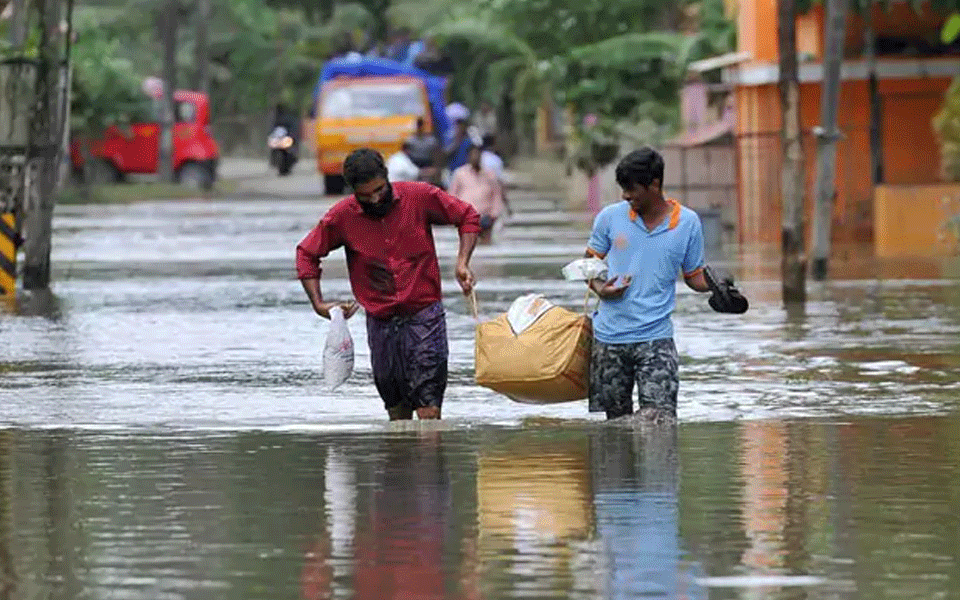
THIRUVANANTHAPURAM, August 26: Nearly a century ago when floods ravaged Kerala, Mahatma Gandhi had termed the misery of the people as "unimaginable" and stepped in to mobilise over Rs. 6,000 to help them, records show.
If the present rain fury has claimed over 290 lives and displaced over 10 lakh people, the massive floods that crippled the state in July 1924 are believed to have claimed a large number of lives and caused widespread destruction.
Mahatma Gandhi, through a series of articles in his publications 'Young India' and 'Navajivan', had urged people of the country to generously contribute for the relief of the flood-hit 'Malabar' (Kerala).
Following his appeal, people from various walks of life including women and children had donated even their gold jewels and meagre savings to help the flood-affected people.
Many had skipped a meal daily or given up milk to find money to contribute to relief fund mobilised by Gandhi, according to the journals penned by him.
The "Father of the Nation" had mentioned in one of his articles in 'Navajivan' about a girl who had stolen three paise to contribute to the relief fund.
"Malabar's misery is unimaginable," Mahatma had said in the article titled "Relief Work in Malabar".
He said he had to "confess" that the response to his appeal had been "more prompt" than he expected.
"It has been proved not once but many times that, by God's grace, compassion does exist in the hearts of the people."
Many funds had been launched for collecting relief amounts and people could contribute whichever one they choose.
"I would only urge that pay, they must," Mahatma Gandhi had said.
The massive flood that lasted for around three weeks in July 1924 had crippled and submerged various parts of the then Kerala including hilly Munnar, Trichur (Thrissur now), Kozhikode, Ernakulam, Aluva, Muvattupuzha, Kumarakom, Chengannur and Thiruvananthapuram.
It was commonly referred to as the "Great flood of 99" as it had happened in the 'Kolla varsham' (Malayalam calendar) 1099.
As per records, Kerala, which was administratively fragmented into three princely states (Travancore, Cochin and Malabar) during the time, had received excessive rains.
Just as now, all rivers were in spate and Periyar had flooded following the opening of the sluice gates of the Mullaperiyar Dam.
Freedom fighter, K Ayyappan Pillai has vivid memories about the "Maha pralayam", the great flood of '99.
"I was a school student when the heavy rains and floods submerged various places causing massive devastation. Normal life was crippled in the unabated rain," the 104-year old Ayyappan Pillai told PTI here.
"Roads had turned into rivers... overflowing water bodies... paddy fields inundated...people even sought refuge on hill tops in many parts," he said.
Gandhi, who came to know about the deluge from the state's Congress leaders, had sent them a telegram on July 30, 1924 asking them to assist the relief measures of the government and also work in their own way to help the affected people.
In another telegram, the Mahatma said he was collecting money and clothes and his only thought was about people who had no food, clothes and shelter.
In an article in 'Navajivan' dated August 17, 1924, he said, "A sister has donated her four bracelets and a chain of pure gold. Another sister has given her heavy necklace. A child has parted with his gold trinket and a sister with her silver anklets."
"One person has given two toe-rings. An Antyaja girl has offered voluntarily the ornaments worn on her feet. A young man has handed over his gold cufflinks. Rs. 6994-13 anna-3 paise have been collected in cash up to date," Gandhi said.
In the wake of the present floods, the state-based multi-lingual history website - dutchinkerala.com has carried Mahatma Gandhi's 1924 appeal to contribute to Kerala's relief fund to persuade people across the world to donate to the Chief Minister's distress relief fund.
Meanwhile, donations pouring into the Kerala Chief Minister's Distress Relief Fund (CMDRF) have crossed Rs. 500 crore.
From school children to corporate giants, all are contributing to the relief fund to help rebuild the flood-hit state, whose loss has been estimated to be over Rs. 20,000 crore.
Courtesy: www.ndtv.com
Let the Truth be known. If you read VB and like VB, please be a VB Supporter and Help us deliver the Truth to one and all.
Maharashtra sets up state vaccination task force to strengthen immunisation programme

Mumbai (PTI): The Maharashtra government has set up a State Vaccination Task Force to strengthen the regular immunisation programme and review the progress of related campaigns, a health department official said on Monday.
The State Vaccination Task Force will comprise at least 29 members and will be headed by the administrative head of the health department, he informed.
The government has also constituted separate district-level and municipal vaccination task forces to improve implementation and address challenges at the grassroots level, he said.
Municipal task forces, chaired by respective civic commissioners, have been constituted in view of the vast urban population in Maharashtra and the role of civic bodies in implementing different health programmes.
The district-level task forces will function under the chairmanship of collectors.
"Complete immunisation of children at the appropriate age is an extremely simple, cost-effective and highly effective measure to reduce child mortality and the prevalence of diseases among kids. Immunisation is a powerful tool for reducing illness in children," maintained the official.
To ensure full vaccination of all children, the state government implements various campaigns from time to time as per the central government guidelines, he pointed out.
"Active participation and cooperation of other relevant government departments are essential (in making these campaigns successful)," according to the official.
The state-level body will review the regular immunisation programme, associated campaigns and vaccine-preventable diseases in detail. It will also conduct focused assessments of high-risk districts and municipal corporations, including vacancies at district, municipal and sub-district levels, availability of cold chain equipment, resource gaps and training requirements, he noted.
The state task force will review allocation and utilisation of funds for immunisation and ensure timely action by officers concerned based on reports from district and municipal task forces and state-level monitoring mechanisms, the official said.
It will also ensure active coordination and participation of other government departments in immunisation drives, while district and municipal task forces will carry out similar functions at their respective levels, the official added.