When SC praised Col Sofiya Qureshi while granting PC to women officers in Indian Army
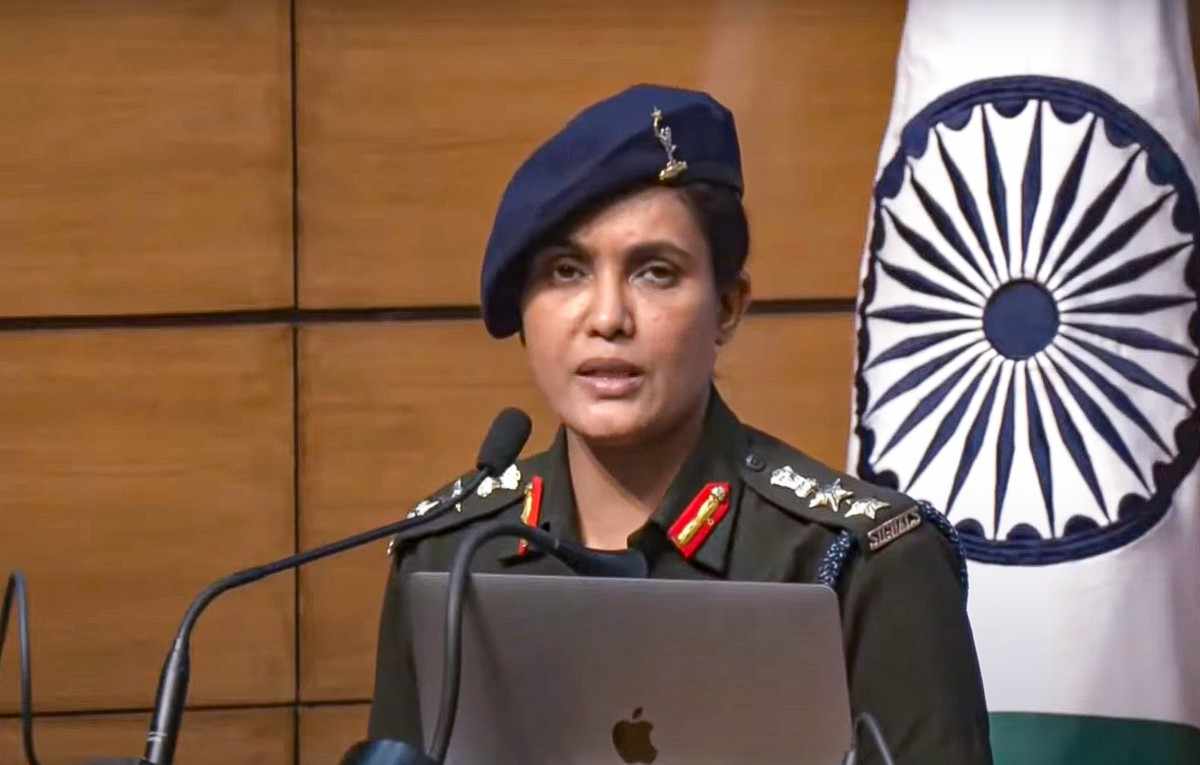
New Delhi (PTI): While ruling in favour of granting Permanent Commission (PC) to women officers in the Indian Army, the Supreme Court in 2020 had acknowledged the achievements of Colonel Sofia Qureshi, one of the two women officers who briefed the media on 'Operation Sindoor' on Wednesday.
In its February 17, 2020, judgement, the top court said that absolute exclusion of women from all positions, except staff assignments, in the Army was indefensible and their blanket non-consideration for command appointments without any justification cannot be sustained in law.
The apex court, which allowed Permanent Commission (PC) to women officers in the Army, said an absolute prohibition of women Short Service Commission (SSC) officers to obtain anything but staff appointments evidently did not fulfil the purpose of granting PC as a means of career advancement in the Army.
The top court also referred to the distinctions achieved by women officers, and put out an example of Col Qureshi's achievements.
"Lieutenant Colonel Sophia Qureshi (Army Signal Corps) is the first woman to lead an Indian Army contingent at a multi-national military exercise named 'Exercise Force 18', which is the largest ever foreign military exercise hosted by India.
"She has served in the United Nations Peacekeeping Operation in Congo in 2006, where she, along with others, was in charge of monitoring ceasefires in those countries and aiding in humanitarian activities. Her job included ensuring peace in the conflict affected areas," the apex court had said.
Taking note of the Centre's affidavit in the matter, the court had said that the counter affidavit contained a detailed elaboration of the service rendered by women SSC officers to the cause of the nation, working shoulder to shoulder with their male counterparts.
"Yet, that role is sought to be diluted by the repeated pleas made before this court that women, by the nature of their biological composition and social milieu, have a less important role to play than their male counterparts.
"Such a line of submission is disturbing as it ignores the solemn constitutional values which every institution in the nation is bound to uphold and facilitate. Women officers of the Indian Army have brought laurels to the force," the apex court had said.
During the media briefing on Wednesday, Col Qureshi and Wing Commander Vyomika Singh of the Indian Air Force (IAF) flanked Foreign Secretary Vikram Misri on the dais, who delivered the opening statement from the government.
The briefing came hours after the Indian armed forces, under 'Operation Sindoor', carried out missile strikes on nine terror targets in Pakistan and Pakistan-occupied Kashmir (PoK) in retaliation for the April 22 Pahalgam attack.
Born in Gujarat's Vadodara in 1974, Col Qureshi graduated with a Master's in biochemistry from the Manonmaniam Sundaranar University in 1997.
An officer in the critical Corps of Signals, in the past, she had been picked for the role of a military observer in Congo in 2006, besides being part of flood relief operations in the Northeast region.
The officer broke the glass ceiling when in 2016, she became the first woman officer to lead its contingent at the multi-national field training exercise, Exercise Force 18, hosted by India for interoperability in sustaining peace among the ASEAN nations.
Let the Truth be known. If you read VB and like VB, please be a VB Supporter and Help us deliver the Truth to one and all.
EAM Jaishankar meets Jamaican PM, gifts over 10 BHISHM Cubes
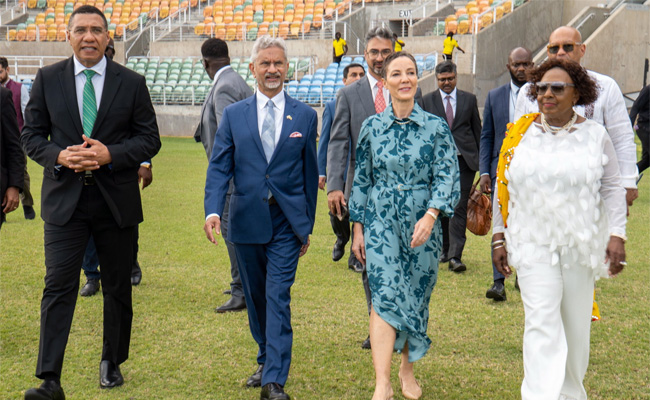
Kingston (PTI): External Affairs Minister S Jaishankar on Monday met Jamaican Prime Minister Andrew Holness and discussed ways to further deepen "political, economic and people-to-people cooperation."
Jaishankar also conveyed greetings from Prime Minister Narendra Modi to Holness.
"Pleased to call on Prime Minister @AndrewHolnessJM in Kingston. Conveyed the greetings of PM @narendramodi," Jaishankar posted on X.
"Discussed deepening our political, economic and people-to-people cooperation. Value his commitment towards further strengthening India-Jamaica relations," the post further read.
Also, the external affairs minister handed over 10 BHISHM (Bharat Health Initiative for Sahyog Hita & Maitri) Cubes as a gift to Jamaica.
"Formally handed over 10 BHISHM Cubes as a gift from India to Jamaica, in the presence of PM @AndrewHolnessJM, Health Minister @christufton and FM @kaminajsmith," Jaishankar posted on X.
"The BHISHM Cube mobile hospital system, designed for rapid deployment, will help Jamaica during disasters and emergencies. The gift of these cubes is a statement of friendship, a commitment to disaster preparedness, and an outcome of innovation," the post said.
Jaishankar arrived in Kingston on Saturday evening, marking the first leg of his nine-day tour of Jamaica, Suriname, and Trinidad and Tobago, aimed at further strengthening India's strategic and cultural ties with the Caribbean nations.
Earlier in the day, he interacted with the Indian diaspora and discussed India's ongoing transformation in infrastructure, human development and technology-driven governance and entrepreneurship with them.
He also highlighted the cricket bond between both countries as India gifted a scoreboard to Jamaica.
A scoreboard was dedicated at Sabina Park in Kingston. It is the home of the Jamaica cricket team and is the only Test cricket ground in the Caribbean island nation.
The minister expressed hope that the new scoreboard would witness many memorable innings, including those symbolising the enduring friendship between the two countries.
Cricket has long been a strong cultural bridge between India and Jamaica, which is part of the West Indies cricket team.
Jamaican players, including Chris Gayle, Courtney Walsh and Michael Holding, have played a major role in shaping the legacy of West Indies cricket in the international arena, contributing to its dominance in earlier decades and its continued global appeal.