While some Covid cases could go undetected, missing out on deaths completely unlikely: Govt
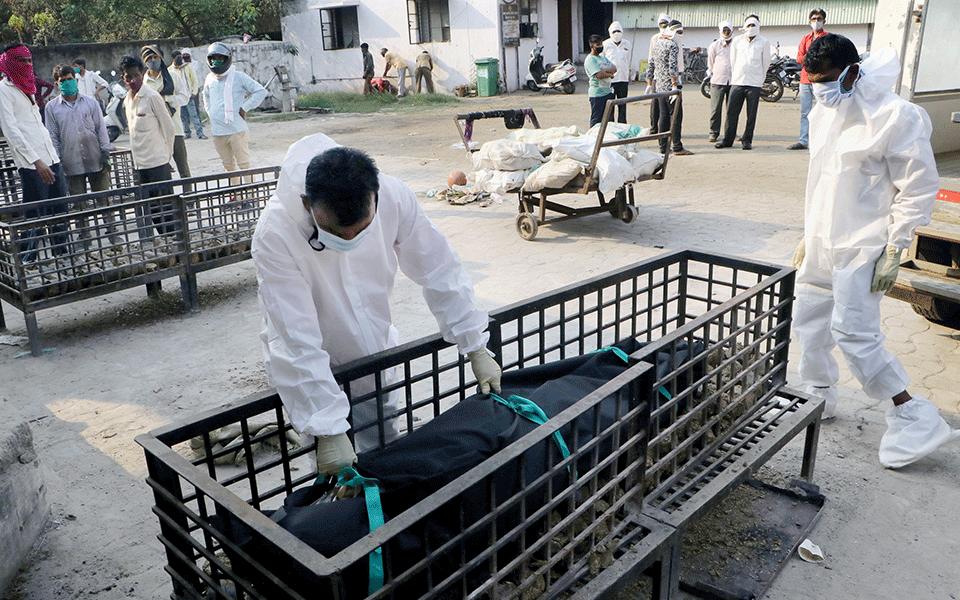
New Delhi: The Union Health Ministry on Wednesday clarified that while some COVID-19 cases could go undetected as per the principles of infectious disease and its management, missing out on deaths was completely unlikely given the robust and statute-based death registration system in India.
During the peak of the second wave, the health system across the country was focused on effective clinical management of cases requiring medical help due to which correct reporting and recording of Covid deaths could have been delayed but it was later reconciled by states and UTs, the ministry said in a statement.
The reconciling of deaths is still being carried out allaying all speculations of under-reporting and under-counting of deaths due to COVID-19, it said.
Noting that there have been some speculative media reports inferring under-counting of deaths from eight states, the ministry said the deaths can only be estimated and the exact data may never be known.
The reports highlight data from the Civil Registration System (CRS) and Health Management Information System (HMIS), including all-cause death numbers, leading to erroneous inferences terming it as 'counting the uncounted', it said.
"It is clarified that given the robust and statute-based death registration system in India, while some cases could go undetected as per the principles of infectious disease and its management, missing out on deaths is completely unlikely.
"This could also be seen in the case fatality rate, which as on 31st December 2020 stood at 1.45 per cent, and even after an unexpected surge observed in the second wave in April-May 2021, the case fatality rate today stands at 1.34 per cent," the ministry said.
Moreover, the reporting of daily new cases and deaths in India follows a bottom-up approach, where districts report the number of cases and deaths to state governments and to the Union ministry on a continuous basis.
As early as May 2020, to avoid inconsistency or confusion in the number of deaths being reported, the Indian Council of Medical Research (ICMR) had issued 'Guidance for appropriate recording of COVID-19 related deaths in India' for correct recording of all deaths by states and UTs as per ICD-10 codes recommended by the WHO for mortality coding, the ministry said in the statement.
The Union Health Ministry has repeatedly been advising states and UTs through formal communications, multiple video conferences and through deployment of central teams for recording of deaths in accordance with laid down guidelines. States have been advised to conduct thorough audits in their hospitals and report any cases or deaths that could have been missed with district and date-wise details so as to guide a data-driven decision-making, it said.
The ministry has regularly emphasized the need for a robust reporting mechanism for monitoring district-wise cases and deaths on a daily basis. States consistently reporting lower number of daily deaths have been advised to re-check their data, the statement said.
A case in point is the Union Health Ministry writing to the state of Bihar to provide detailed date and district wise break-up of the reconciled number of deaths.
"In addition to reporting by states and UTs, the robustness of statute based Civil Registration System (CRS) ensures all births and deaths in the country get registered. The CRS follows process of data collection, cleaning, collating and publishing the numbers, which although is a long-drawn process, but ensures no deaths are missed out. Because of the expanse and the amplitude of the activity, the numbers are usually published the next year, which has also been acknowledged in the referred to media report," the statement said.
"It is a well-known fact that there shall always be some differences in mortality recorded during a profound and prolonged public health crisis such as Covid pandemic. Well conducted research studies on mortalities are usually done after the event when data on mortalities are available from reliable sources. The methodologies for such studies are well established, the data sources are defined as also the valid assumptions for computing mortality," it added.
Let the Truth be known. If you read VB and like VB, please be a VB Supporter and Help us deliver the Truth to one and all.
Trump says EU has until July 4 to approve last year's trade deal or it will face higher tariffs
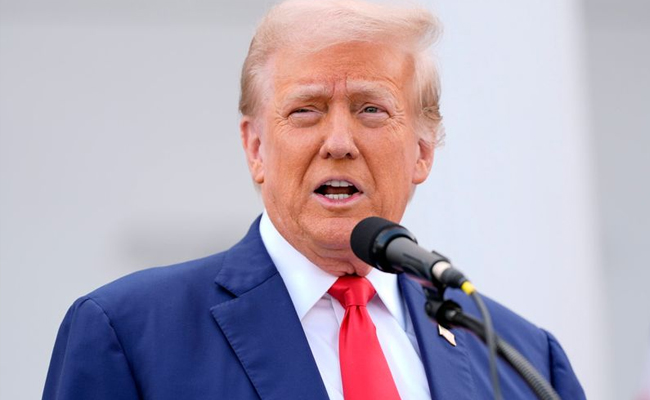
Washington (AP): President Donald Trump has said in a social media post that goods from the European Union would face higher tariff rates if the 27-member bloc fails to approve last year's trade framework by July 4.
The announcement on Thursday appeared to be a deadline extension after the president said last Friday that EU autos would face a higher 25 per cent tariff starting this week. Trump made the updated announcement after what he described as a "great call" with European Commission President Ursula von der Leyen.
Still, the US president was displeased that the European Parliament had yet to finalize the trade arrangement reached last year, which was further complicated in February by the US Supreme Court ruling that Trump lacked the legal authority to declare an economic emergency to impose the initial tariffs used to pressure the EU into talks.
"A promise was made that the EU would deliver their side of the Deal and, as per Agreement, cut their Tariffs to ZERO!" Trump posted. "I agreed to give her until our Country's 250th Birthday or, unfortunately, their Tariffs would immediately jump to much higher levels."
It was unclear from the post whether Trump was implying that the tariff rates would jump on all EU goods or the increase would only apply to autos.
His latest statement indicates he might be backing away from his earlier threat on EU autos by giving the European Parliament several more weeks to approve the agreement.
Under the original terms of the framework, the US would charge a 15 per cent tax on most goods imported from the EU.
But since the Supreme Court ruling, the administration has levied a 10 per cent tariff while investigating trade imbalances and national security issues, aiming to put in new tariffs to make up for lost revenues.